
Xyleborus bispinatus
Eichhoff, 1868
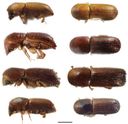
Xyleborus bispinatus is a tropical ambrosia beetle in the tribe Xyleborini. Native to the Americas, it has established in Florida and been introduced to the Iberian Peninsula. The maintains nutritional mutualisms with ambrosia fungi and has demonstrated unusual flexibility in acquiring from beetle , including plant . It is a potential for laurel wilt and has been associated with avocado decline in multiple regions.
Pronunciation
How to pronounce Xyleborus bispinatus: /zaɪˈliːbɔrəs baɪˌspɪˈneɪtəs/
These audio files are automatically generated. While they are not always 100% accurate, they are a good starting point.
Images
Habitat
Native to tropical regions of the Americas; established in Florida avocado orchards. In Spain, detected in baited traps in Murcia, Alicante, and Valencia provinces; stable confirmed in central Valencian province. Laboratory rearing successful on artificial sawdust media at 25°C and 70% relative humidity.
Distribution
Native range: Middle America, North America, South America (present in Brazil: Mato Grosso, Santa Catarina). Introduced range: Iberian Peninsula (Spain, first detected 2009), India. Florida established in avocado production areas.
Diet
Obligate nutritional mutualism with ambrosia fungi. Native include Raffaelea subfusca and Raffaelea arxii. Capable of acquiring and sustaining on non-native fungal symbionts including Harringtonia lauricola (laurel wilt from Xyleborus glabratus) and Fusarium sp. nov. (Fusarium dieback pathogen from Euwallacea perbrevis). Fungi serve as sole food source; no wood consumption.
Host Associations
- Persea americana - treeavocado; used for gallery establishment and larval development in Florida orchards
- Persea humilis - treesilkbay; used in artificial rearing media
- Raffaelea subfusca - native nutritional primary ambrosia fungus
- Raffaelea arxii - native nutritional primary ambrosia fungus
- Harringtonia lauricola - acquired laurel wilt ; acquired from Xyleborus glabratus, can transmit to healthy avocado trees
- Fusarium sp. nov. - acquired Fusarium dieback ; acquired from Euwallacea perbrevis, significantly increased in laboratory
- Fusarium proliferatum - associated associated with avocado decline in India
Life Cycle
Complete : , larva, pupa, . time approximately 16-20 days at optimal temperatures (26-29°C), extending to 36 days at lower temperatures. Optimal thermal range 26.2°C with maximum intrinsic growth rate of 0.13 individuals/individuals/day. Larvae feed on symbiotic fungi in gallery tunnels. Gut contents emptied during pupal stage; naïve adults acquire via feeding after . Pre-oral mycangia present for fungal transport and inoculation of new galleries.
Behavior
In- at dusk, attracted to ethanol lures. Single female foundress establishes galleries; males few in number, produced parthenogenetically. Gallery boring into trees and artificial media. Capable of lateral transfer of fungal from ambrosia beetle . Surface-disinfested pupae can be rendered and re-established with novel fungal partners under laboratory conditions.
Ecological Role
Native ambrosia beetle that functions as a bridge between native and ambrosia beetle-fungus . Potential for economically significant plant including laurel wilt (Harringtonia lauricola) and Fusarium dieback. In invaded ranges, may contribute to disease in avocado production systems and native Lauraceae forests. influenced by identity and thermal conditions.
Human Relevance
Economic pest of avocado production in Florida and potential threat to avocado industries in invaded regions. Associated with avocado decline in India through Fusarium proliferatum transmission. capability for laurel wilt raises concerns for commercial avocado production and native forest conservation. Subject of biosecurity surveillance in Spain due to established without known plant attacks.
Similar Taxa
- Xyleborus glabratusBoth are Xyleborus ambrosia beetles; X. glabratus is the primary of Harringtonia lauricola, while X. bispinatus has demonstrated ability to acquire and transmit this secondarily
- Euwallacea perbrevisBoth share Fusarium sp. nov. as a ; X. bispinatus acquired this from Euwallacea through lateral transfer
More Details
Symbiont flexibility significance
Xyleborus bispinatus demonstrates exceptional flexibility in fungal , surviving and reproducing on fungi from phylogenetically distant lineages including plant . This trait enables lateral transfer of virulent pathogens between and native , with implications for in agricultural and forest systems.
Thermal biology
Laboratory studies demonstrate narrow optimal thermal range (26-29°C) with sharp declines outside this range. This thermal sensitivity may limit establishment in temperate regions but facilitate modeling for invaded ranges.
Iberian Peninsula invasion status
First detected in Spain in 2009 with stable confirmed by 2021. Unlike Florida populations, no plant attacks have been detected and the host plant remains unknown, suggesting possible alternative or incomplete establishment.
Sources and further reading
- BugGuide
- GBIF taxonomy match
- iNaturalist taxon
- NCBI Taxonomy
- Catalogue of Life
- Xyleborus glabratus and Euwallacea fornicatus - Entomology Today
- Xyleborus-glabratus - Entomology Today
- Forest Pest Invasions Can—And Should—Be Studied Before They Happen
- The Ambrosia Beetle Megaplatypus mutatus: Tiny but Destructive
- The Best Look Yet at the Tiny Fungus Storage Units Inside Ambrosia Beetles
- Why Are We Having a Record Outbreak of Exotic Fruit Flies in 2025?
- Flexibility in the ambrosia symbiosis of Xyleborus bispinatus
- First report of avocado decline in India associated with the Xyleborus bispinatus-Fusarium proliferatum complex
- First record of Xyleborus bispinatus (Coleoptera: Curculionidae, Scolytinae) and evidence of stable populations in the Iberian Peninsula
- Xyleborus bispinatus Reared on Artificial Media in the Presence or Absence of the Laurel Wilt Pathogen (Raffaelea lauricola)
- Temperature fluctuation effects on the demography and fitness of Xyleborus bispinatus (Coleoptera: Curculionidae: Scolytinae): thresholds and growth rates
- Developmental biology of Xyleborus bispinatus (Coleoptera: Curculionidae) reared on an artificial medium and fungal cultivation of symbiotic fungi in the beetle's galleries
- Euwallacea similis (Ferrari), a new ambrosia beetle (Coleoptera: Curculionidae: Scolytinae) for the Iberian Peninsula, and new records on Euwallacea fornicatus (Eichhoff), Xyleborus bispinatus Eichhoff and Amasa parviseta Knížek & Smith