
Euwallacea interjectus
Wood & Bright, 1992
ambrosia beetle
Euwallacea interjectus is an ambrosia beetle native to Asia that has become an pest in multiple regions worldwide. The cultivates mutualistic Fusarium fungi in galleries within tree xylem, which serve as its primary food source. Females possess specialized mycangia for transporting fungal spores. The has emerged as a significant economic threat to poplar plantations in China and has been documented attacking living trees, a atypical for many ambrosia beetles. In Japan, it Ceratocystis ficicola, a pathogenic fungus causing fig wilt .
Pronunciation
How to pronounce Euwallacea interjectus: /juːˈwæleɪsiə ˌɪntərˈdʒɛktəs/
These audio files are automatically generated. While they are not always 100% accurate, they are a good starting point.
Identification
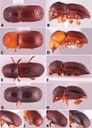
Morphological differentiation from the sister Euwallacea validus relies on declivity shape, puncture patterns, and placement at the body base. In E. interjectus, the declivity slopes gradually rather than abruptly. sequencing provides definitive identification where morphological characters are ambiguous. The species is part of the Euwallacea fornicatus , whose members cannot be reliably distinguished by appearance alone due to overlapping size ranges (1.8-2.9 mm in related species).
Images
Appearance
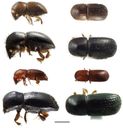
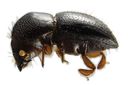
range from 3.5 to 9 mm in length (mean 3.78 mm) and 2.4 to 2.64 mm in width. Body color ranges from brown to black. The pronotum is a prominent plate-like structure covering the . Spindles are present across the body surface. Males are significantly smaller than females. The declivity ( slope) is gradually sloped from base to apex, giving a smoother appearance compared to the sister Euwallacea validus.
Habitat
Primarily inhabits tree xylem within self-constructed galleries. In native and invaded ranges, occupies living trees in riparian zones and urban forests, with damage correlated to proximity to water sources. In China, extensive occur in poplar plantations, particularly in water-stressed regions. The is found in high- planting sites where resource competition weakens resistance.
Distribution
Native to Asia: Myanmar, Japan, North Korea, South Korea, China, Taiwan, Tibet, India, Indonesia (Borneo, Java, Mentawei, Sumatra), Malaysia, Sarawak, Nepal, Philippines, Sri Lanka, Thailand, and Vietnam. Introduced to Western Hemisphere: United States (first collected Hawaii 1976; mainland Florida 2011; now present in Alabama, Louisiana, Texas, Georgia, Mississippi, South Carolina) and Argentina (first detected 2009).
Seasonality
Breeds throughout the year in many regions. Short period follows of females.
Diet
Exclusively fungus-feeding (xylomycetophagous). Cultivates mutualistic ambrosia fungi, primarily Fusarium populicola in Chinese poplar plantations and Fusarium kuroshium in Japanese fig orchards, within galleries excavated in tree xylem. Does not consume wood tissue.
Host Associations
- Populus (poplars) - primary Major economic in China and Argentina; attacks living trees in water-stressed conditions
- Ficus carica (fig) - In Japan, Ceratocystis ficicola causing fig wilt
- Acer negundo (boxelder maple) - Mass observed on water-stressed trees in U.S.
- Celtis sinensis - Riparian in Shanghai
- Cinnamomum camphora - Riparian in Shanghai
- Liquidambar formosana - Riparian in Shanghai
- Platanus acerifolia - Riparian in Shanghai
- Salix babylonica - Riparian in Shanghai
- Sapium sebiferum/Triadica sebifera - Riparian in Shanghai
- Fusarium populicola - mutualistic Primary ambrosia fungus cultivated as food in poplar regions
- Fusarium kuroshium - mutualistic Primary mycangial fungus in Japanese ; synergizes with C. ficicola to accelerate fig wilt
- Ceratocystis ficicola - vectored Transmitted to fig trees in Japan; causes wilt
- Neocosmospora metavorans - associated fungusFrequently isolated from mycangia in reared
Life Cycle
Complete with , larval, pupal, and stages. Under laboratory conditions: egg stage approximately 6 days; larval stage approximately 18 days with three instars (first instar peak moulting at 3.45 days, second instar at 7.92 days); pupal stage approximately 6 days. Larvae remain hidden deep within tunnels before . Sex ratio heavily female-biased at approximately 31:1 female:male in galleries. Haplodiploid : females , males haploid. Single foundress can establish new through inbreeding.
Behavior
Females disperse to locate trees, carrying fungal spores in mandibular mycangia. After boring through bark, females excavate galleries and inoculate them with fungi. Gallery construction produces characteristic "noodle-like" extrusions at entrance holes. Males remain within galleries with limited role beyond mating. Foundress increases with nutrient-rich diets. Positive correlation between gallery system length and progeny number. In laboratory studies, treated with biocontrol agents exhibited and death at gallery bottoms or blocked gallery entrances.
Ecological Role
As a of pathogenic fungi, contributes to tree wilt and mortality in both native and invaded ranges. In native Asian forests, colonizes stressed or injured trees; in invaded regions, attacks living trees including economically important . Associated fungi compete with pre-existing decay fungi in woody tissues, potentially altering decomposition dynamics. In high- plantations, can cause significant tree mortality and disruption.
Human Relevance
Significant economic pest of forestry and agricultural industries. In China, has devastated over 1500 hectares of poplar plantations since 2020, killing tens of thousands of trees and threatening the lumber, pulp, and paper industries. In Argentina, damage Populus plantations used for lumber and reconstituted board products. In Japan, fig wilt affecting orchard production. In the United States, abundant in southeastern states with occasional mass on landscape trees. Difficult to control chemically due to cryptic lifestyle within wood; limited efficacy of most and . agents under investigation include bassiana, Serratia marcescens, and parasitic mites Pyemotes spp.
Similar Taxa
- Euwallacea validusSister with nearly identical appearance; distinguished by declivity shape (abrupt slope in E. validus vs. gradual in E. interjectus), puncture patterns, placement, and fungal associations. E. validus predominates in northeastern United States with range overlap in Georgia and the Carolinas.
- Euwallacea fornicatus (sensu lato)Part of same ; morphological overlap prevents reliable visual identification. Molecular methods required for definitive separation.
- Euwallacea aff. fornicatus / 'polyphagous shot hole borer'Distinct in California causing similar damage; not yet formally described as separate but genetically distinct from E. interjectus.
More Details
Biocontrol research
Laboratory studies have identified promising agents: bassiana strain B-BB-1 causes significant lethality to females and inhibits Fusarium populicola growth; Serratia marcescens and its metabolite prodigiosin affect larvae and fungal growth; ectoparasitic mites Pyemotes moseri and P. zhonghuajia effectively parasitize pupae and larvae.
Chemical control challenges
Beta-cyfluthrin showed lowest laboratory LC50 (8.989 mg/L) with 80.6% reduction in after 30 days. Field application of fludioxonil:prochloraz-manganese chloride mixture at 2000 mg/L achieved 58.7% reduction after 60 days. Beetles' minimal time on bark surface and non-feeding on tree tissue limit contact with surface sprays; gallery-based lifestyle protects from .
Fungal symbiont dynamics
Reared show switching, with Neocosmospora metavorans dominating in laboratory conditions versus Fusarium kuroshium in wild Japanese populations. Temperature significantly affects growth of symbiont . Dual inoculation of F. kuroshium and Ceratocystis ficicola accelerates fig wilt development compared to single inoculation.
Sources and further reading
- BugGuide
- Wikipedia
- GBIF taxonomy match
- iNaturalist taxon
- NCBI Taxonomy
- Catalogue of Life
- The sweet smell of ants - Citronella or Large yellow ants, Acanthomyops interjectus — Bug of the Week
- Playground ants: Citronella or Large yellow ants, Acanthomyops interjectus, and field ants, Formica sp. — Bug of the Week
- Xyleborus glabratus and Euwallacea fornicatus - Entomology Today
- four species of Euwallacea - Entomology Today
- Search Continues for Methods to Control Fungus-Farming Beetle in SoCal Trees
- Forest Pest Invasions Can—And Should—Be Studied Before They Happen
- Laboratory Exploration of Several Potential Biocontrol Methods Against the Ambrosia Beetle, Euwallacea interjectus
- XYLEM DYSFUNCTION IN FICUS CARICA INFECTED WITH WILT FUNGUS CERATOCYSTIS FICICOLA AND THE ROLE OF THE VECTOR BEETLE EUWALLACEA INTERJECTUS
- The infestation and habitat of the ambrosia beetle Euwallacea interjectus (Coleoptera: Curculionidae: Scolytinae) in the riparian zone of Shanghai, China
- Biology of Euwallacea interjectus, an emerging poplar pest, reared on an ambrosia beetle artificial diet and medium of fungal symbiont
- Laboratory and field evaluation of integrated insecticide-fungicide treatments for controlling Euwallacea interjectus and its symbiotic Fusarium fungi
- Fungal Flora in Adult Females of the Rearing Population of Ambrosia Beetle Euwallacea interjectus (Blandford) (Coleoptera: Curculionidae: Scolytinae): Does It Differ from the Wild Population?
- The Role of Mycangial Fungi Associated with Ambrosia Beetles (Euwallacea interjectus) in Fig Wilt Disease: Dual Inoculation of Fusarium kuroshium and Ceratocystis ficicola Can Bring Fig Saplings to Early Symptom Development