
Euwallacea validus
Wood & Bright, 1992
Valid Bark Beetle
Euwallacea validus is an ambrosia beetle native to Asia, first detected in North America in Long Island, New York in 1975. It is the most widespread and longest-established Euwallacea in the United States, having spread throughout the eastern U.S. and into Canada. The maintains a mutualistic symbiotic relationship with two fungal associates: Fusarium oligoseptatum (AF-4) and Raffaelea subfusca, which it cultivates in galleries bored into trees. Unlike some related ambrosia beetles, its fungal do not appear to be virulent to known hosts.

Pronunciation
How to pronounce Euwallacea validus: /juːˈwæləsiə vəˈlaɪdəs/
These audio files are automatically generated. While they are not always 100% accurate, they are a good starting point.
Identification
Differentiation from the sister Euwallacea interjectus requires close examination. E. validus differs in the shape of the declivity, puncture patterns, and placement of on the body. The downward angle of the slope from base to apex of the differs between the two species. Reliable identification often requires sequencing due to near-identical and overlapping geographic ranges, particularly in Georgia and South Carolina where both species co-occur.
Images
Appearance
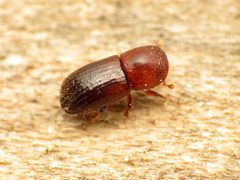
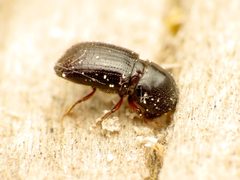
range 3.9–4.1 mm in length (average 4.0 mm) and 2.5–2.73 mm in width. Body color ranges from dark brown to black. The pronotum is plate-like and protective. Body surface covered with spindles. is pronounced: males are significantly smaller than females, with reduced wings, smaller , and flightlessness. Mycangia (fungus-storage structures) are present in females and rarely in males; in E. validus, mycangia are positioned between the and rather than paired to the . The declivity ( slope of the ) has a characteristic downward angle from base to apex that differs from the sister E. interjectus.
Habitat
In its native Asian range, found in forested across China, Malaysia, Myanmar, Vietnam, the Philippines, Japan, and Korea. In North America, infests a broad range of hardwood trees in urban, suburban, and forested settings. Shows preference for Tree of Heaven (Ailanthus altissima), particularly stands infected with Verticillium wilt. Also attacks striped maple, red maple, tulip-poplar, and American beech. Some trees serve as for while others may function only as sites for females.
Distribution
Native to Asia: China, Malaysia, Myanmar, Vietnam, the Philippines, Japan, and Korea. Introduced to North America: first detected in Nassau County, New York in 1975, subsequently spread throughout eastern United States (Pennsylvania, Louisiana, Delaware, Maryland, New Jersey, Virginia, West Virginia, North Carolina, Kentucky, Michigan, Georgia, Tennessee) and into Canada (Ontario). Distribution records in the southern U.S. require verification due to past confusion with E. interjectus.
Diet
and larvae feed on ambrosia fungi cultivated within tree galleries. Females transport fungal spores in mycangia from natal galleries to new . The two confirmed fungal associates are Fusarium oligoseptatum (AF-4) and Raffaelea subfusca.
Host Associations
- Ailanthus altissima - preferred Tree of Heaven; large- observed in stands infected with Verticillium wilt
- Acer pensylvanicum - striped maple
- Acer rubrum - red maple
- Liriodendron tulipifera - tulip-poplar
- Fagus grandifolia - American beech
Life Cycle
occurs via haplodiploid sibling mating: fertilized develop into females, unfertilized haploid eggs into males. Males remain in natal galleries, are flightless, and mate with siblings. Females disperse to establish new galleries and fungal . Development progresses from larva to early pupa to late pupa. becomes apparent in early pupal stages; superior and inferior mycangia structures develop in late pupal females. Larvae feed on fungi growing in galleries.
Behavior
Females bore into tree bark to create galleries, then inoculate them with fungal spores carried in mycangia. Exhibits strong fidelity to its primary fungal associate Fusarium sp. AF-4 across both native (South Korea) and invaded (United States) ranges—a pattern not observed in other Euwallacea . Males are confined to galleries for and potential fungal maintenance due to reduced musculature and flightlessness.
Ecological Role
Acts as a for fungal between trees. The -fungus mutualism facilitates nutrient acquisition from woody substrates. While the beetle and its associated fungi do not appear to cause significant on tested hosts, the beetle can potentially transmit other between trees. In its native Asian range, contributes to nutrient cycling in forest ; in North America, functions as a non-native wood-boring insect with established .
Human Relevance
Subject of entomological research due to its status as the longest-established and most widespread Euwallacea in North America. Provides comparative data for understanding invasion of more damaging relatives such as E. fornicatus complex species. Not currently considered a major economic pest, as its fungal associates lack the of those carried by related ambrosia beetles. Historical misidentification with E. interjectus has complicated tracking of its actual distribution and impact.
Similar Taxa
- Euwallacea interjectusSister with nearly identical appearance; differentiated by slight differences in declivity shape, punctures, and placement. Overlapping distribution in Georgia and South Carolina causes frequent misidentification. sequencing required for reliable separation.
- Euwallacea fornicatus complexRelated ambrosia beetles including tea shot hole borer, Kuroshio shot hole borer, and shot hole borer; these carry more virulent fungal and cause significant agricultural and urban tree damage, unlike E. validus.
More Details
Fungal Symbiont Fidelity
E. validus exhibits unusual fidelity to Fusarium sp. AF-4 across native and invaded ranges, with no indication of competition from other Ambrosia Fusarium clade members within mycangial . This contrasts with other Euwallacea , which show widespread fungal infidelity and frequent shifts.
Historical Detection
The 1975 Long Island discovery makes E. validus one of the earliest documented ambrosia beetles in North America, predating many better-known invasive relatives by decades. Its introduction is believed to have occurred via wooden packing crates from Japanese ports.
Sources and further reading
- BugGuide
- Wikipedia
- GBIF taxonomy match
- iNaturalist taxon
- NCBI Taxonomy
- Catalogue of Life
- Search Continues for Methods to Control Fungus-Farming Beetle in SoCal Trees
- Forest Pest Invasions Can—And Should—Be Studied Before They Happen
- So Many Shot Hole Borers: New Research Charts Four Nearly Identical Species
- Spring sunshine heralds the appearance of plasterer bees: Colletes — Bug of the Week
- Spring arrives and with it, delightful Plasterer bees: Colletes spp. — Bug of the Week
- Bug of the Week