
Anisandrus dispar
Hulcr, Dole, Beaver & Cognato, 2007
European Shothole Borer
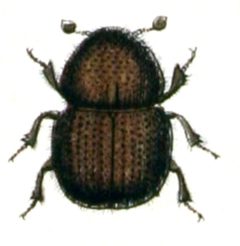
Anisandrus dispar is an ambrosia beetle in the Curculionidae, commonly known as the European Shothole Borer. It is an economically significant pest in fruit orchards, particularly apple . The exhibits a distinct seasonal pattern, with females conducting most flight activity from February through May. It maintains an obligate symbiotic relationship with the fungus Ambrosiella hartigii, which it cultivates in gallery systems within wood.
Pronunciation
How to pronounce Anisandrus dispar: //æn.ɪˈsæn.drəs ˈdɪs.pɑːr//
These audio files are automatically generated. While they are not always 100% accurate, they are a good starting point.
Images
Habitat
Apple orchards in temperate regions; specifically documented in phenologically distinct areas within the Lower Adige Valley of South Tyrol, Italy. The occupies cultivated agricultural environments where suitable trees are available.
Distribution
Europe and Northern Asia (excluding China); North America; Southern Asia; specifically recorded in Switzerland and Denmark. Present in Italy (Lower Adige Valley, South Tyrol).
Seasonality
Main period extends from February to the end of May. Flight initiation timing varies significantly between early and late phenological areas, with earlier onset in warmer, early-developing regions.
Diet
Cultivates and feeds upon Ambrosiella hartigii, a symbiotic ambrosia fungus grown within wood galleries. The fungus serves as the primary nutritional source; the does not consume wood directly.
Host Associations
- Ambrosiella hartigii - symbiotic fungus (cultivated and consumed)Obligate mutualism; transports fungal spores and maintains fungal gardens in excavated galleries
- Malus domestica (apple) - treeDocumented in apple orchard trapping studies; specific damage or patterns not detailed
- hazelnut - potential Inferred from secondary literature keywords only; direct association not confirmed in primary sources
Life Cycle
period with female-biased flight activity. Precise developmental stages and timing not documented in available sources.
Behavior
Females conduct the majority of activity. are attracted to ethanol , which is used for monitoring. via ballooning on silk strands, as observed in related Lymantria , has not been documented for this species.
Ecological Role
Economically important pest in apple systems. As an ambrosia beetle, it functions as a fungal and cultivator, potentially affecting tree health through gallery excavation and symbiotic fungus establishment.
Human Relevance
Significant agricultural pest requiring monitoring and management in orchard systems. Ethanol-baited traps are employed for detection and assessment. applications targeting its symbiotic fungus (imazalil, prochloraz, cyprodinil+fludioxonil) have been evaluated as potential control measures.
Similar Taxa
- Xylosandrus germanusShares (Curculionidae: Scolytinae), similar ambrosia beetle , and symbiotic fungus (Ambrosiella hartigii). Both are economically significant orchard pests with comparable management challenges.
- Lymantria dispar complexNot similar taxonomically (Lepidoptera: Erebidae vs. Coleoptera: Curculionidae), but frequently confused in search results and regulatory contexts due to shared 'dispar' epithet and pest status. Anisandrus dispar is a ; Lymantria are with entirely different .
More Details
Taxonomic note
The was described by Hulcr, Dole, Beaver & Cognato in 2007, representing a relatively recent taxonomic revision within the Scolytinae.
Symbiosis specificity
The relationship with Ambrosiella hartigii appears obligate; the 's survival and depend upon successful fungal , making the fungus a potential target for indirect pest management.
Sources and further reading
- BugGuide
- GBIF taxonomy match
- iNaturalist taxon
- NCBI Taxonomy
- Catalogue of Life
- It Flies! Regulatory Officials on Constant Alert for Flighted Spongy Moths
- Evaluation of some fungicides against symbiotic fungus Ambrosiella hartigii associated with Anisandrus dispar Fabricius and Xylosandrus germanus Blandford (Coleoptera: Curculionidae: Scolytinae)
- Investigations on the flight behaviour of Anisandrus dispar (FABRICIUS, 1792) (Coleoptera: Scolytidae) in trap catches in apple orchards of the Lower Adige Valley in South Tyrol