
Anisandrus
Ferrari, 1867
Species Guides
4- Anisandrus dispar(European Shothole Borer)
- Anisandrus maiche
- Anisandrus obesus
- Anisandrus sayi
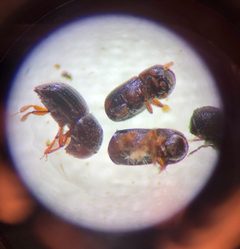
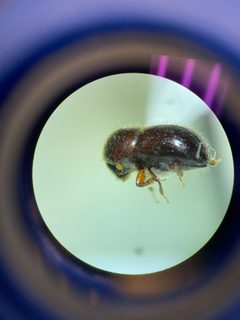
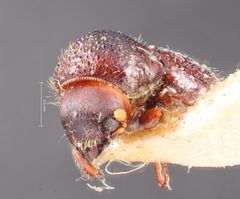
Anisandrus is a of ambrosia beetles in the Scolytinae, tribe Xyleborini, comprising approximately 40-41 distributed primarily across Asia, with some species introduced to Europe and North America. The genus is characterized by a mycangial tuft at the pronotal base used for transporting symbiotic fungi. Several species, including A. maiche and A. dispar, are recognized as economically significant pests of fruit orchards, ornamental trees, and forest .
Pronunciation
How to pronounce Anisandrus: //ænɪˈsændrəs//
These audio files are automatically generated. While they are not always 100% accurate, they are a good starting point.
Identification
Members of Anisandrus possess a distinctive mycangial tuft at the base of the pronotum, a key diagnostic feature for the within Xyleborini. -level identification requires examination of morphological characters including pronotal and elytral , declivital shape, and body size. Anisandrus maiche is similar in appearance to Xylosandrus germanus and has been subject to misidentification in North American surveys.
Images
Habitat
Native occur in mountainous forest of Southeast Asia, including low montane and montane forests at elevations of 1150-1900 m. Introduced species have established in temperate forest and agricultural systems, including apple orchards, where they show preference for forest edges and areas adjacent to woodlots.
Distribution
Native range includes the Indochinese Peninsula, China, Bhutan, Cambodia, India, Indonesia, Malaysia, Myanmar, Nepal, Philippines, Taiwan, Thailand, Vietnam, and New Guinea. Introduced established in Europe (first records in Italy and Switzerland for A. maiche), eastern and western North America (United States, Canada, British Columbia), and Denmark, Norway, Sweden.
Seasonality
activity varies by and region. Anisandrus dispar exhibits main flight period from February to May in South Tyrol, Italy. Anisandrus maiche is active from late May to mid-September in New York, with peak activity between 961.2 and 1,102.9 above 10°C in Michigan. Anisandrus pyri occurs in coastal districts of western North America.
Diet
Ambrosia beetles that cultivate and feed on symbiotic fungi within wood galleries. The fungal Ambrosiella cleistominuta has been documented for A. maiche; A. dispar is associated with Ambrosiella hartigii.
Host Associations
- Symplocos sp. - Specific for A. bolavenensis in Laos
- Malus domestica - Apple orchards; introduced range
- Populus grandidentata - Big tooth aspen; A. obesus
Life Cycle
Development occurs within wood galleries where females cultivate fungal gardens. Complete development from to requires temperatures above 14°C, with full development occurring between 14°C and 18°C for A. maiche. No development occurs at 10°C, though foundress females may survive up to 8 weeks. characterized by typical of Xyleborini; males are flightless and rarely collected.
Behavior
Females construct galleries in wood and introduce symbiotic fungi that serve as food for larvae. activity peaks in spring and summer, with captures highest in forest interiors declining toward orchard edges. Both A. germanus and A. maiche can be present simultaneously across . Trees with 6 or more boring holes from previous seasons show significantly higher probability of continued .
Ecological Role
Contributes to decomposition of dead and stressed wood in native forest . In introduced ranges, acts as pest of stressed trees in agricultural and urban settings, with fungal causing continued tree stress, potential yield loss, and dieback. The symbiotic fungus Ambrosiella cleistominuta represents the first reported sexual state in an ambrosia fungus, with homothallic .
Human Relevance
Several are pests of the European Union and significant economic pests of apple orchards, requiring monitoring and management. Citizen science projects have successfully engaged students in detection efforts, contributing to first European records of . Bottle traps with ethanol attractants are standard monitoring tools.
Similar Taxa
- Xylosandrus germanusSimilar appearance and ; both ambrosia beetles in North American orchards, with overlapping periods and use. A. maiche has been misidentified as X. germanus in trap surveys.
- Anisandrus disparClosely related with similar pest status in European orchards; A. pyri has been considered the American representative of A. dispar, from which it is doubtfully distinct.
More Details
Invasion History
Anisandrus maiche was first recorded in Pennsylvania in 2005, with subsequent detection in New York by 2021 and first European records from Italy in 2023. The has expanded rapidly in North America, showing high abundance in the Finger Lakes region of New York but low numbers near Lake Ontario.
Thermal Biology
A. maiche has a higher thermal threshold for development than X. germanus, with no below 14°C and optimal development above 18°C. This thermal influences regional abundance patterns and management timing.
Fungal Symbiosis
The symbiotic fungus Ambrosiella cleistominuta, first described from A. maiche, produces cleistothecious ascomata with ascospores in galleries and culture, representing the first documented sexual state in an ambrosia fungus. The fungus is homothallic and distinguished by neckless ascomata without .
Sources and further reading
- BugGuide
- GBIF taxonomy match
- iNaturalist taxon
- NCBI Taxonomy
- Catalogue of Life
- Beetles in a bottle: a message from aliens to schools | Blog
- Anisandrus maiche (Kurentzov). [Distribution map].
- THE SHOT HOLE BORER, ANISANDRUS PYRI (PECK), IN BRITISH COLUMBIA (COLEOPTERA, SCOLYTIDAE)
- Anisandrus bolavenensis sp. nov. (Col.: Curculionidae, Scolytinae, Xyleborini), a new ambrosia beetle from Laos
- Investigations on the flight behaviour of Anisandrus dispar (FABRICIUS, 1792) (Coleoptera: Scolytidae) in trap catches in apple orchards of the Lower Adige Valley in South Tyrol
- Assessing the lower thermal limits for development, fecundity and survival in Anisandrus maiche ( K urentzov)
- Gallery Characteristics and Life History of the Ambrosia Beetle Anisandrus obesus (Coleoptera: Curculionidae: Scolytinae) in Big Tooth Aspen
- Supplementary material 1 from: Ribeiro-Correia JP, Prospero S, Beenken L, Biedermann PHW, Blaser S, Branco M, Chittaro Y, Frey D, Hölling D, Kaya SO, Knížek M, Mittelstrass J, Ruffner B, Sanchez A, Brockerhoff EG (2024) Distribution of the invasive ambrosia beetle Anisandrus maiche (Coleoptera, Scolytinae) in Switzerland and first record in Europe of its ambrosia fungus Ambrosiella cleistominuta. Alpine Entomology 8: 35-49. https://doi.org/10.3897/alpento.8.117537
- Supplementary material 2 from: Ribeiro-Correia JP, Prospero S, Beenken L, Biedermann PHW, Blaser S, Branco M, Chittaro Y, Frey D, Hölling D, Kaya SO, Knížek M, Mittelstrass J, Ruffner B, Sanchez A, Brockerhoff EG (2024) Distribution of the invasive ambrosia beetle Anisandrus maiche (Coleoptera, Scolytinae) in Switzerland and first record in Europe of its ambrosia fungus Ambrosiella cleistominuta. Alpine Entomology 8: 35-49. https://doi.org/10.3897/alpento.8.117537
- Spatial and temporal distribution of Xylosandrus germanus and Anisandrus maiche (Coleoptera: Curculionidae: Scolytinae) in Michigan apple
- Flight phenology and influence of region and habitat on the abundance of Xylosandrus germanus and Anisandrus maiche (Coleoptera: Curculionidae: Scolytinae) in New York
- Evaluation of some fungicides against symbiotic fungus Ambrosiella hartigii associated with Anisandrus dispar Fabricius and Xylosandrus germanus Blandford (Coleoptera: Curculionidae: Scolytinae)
- First report of a sexual state in an ambrosia fungus: Ambrosiella cleistominuta sp. nov. associated with the ambrosia beetle Anisandrus maiche
- Figure 4 from: Ribeiro-Correia JP, Prospero S, Beenken L, Biedermann PHW, Blaser S, Branco M, Chittaro Y, Frey D, Hölling D, Kaya SO, Knížek M, Mittelstrass J, Ruffner B, Sanchez A, Brockerhoff EG (2024) Distribution of the invasive ambrosia beetle Anisandrus maiche (Coleoptera, Scolytinae) in Switzerland and first record in Europe of its ambrosia fungus Ambrosiella cleistominuta. Alpine Entomology 8: 35-49. https://doi.org/10.3897/alpento.8.117537
- Figure 3 from: Ribeiro-Correia JP, Prospero S, Beenken L, Biedermann PHW, Blaser S, Branco M, Chittaro Y, Frey D, Hölling D, Kaya SO, Knížek M, Mittelstrass J, Ruffner B, Sanchez A, Brockerhoff EG (2024) Distribution of the invasive ambrosia beetle Anisandrus maiche (Coleoptera, Scolytinae) in Switzerland and first record in Europe of its ambrosia fungus Ambrosiella cleistominuta. Alpine Entomology 8: 35-49. https://doi.org/10.3897/alpento.8.117537
- Figure 2 from: Ribeiro-Correia JP, Prospero S, Beenken L, Biedermann PHW, Blaser S, Branco M, Chittaro Y, Frey D, Hölling D, Kaya SO, Knížek M, Mittelstrass J, Ruffner B, Sanchez A, Brockerhoff EG (2024) Distribution of the invasive ambrosia beetle Anisandrus maiche (Coleoptera, Scolytinae) in Switzerland and first record in Europe of its ambrosia fungus Ambrosiella cleistominuta. Alpine Entomology 8: 35-49. https://doi.org/10.3897/alpento.8.117537