
Anisandrus maiche
Stark, 1936
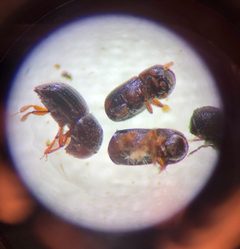
Anisandrus maiche is an ambrosia beetle native to East Asia that has established in North America and Europe. It is a significant pest of stressed trees in orchards, forests, and ornamental settings, boring into wood and cultivating symbiotic fungi in galleries. The has been recorded in the United States since 2005, in Italy and Switzerland since 2021-2022, and was previously detected in Ukraine and European Russia. Its spread is facilitated by international transport of wood products and an inbreeding mating system that allows single females to establish new populations.
Pronunciation
How to pronounce Anisandrus maiche: /ˈænɪsændrəs ˈmaɪkɛ/
These audio files are automatically generated. While they are not always 100% accurate, they are a good starting point.
Identification
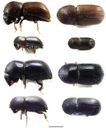
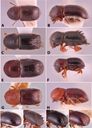
Anisandrus maiche can be distinguished from the similar-looking Xylosandrus germanus by morphological examination; molecular identification using COI, 28S, and CAD markers confirms identity. All trapped specimens in European studies have been female, consistent with the haplodiploid system typical of Xyleborini ambrosia beetles. The species is smaller than many other ambrosia beetles and requires careful examination for reliable identification.
Images
Habitat
Found in managed and natural forests, apple orchards, and urban areas including school grounds. In orchard systems, captures are higher at orchard edges and near woodlots than in interior areas. Occupies forest interiors, forest edges, and orchard edges simultaneously. Attacks stressed and weakened trees across multiple .
Distribution
Native to East Asia; in United States (first recorded 2005 in Pennsylvania, established in Indiana, Michigan, New York), Canada, western Russia, Ukraine, Italy (first recorded 2021), and Switzerland (canton Ticino, 2022). In Europe, currently known from northern Italy and southern Switzerland with potential for further spread.
Seasonality
activity occurs primarily from June to mid-August in Switzerland, with trapping records from late May to mid-September in New York. In Michigan apple orchards, peak activity occurs between 961.2 and 1,102.9 above 10°C, later than Xylosandrus germanus. Can potentially infest stressed trees throughout the growing season.
Diet
Cultivates and feeds on ambrosia fungi, primarily Ambrosiella cleistominuta, in galleries bored into wood. The mutualistic fungus serves as the sole nutritional source for and larvae.
Life Cycle
Development requires temperatures above 14°C; no development occurs at 10°C, with foundress females surviving up to 8 weeks. At 14°C, only occasional production occurs. Complete development from egg to observed at 18°C, with eggs appearing at 2 weeks and all life stages present by 8 weeks. is haplodiploid and inbreeding, with females producing offspring from stored sperm.
Behavior
Exhibits haplodiploid inbreeding system where single females can establish . Bores into trees to create galleries for fungal . activity is influenced by ethanol and fungal volatiles; attraction to ethanol-baited traps is reduced by benzyl alcohol, isobutyl alcohol, hexanol, methyl phenylacetate, phenethyl alcohol, and piperitone. Isoamyl alcohol repels beetles during early flight period. Shows high fidelity to its mutualistic fungus Ambrosiella cleistominuta.
Ecological Role
Acts as a for its nutritional Ambrosiella cleistominuta and potentially other fungi including Fusarium lateritium, which may serve as a plant vector. Contributes to tree stress and dieback in invaded . Interspecific lateral transfer of fungal symbionts has been observed with Xylosandrus crassiusculus in Switzerland, an unusual association given typical ambrosia beetle-fungus specificity.
Human Relevance
Listed as an EU pest associated with plants for planting and wood material . Causes economic damage in apple orchards through tree boring and fungal introduction, leading to continued stress, potential yield loss, and dieback. Subject to citizen science monitoring programs for early detection. Management relies on ethanol-baited bottle traps, which capture more specimens than sticky v-traps or delta traps with lower non-target bycatch.
Similar Taxa
- Xylosandrus germanusCo-occurs in orchards and forests; similar but differs in (peaks earlier in season), distribution within regions (X. germanus more abundant near Lake Ontario, A. maiche more abundant in Finger Lakes), and slightly smaller size.
- Cnestus mutilatusAnother Asian ambrosia beetle detected in same citizen science surveys in Italy; both are EU pests with similar invasion via wood products.
- Xylosandrus crassiusculusOverlaps in distribution in Europe; unusual association documented in Switzerland where A. cleistominuta was found in X. crassiusculus galleries, suggesting potential for exchange between these .
Sources and further reading
- BugGuide
- GBIF taxonomy match
- iNaturalist taxon
- NCBI Taxonomy
- Catalogue of Life
- Beetles in a bottle: a message from aliens to schools | Blog
- Anisandrus maiche (Kurentzov). [Distribution map].
- Volatiles from nutritional fungal symbiont influence the attraction of Anisandrus maiche (Coleoptera: Curculionidae) to ethanol-baited traps
- Spatial and temporal distribution of Xylosandrus germanus and Anisandrus maiche (Coleoptera: Curculionidae: Scolytinae) in Michigan apple
- Assessing the lower thermal limits for development, fecundity and survival in Anisandrus maiche ( K urentzov)
- Distribution of the invasive ambrosia beetle Anisandrus maiche (Coleoptera, Scolytinae) in Switzerland and first record in Europe of its ambrosia fungus Ambrosiella cleistominuta
- First report of a sexual state in an ambrosia fungus: Ambrosiella cleistominuta sp. nov. associated with the ambrosia beetle Anisandrus maiche
- Supplementary material 1 from: Ribeiro-Correia JP, Prospero S, Beenken L, Biedermann PHW, Blaser S, Branco M, Chittaro Y, Frey D, Hölling D, Kaya SO, Knížek M, Mittelstrass J, Ruffner B, Sanchez A, Brockerhoff EG (2024) Distribution of the invasive ambrosia beetle Anisandrus maiche (Coleoptera, Scolytinae) in Switzerland and first record in Europe of its ambrosia fungus Ambrosiella cleistominuta. Alpine Entomology 8: 35-49. https://doi.org/10.3897/alpento.8.117537
- Supplementary material 2 from: Ribeiro-Correia JP, Prospero S, Beenken L, Biedermann PHW, Blaser S, Branco M, Chittaro Y, Frey D, Hölling D, Kaya SO, Knížek M, Mittelstrass J, Ruffner B, Sanchez A, Brockerhoff EG (2024) Distribution of the invasive ambrosia beetle Anisandrus maiche (Coleoptera, Scolytinae) in Switzerland and first record in Europe of its ambrosia fungus Ambrosiella cleistominuta. Alpine Entomology 8: 35-49. https://doi.org/10.3897/alpento.8.117537
- Flight phenology and influence of region and habitat on the abundance of Xylosandrus germanus and Anisandrus maiche (Coleoptera: Curculionidae: Scolytinae) in New York
- Figure 2 from: Ribeiro-Correia JP, Prospero S, Beenken L, Biedermann PHW, Blaser S, Branco M, Chittaro Y, Frey D, Hölling D, Kaya SO, Knížek M, Mittelstrass J, Ruffner B, Sanchez A, Brockerhoff EG (2024) Distribution of the invasive ambrosia beetle Anisandrus maiche (Coleoptera, Scolytinae) in Switzerland and first record in Europe of its ambrosia fungus Ambrosiella cleistominuta. Alpine Entomology 8: 35-49. https://doi.org/10.3897/alpento.8.117537
- Figure 4 from: Ribeiro-Correia JP, Prospero S, Beenken L, Biedermann PHW, Blaser S, Branco M, Chittaro Y, Frey D, Hölling D, Kaya SO, Knížek M, Mittelstrass J, Ruffner B, Sanchez A, Brockerhoff EG (2024) Distribution of the invasive ambrosia beetle Anisandrus maiche (Coleoptera, Scolytinae) in Switzerland and first record in Europe of its ambrosia fungus Ambrosiella cleistominuta. Alpine Entomology 8: 35-49. https://doi.org/10.3897/alpento.8.117537
- Figure 3 from: Ribeiro-Correia JP, Prospero S, Beenken L, Biedermann PHW, Blaser S, Branco M, Chittaro Y, Frey D, Hölling D, Kaya SO, Knížek M, Mittelstrass J, Ruffner B, Sanchez A, Brockerhoff EG (2024) Distribution of the invasive ambrosia beetle Anisandrus maiche (Coleoptera, Scolytinae) in Switzerland and first record in Europe of its ambrosia fungus Ambrosiella cleistominuta. Alpine Entomology 8: 35-49. https://doi.org/10.3897/alpento.8.117537
- First report of the alien ambrosia beetle Cnestus mutilatus and further finding of Anisandrus maiche in the European part of the EPPO region (Coleoptera: Curculionidae: Scolytinae: Xyleborini)
- Distribution of the invasive Anisandrus maiche (Coleoptera: Scolytinae) in Switzerland, first record in Europe of its ambrosia fungus Ambrosiella cleistominuta , and its new association with Xylosandrus crassiusculus
- Figure 1 from: Ribeiro-Correia JP, Prospero S, Beenken L, Biedermann PHW, Blaser S, Branco M, Chittaro Y, Frey D, Hölling D, Kaya SO, Knížek M, Mittelstrass J, Ruffner B, Sanchez A, Brockerhoff EG (2024) Distribution of the invasive ambrosia beetle Anisandrus maiche (Coleoptera, Scolytinae) in Switzerland and first record in Europe of its ambrosia fungus Ambrosiella cleistominuta. Alpine Entomology 8: 35-49. https://doi.org/10.3897/alpento.8.117537