
Cnestus mutilatus
(Blandford, 1894)
camphor shot borer, camphor shoot borer, sweetgum ambrosia beetle
Cnestus mutilatus is a large ambrosia beetle native to Asia that has been established as an in the United States since 1999. It is the largest ambrosia beetle in North America, with females reaching 3.4–3.9 mm in length. The species carries a symbiotic fungus (Ambrosiella beaveri) that serves as the primary food source for and larvae. It has been documented damaging plastic fuel containers and lines due to attraction to ethanol in gasoline.
Pronunciation
How to pronounce Cnestus mutilatus: /ˈknɛs.tus ˌmjuː.tɪˈleɪ.təs/
These audio files are automatically generated. While they are not always 100% accurate, they are a good starting point.
Identification
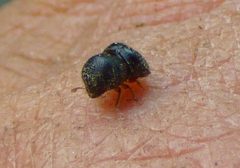
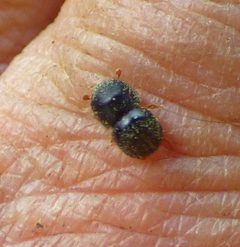
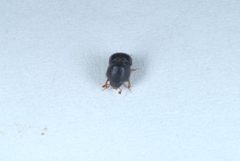
Distinguished from other ambrosia beetles by its large size (largest in North America), robust build, and distinctive body proportions with a shortened that creates a sharply sloping . The black coloration and "squished" appearance are diagnostic. Entrance holes in material are circular and approximately 2 mm in diameter.
Images
Appearance
females are mainly black, large and robust compared to most ambrosia beetles, measuring 3.4–3.9 mm in length and approximately 1.7 times longer than wide. The body shape is distinctive: the is shorter than the and combined, with a sharp slope to the end that gives a severed or "squished" appearance. Adult males are smaller and flightless.
Habitat
Found in forests and urban areas where trees occur. Attacks stems 1–5 cm in diameter. Has been documented in fuel containers and lines due to ethanol attraction, representing an "accidental" association.
Distribution
Native to Asia (Burma, China, India, Indonesia, Japan, Korea, Malaysia, New Guinea, Sri Lanka, Thailand). Introduced to the United States, first detected in Mississippi in 1999. Established throughout much of the eastern United States from Florida north to Pennsylvania, and west to Illinois and Texas. First recorded in Europe (Italy) in 2023.
Diet
Feeds primarily on ambrosia fungus (Ambrosiella beaveri), which is introduced into plant tunnels. The fungus serves as the main food source for both and larvae.
Host Associations
- Ambrosiella beaveri - symbiotic fungusCultivated by the in galleries; primary food source for and larvae
Life Cycle
Females tunnel directly through bark into wood of tree branches, creating circular entrance holes approximately 2 mm in diameter. Galleries extend horizontally a short distance before branching into long vertical tunnels up to 3.8 cm. Males are flightless and remain in galleries.
Behavior
Strongly attracted to ethanol, which is used as a primary attractant for monitoring. This attraction explains documented damage to gasoline fuel containers and lines, as standard U.S. gasoline contains up to 10% ethanol. Both ethanol and isopropanol are effective for trapping, though ethanol captures more specimens.
Ecological Role
As an ambrosia beetle, introduces symbiotic fungi into trees and creates gallery systems. In its native range, it is a major pest of several tree . In the invaded range, it has not yet become a major pest but has potential for future as increase.
Human Relevance
Considered a potential forest pest in invaded regions. Documented as damaging plastic fuel storage containers, lawnmower components, and boat fuel lines due to ethanol attraction. Classified as an EU pest. Subject of citizen science monitoring programs for early detection.
Similar Taxa
- Other Xyleborini ambrosia beetlesCnestus mutilatus is distinguished by its larger size, robust build, and distinctive body proportions with shortened ; most other ambrosia beetles are smaller with more conventional body shapes
More Details
Invasive potential
Climate modeling indicates suitable in the southeastern United States will expand under moderate emission scenarios by 2060, with nearly half of Louisiana parishes and Mississippi counties becoming suitable by 2020 under some scenarios.
Trapping efficacy
Studies show ethanol/red wine mixtures are more effective than ethanol-only traps for capturing this , with higher numbers and diversity of beetles attracted.
Sources and further reading
- BugGuide
- Wikipedia
- GBIF taxonomy match
- iNaturalist taxon
- NCBI Taxonomy
- Catalogue of Life
- Beetles in a bottle: a message from aliens to schools | Blog
- Ascalaphidae | Beetles In The Bush
- August | 2022 | Beetles In The Bush
- Arthropoda | Beetles In The Bush | Page 5
- Trapping the exotic weevil Cnestus mutilatus with Isopropanol
- Habitat Suitability Under Changing Climatic Conditions for the Exotic Ambrosia Beetle, Cnestus mutilatus (Curculionidae: Scolytinae: Xyleborini) in the Southeastern United States
- First report of the alien ambrosia beetle Cnestus mutilatus and further finding of Anisandrus maiche in the European part of the EPPO region (Coleoptera: Curculionidae: Scolytinae: Xyleborini)