
Orthotomicus erosus
Bright & Skidmore, 1997
Mediterranean pine engraver
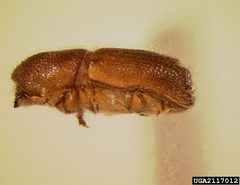
Orthotomicus erosus, the Mediterranean pine engraver, is a bark beetle native to the Mediterranean region, southern Europe, Asia, and North Africa. It is primarily a secondary pest that colonizes stressed, weakened, or recently dead pine trees, but can reach levels and attack healthy trees during drought conditions or following fire. The has expanded its range through domestic and international trade, with established in South America (Argentina and Uruguay) and South Africa. It multiple ophiostomatoid fungi, including Ophiostoma ips, which contribute to blue staining and tree decline.
Pronunciation
How to pronounce Orthotomicus erosus: /ɔr.θoʊˈtoʊ.mɪ.kəs ɛˈroʊ.səs/
These audio files are automatically generated. While they are not always 100% accurate, they are a good starting point.
Identification
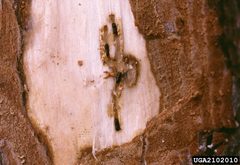
are small bark beetles (exact size not specified in sources). Morphological identification requires stereomicroscopic examination and use of keys for European bark beetles. The produces distinctive larval galleries under bark of pine trees. monitoring using traps baited with 2-methyl-3-buten-2-ol and ipsdienol is used for detection and assessment.
Images
Habitat
Pine forests, particularly those dominated by Pinus halepensis (Aleppo pine), Pinus brutia (Turkish pine), Pinus sylvestris (Scots pine), and Pinus eldarica. Colonizes the phloem and inner bark of pine trunks and branches. Thrives in recently dead or felled trees, weakened living trees, and can attack healthy trees during conditions. Urban pine plantings are also susceptible.
Distribution
Native range: Mediterranean region, southern Europe, Asia, and North Africa. Introduced : South America (Argentina, Uruguay), South Africa. Within native range, populations show genetic structure with western European and other regional clusters. Spread facilitated by domestic sea trade and transport of infested wood material.
Seasonality
In Croatia, first observed in May. Multiple generations per year reported—at least 5 generations annually in Dalmatia, Croatia during conditions (2018). Spring activity initiated in late March. Increased voltinism and earlier spring flights associated with warming temperatures.
Diet
Phloem and inner bark tissues of pine trees (Pinus ).
Host Associations
- Pinus halepensis - Aleppo pine; primary during Croatia
- Pinus brutia - Turkish pine
- Pinus sylvestris - Scots pine; in Bulgaria
- Pinus eldarica - Eldar pine; urban in Iran
- Pinus pinaster - Maritime pine; in Spain
- Ophiostoma ips - /Primary fungal associate; most common
- Leptographium wingfieldii - /Associated fungus; high frequency in some regions
- Ceratocystis ips - / fungal associate in Turkish
- Graphilbum sp. - /Associated ophiostomatoid fungus
- Ophiostoma piceae - /Isolated from beetles and galleries in Croatia
- Graphilbum cf. rectangulosporium - /Isolated from beetles in Croatia
- Ophiostoma floccosum - /Isolated from beetles in Croatia
- Sporothrix pseudoabietina - /Isolated from beetles in Croatia
- Ceratocystiopsis cf. minuta - /Isolated from beetles in Croatia
- Bursaphelenchus fungivorus - phoretic association vectored by in Spain
Life Cycle
Complete with , larval, pupal, and stages. Larvae develop in galleries constructed in phloem and inner bark. Multiple per year under favorable conditions (at least 5 generations documented in Croatia during ). performance improved by warming temperatures.
Behavior
Aggregates in response to ; 2-methyl-3-buten-2-ol functions as a landing signal, while ipsdienol serves as a long-distance attractant. Pheromone response inhibited by verbenone and (S)-cis-verbenol. Capable of active for . bore into bark to initiate galleries. Domestic sea trade and transport of infested logs and branches facilitate long-distance dispersal.
Ecological Role
Secondary bark beetle that accelerates decomposition of dead and dying pine trees. During , can cause tree dieback and mortality in healthy stands. ophiostomatoid fungi that cause blue staining of sapwood and contribute to tree decline. Part of supporting predatory insects including Medetera pinicola, M. signaticornes, Lonchaea collini, and Zabrachia tenella. Associated with actinomycete bacteria (Streptomyces, Gordonia) that produce antifungal compounds.
Human Relevance
Significant forest pest in pine plantations and urban forests. Caused first recorded in Croatia in 2017-2018, affecting 446 hectares. Contributes to decline of urban pine forests in Tehran, Iran. Subject to monitoring using traps for assessment and management. Spread facilitated by untreated wood packaging material in domestic and international trade. Management complicated by physical protection of beetles within bark.
Similar Taxa
- Ips sexdentatusSympatric bark beetle that responds to similar components (ipsdienol, 2-methyl-3-buten-2-ol); both species inhibited by verbenone and (S)-cis-verbenol
- Tomicus piniperdaCo-occurring pine bark beetle that overlapping ophiostomatoid fungi including Ophiostoma ips and Leptographium wingfieldii; both associated with pine decline
More Details
Pheromone chemistry
consists of 2-methyl-3-buten-2-ol (landing signal) and ipsdienol (long-distance attractant). Racemic frontalin has additive kairomonal effect when combined with the binary mixture. (S)-cis-verbenol and racemic frontalin cannot replace ipsdienol in pheromone function.
Climate change effects
Warming temperatures associated with increased voltinism, better performance, earlier spring , and elevated densities leading to conditions. Predicted temperature increases expected to directly influence and geographic distribution.
Invasion genetics
South American (Argentina, Uruguay) derived from western European source populations, with evidence of single introduction event likely through Uruguay first. Shared haplotypes between Argentina and Uruguay indicate connected populations facilitated by regional trade and extensive pine plantations.
Sources and further reading
- BugGuide
- GBIF taxonomy match
- iNaturalist taxon
- NCBI Taxonomy
- Catalogue of Life
- Domestic Sea Trade Aids Wood-Boring Beetles' Range Expansion
- Orthotomicus erosus Archives - Entomology Today
- Antifungal actinomycetes associated with the pine bark beetle, Orthotomicus erosus, in South Africa
- Ophiostomatales Associated with Mediterranean Pine Engraver, Orthotomicus erosus (Coleoptera, Curculionidae) in Dalmatia, Croatia
- New predatory flies associated with Orthotomicus erosus (Wollaston) (Coleoptera: Curculionidae, Scolytinae) in Bulgaria
- Die Wirkung insektenbürtiger Duftstoffe auf das Aggregationsverhalten des mediterranen Kiefernborkenkäfers Orthotomicus erosus1
- The occurrence and pathogenicity of fungi associated with Orthotomicus erosus on Pinus brutia in the Southern Marmara, Türkiye
- Remote Sensing–Based Index Reveals Urban Pinus eldarica Decline Linked to Orthotomicus erosus and Associated Pathogens in Tehran
- Outbreak of Orthotomicus erosus (Coleoptera, Curculionidae) on Aleppo Pine in the Mediterranean Region in Croatia
- Reconstructing the invasion pathways of the bark beetles Orthotomicus erosus and Cyrtogenius luteus (Coleoptera, Curculionidae, Scolytinae) in South America
- Maximum entropy modelling to predict the impact of abiotic variables on the potential distribution of Orthotomicus erosus (Wollaston) (Coleoptera, Curculionidae, Scolytinae)
- Boring in Response to Bark and Phloem Extracts From North American Trees Does Not Explain Host Acceptance Behavior ofOrthotomicus erosus(Coleoptera: Scolytidae)
- The virulence of phytopathogenic fungi associated with the bark beetles Tomicus piniperda and Orthotomicus erosus in Tunisia
- Bursaphelenchus fungivorus (Nematoda: Aphelenchida) associated with Orthotomicus erosus (Coleoptera: Scolitydae) in Spain
- Reduction in the pheromone attractant response of Orthotomicus erosus (Woll.) and Ips sexdentatus Boern. (Col., Scolytidae)1