
Orthotomicus
Ferrari, J.A., 1867
Species Guides
4- Orthotomicus caelatus(Carving Bark Beetle)
- Orthotomicus erosus(Mediterranean pine engraver)
- Orthotomicus latidens(Wide-toothed Bark Weevil)
- Orthotomicus spinifer
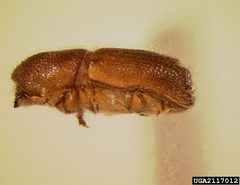
Orthotomicus is a of bark beetles in the Curculionidae, Scolytinae, containing approximately nine described . The genus is primarily associated with coniferous trees, particularly pines (Pinus spp.) and cedars (Cedrus spp.). Several species, notably Orthotomicus erosus (Mediterranean pine engraver) and O. laricis, have become significant forest pests through native and range expansions. Species in this genus are known for their associations with ophiostomatoid fungi, which they and which contribute to tree decline.
Pronunciation
How to pronounce Orthotomicus: /ˌɔr.θoʊˈtoʊ.mɪ.kəs/
These audio files are automatically generated. While they are not always 100% accurate, they are a good starting point.
Images
Habitat
in this inhabit coniferous forests, primarily pine and cedar stands. Orthotomicus erosus occurs in Mediterranean pine forests, including Aleppo pine (Pinus halepensis) and Brutia pine (Pinus brutia) stands. Orthotomicus tridentatus is to cedar forests (Cedrus libani) in the Taurus Mountains of southern Turkey. The genus has been introduced to non-native pine plantations in South America, South Africa, and other regions through global trade.
Distribution
Native range includes Europe, the Mediterranean region, Asia, and North Africa. Orthotomicus erosus is widely distributed across the Mediterranean, southern Europe, Asia, and North Africa. Orthotomicus tridentatus is to Turkey. Introduced established in South America (Chile, Argentina, Uruguay), South Africa, and potentially other regions through human-mediated transport. GBIF records indicate presence in Denmark, Norway, Sweden, and the United States (Vermont).
Host Associations
- Pinus halepensis - Aleppo pine; primary for O. erosus
- Pinus brutia - Brutia pine; for O. erosus
- Pinus sylvestris - Scots pine; for O. erosus
- Pinus eldarica - Eldar pine; for O. erosus in urban Iran
- Cedrus libani - Lebanon cedar; sole for O. tridentatus
- Ophiostomatales fungi - mutualistOphiostomatoid fungi including Ophiostoma ips, O. piceae, O. minus, Leptographium wingfieldii; vectored by beetles and associated with blue-stain
- Streptomyces bacteria - associateActinomycete bacteria producing antifungal compounds; isolated from O. erosus in South Africa
Behavior
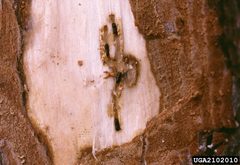
are bark borers that construct galleries in phloem and inner bark. Orthotomicus tridentatus constructs characteristic 'S'-shaped main galleries. Orthotomicus erosus has high ability through active and can be transported in infested wood material. The species exhibits mediated by , with 2-methyl-3-buten-2-ol and ipsdienol identified as key compounds for O. erosus. are influenced by drought stress and temperature, with potential increasing under climate warming scenarios.
Ecological Role
As primary or secondary bark beetles, in this contribute to tree mortality in coniferous forests. Orthotomicus erosus acts as a for ophiostomatoid fungi that cause blue-stain in pine sapwood. The -fungus mutualism facilitates of trees and may accelerate tree decline. In ranges, O. erosus poses significant threats to plantation forestry. The genus participates in complex multipartite involving fungal mutualists and bacterial associates that may influence fungal composition in galleries.
Human Relevance
Several are economically important forest pests. Orthotomicus erosus caused the first recorded in Croatia in 2017-2018, affecting 23% of trees in Marjan Forest Park with at least five per year. The species has invaded South America, South Africa, and other regions, threatening pine plantations. Control efforts include trapping using lures such as Erosowit®. Domestic sea trade facilitates range expansion within countries, as demonstrated in Italy where abundance at ports correlated with trade volume. Correct identification is critical for management; O. laricis was misidentified as O. erosus in Chilean research.
Sources and further reading
- BugGuide
- Wikipedia
- GBIF taxonomy match
- iNaturalist taxon
- NCBI Taxonomy
- Catalogue of Life
- Orthotomicus erosus Archives - Entomology Today
- Domestic Sea Trade Aids Wood-Boring Beetles' Range Expansion
- Orthotomicus tridentatus Eggers: distribution and biology in cedar forests of Turkey
- Antifungal actinomycetes associated with the pine bark beetle, Orthotomicus erosus, in South Africa
- Ophiostomatales Associated with Mediterranean Pine Engraver, Orthotomicus erosus (Coleoptera, Curculionidae) in Dalmatia, Croatia
- New predatory flies associated with Orthotomicus erosus (Wollaston) (Coleoptera: Curculionidae, Scolytinae) in Bulgaria
- Grosmannia tibetensis, a new ophiostomatoid fungus associated with Orthotomicus sp. (Coleoptera) in Tibetan subalpine forests
- The occurrence and pathogenicity of fungi associated with Orthotomicus erosus on Pinus brutia in the Southern Marmara, Türkiye
- Remote Sensing–Based Index Reveals Urban Pinus eldarica Decline Linked to Orthotomicus erosus and Associated Pathogens in Tehran
- Invasive Bark Beetles (Coleoptera, Curculionidae, Scolytinae) in Chile and Argentina, Including Two Species New for South America, and the Correct Identity of the Orthotomicus Species in Chile and Argentina
- Outbreak of Orthotomicus erosus (Coleoptera, Curculionidae) on Aleppo Pine in the Mediterranean Region in Croatia
- Maximum entropy modelling to predict the impact of abiotic variables on the potential distribution of Orthotomicus erosus (Wollaston) (Coleoptera, Curculionidae, Scolytinae)
- Reconstructing the invasion pathways of the bark beetles Orthotomicus erosus and Cyrtogenius luteus (Coleoptera, Curculionidae, Scolytinae) in South America
- Die Wirkung insektenbürtiger Duftstoffe auf das Aggregationsverhalten des mediterranen Kiefernborkenkäfers Orthotomicus erosus1
- Boring in Response to Bark and Phloem Extracts From North American Trees Does Not Explain Host Acceptance Behavior ofOrthotomicus erosus(Coleoptera: Scolytidae)
- The virulence of phytopathogenic fungi associated with the bark beetles Tomicus piniperda and Orthotomicus erosus in Tunisia
- Bursaphelenchus fungivorus (Nematoda: Aphelenchida) associated with Orthotomicus erosus (Coleoptera: Scolitydae) in Spain