
Medetera
Fischer von Waldheim, 1819
Woodpecker Flies
Species Guides
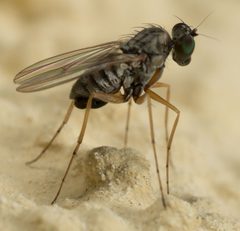
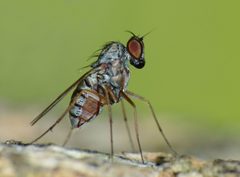
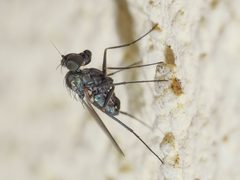
5Medetera is a large of predatory long-legged flies ( Dolichopodidae) comprising approximately 350 worldwide. are commonly found resting on vertical surfaces, particularly tree trunks, where they adopt a characteristic upright stance that has earned them the "woodpecker flies." Adults prey on soft-bodied arthropods, while larvae develop as within bark beetle galleries, feeding on , larvae, pupae, and newly emerged adults. Several species have been studied as potential biocontrol agents for forest pest management.
Pronunciation
How to pronounce Medetera: /mɛˈdɛt.ɛ.ra/
These audio files are automatically generated. While they are not always 100% accurate, they are a good starting point.
Identification
distinguished from other dolichopodid by characteristic upright vertical stance on tree trunks and associated bark beetle . -level identification generally requires examination of male genitalia; female specimens often difficult to identify definitively. Separation from Dolichophorus and Thrypticus requires careful morphological analysis, as molecular phylogenetic studies indicate Medetera is with respect to Dolichophorus. Some species groups (aberrans, melanesiana, salomonis) treated as separate genera by certain authors.
Images
Habitat
Primarily arboreal, associated with coniferous and deciduous forests. commonly found on tree trunks, bark surfaces, and foliage. Larval restricted to inner bark, phloem, and bark beetle galleries in infested trees. Some lineages in southern Europe have been discovered as soil-dwelling, representing an ecological departure from the predominantly arboreal habit.
Distribution
distribution with approximately 350 worldwide. Well-represented in North America, Europe, Asia, and Australia. Documented from forests through tropical regions. Specific distribution records include Scandinavia (Sweden, Norway, Denmark), Bulgaria, North America, and Southeast Asia.
Seasonality
active from early spring through summer until first frost in temperate regions. Activity patterns closely tied to bark beetle , with peak abundance corresponding to bark beetle and gallery establishment periods.
Diet
are active of soft-bodied arthropods. Larvae are specialized predators of bark beetles (Scolytinae), consuming , larvae, pupae, and newly emerged adults within galleries. Specific prey documented includes , Ips acuminatus, and Dendroctonus pseudotsugae.
Host Associations
- Ips typographus - preyEurasian eight-spined spruce bark beetle; primary prey for M. signaticornis larvae
- Ips acuminatus - preyPrey for M. pinicola and M. dendrobaena
- Dendroctonus pseudotsugae - preyDouglas-fir beetle; prey for M. aldrichii larvae
- Picea abies - Norway spruce; tree for bark beetle prey
- Pinus sylvestris - Scots pine; tree for bark beetle prey
Life Cycle
Females oviposit on newly infested tree trunks, depositing near entrances to bark beetle galleries. Larvae emerge and migrate into galleries, where they develop as of bark beetle immatures. Development occurs entirely within bark beetle galleries on infested trees. Larvae cannot penetrate unmined phloem or galleries tightly packed with ; movement restricted to loose frass and interspaces. presumably occurs within galleries or adjacent bark, though specific details remain poorly documented for most .
Behavior
adopt characteristic vertical upright stance on tree trunks, facilitating detection of prey and mates. Use volatile chemical cues () for location, detecting blends of bark beetle , microbial compounds, and host tree volatiles. Antennal detection includes compounds such as (-)-cis-verbenol, (+)-trans-verbenol, myrtenol, and α-pinene. At high prey densities, larvae can attack several prey in rapid . Adults are agile, fast-moving, and rarely stationary, making observation and photography challenging.
Ecological Role
Important natural enemies of bark beetles, contributing to in forest . Potential biocontrol agents for sustainable management of forest pests such as . Role in as both ( and larvae) and prey for other arthropods and insectivorous vertebrates.
Human Relevance
Investigated as biocontrol agents for destructive bark beetle pests in forestry. Synthetic blends developed for M. signaticornis show promise as monitoring lures in programs. No known negative impacts; beneficial as natural regulators of forest pest .
Similar Taxa
- DolichophorusClosely related ; Medetera is with respect to Dolichophorus based on molecular phylogenetic analysis. Some formerly placed in Medetera transferred to Dolichophorus.
- ThrypticusSister to Medetera + Dolichophorus clade; distinguished by morphological and ecological differences.
- CondylostylusCommon dolichopodid found in similar but lacks characteristic upright stance on tree trunks and bark beetle association; typically more brightly metallic and foliage-dwelling.
- HydrophorusDolichopodid associated with water surfaces rather than tree trunks; exhibits skating on water films.
More Details
Phylogenetic Status
Molecular phylogenetic analysis (2011) demonstrated that Medetera is with respect to Dolichophorus, suggesting need for taxonomic revision. Thrypticus is sister to the Medetera + Dolichophorus clade.
Species Groups
Bickel (1985, 1987) recognized numerous groups (nova, isobellae, petulca, aberrans, melanesiana, signaticornis-pinicola, apicalis, crassivenis, diadema-veles, chillcotti, australiana, toxopeusi, gracilis, flaviscutellum, salomonis); some treated as separate by other authors.
Chemical Ecology
M. signaticornis demonstrates sophisticated olfactory orientation to complex volatile blends, integrating bark beetle , microbial metabolites, and tree compounds for host location at multiple .
Sources and further reading
- BugGuide
- Wikipedia
- GBIF taxonomy match
- iNaturalist taxon
- NCBI Taxonomy
- Catalogue of Life
- Bug Eric: Long-legged Flies
- Two predatory Medetera (Diptera: Dolichopodidae) species associated with Ips acuminatus (Gyllenhal) (Coleoptera: Curculionidae) in Bulgaria
- Medetera aldrichii larval feeding behavior and prey consumption [Dipt.: Dolichopodidae]
- Odors Attracting the Long-Legged Predator Medetera signaticornis Loew to Ips typographus L. Infested Norway Spruce Trees.
- Discovery of a Lineage of Soil-Dwelling Medetera Species with Multi-Coloured Eyes in Southern Europe (Diptera: Dolichopodidae).