
Condylostylus
Bigot, 1859
long-legged flies
Species Guides
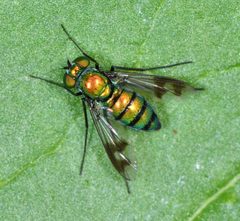
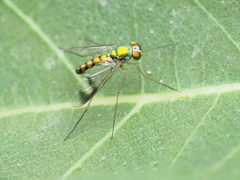
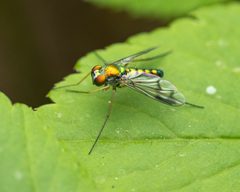
27Condylostylus is a large of predatory flies in the Dolichopodidae, comprising over 250 and representing the second largest genus in the Sciapodinae. The genus exhibits exceptional diversity in the , where approximately 70% of species occur. Members are small to medium-sized dolichopodids, typically displaying metallic coloration and characteristic long-legged . The genus includes species with documented potential as agents in agricultural settings.
Pronunciation
How to pronounce Condylostylus: /ˌkɒn.dɪ.loʊˈstɪləs/
These audio files are automatically generated. While they are not always 100% accurate, they are a good starting point.
Identification
-level identification within Condylostylus generally requires examination of male genitalia, including forward-protruding claspers at the abdominal tip. Some species exhibit distinctive morphological traits: Condylostylus longicornis has alternating vertical rows of orange-red and green-yellow corneal lenses, dark-colored legs, narrow wings canted downward at rest, rounded abdominal segments, and a dark abdominal tip. Male genitalia are often visible as curled appendages beneath the tip without dissection.
Images
Habitat
occupy diverse environments including plant leaves in sunny spots, forest edges, gardens, agricultural fields, and areas near marshes, streams, or meadows with slight shade. Some species have been documented in commercial coconut plantations and urban/suburban areas.
Distribution
(primary center of diversity, ~70% of ); Nearctic region including United States (Vermont, Illinois); Hawaii (introduced/tramp species); India (Madurai District); Brazil (Pará state).
Diet
Predatory on other small insects. Specific prey documentation includes agricultural pests, including mosquitoes, and potentially bark beetles. are adept at capturing mosquito larvae at the water surface.
Host Associations
- Cocos nucifera - found in coconut plantations association; not a feeding
Behavior
are active that rarely stop moving, making them difficult to photograph. Some rest with narrow wings canted downward. Males possess ornamented fore with special resembling tiny flags, used in complex . Some species exhibit hunting in agricultural fields.
Ecological Role
of small insects including agricultural pests and . Potential agents of biological pest control. Condylostylus longicornis has been proposed as a bio- for monitoring water quality.
Human Relevance
Potential value for in agricultural systems, particularly in coconut plantations and other crop settings. Presence may indicate environmental quality. Frequently encountered by photographers and naturalists but challenging to image due to constant movement.
Similar Taxa
- DolichopusShorter-legged dolichopodid ; Condylostylus typically has relatively longer legs and different wing posture at rest
- HydrophorusSurface-skating dolichopodids on water; Condylostylus are primarily foliage-dwelling rather than aquatic surface
- MedeteraTree trunk-dwelling 'woodpecker' flies with distinctive tiptoe posture; Condylostylus occurs more commonly on leaves and in open vegetation
More Details
Genomic resources
Condylostylus longicornis from Hawaii has a published high-quality assembly (544 Mb, 847 contigs, N50 7.2 Mb, 26.5% GC content) with complete mitochondrial genome (16,606 ) and transcriptome from female and body. This represents the third genome assembly for Dolichopodidae and the first from tropical material.
Taxonomic complexity
The has extensive synonymy and nomenclatural issues, including numerous nomina dubia, , and unrecognized . Species-level requires careful examination of and male genitalia.
Sex determination
XY sex determination system has been documented; males were selected for sequencing based on this system.
Sources and further reading
- BugGuide
- Wikipedia
- GBIF taxonomy match
- iNaturalist taxon
- NCBI Taxonomy
- Catalogue of Life
- Bug Eric: Long-legged Flies
- First records of Condylostylus depressus (Aldrich, 1901) and Condylostylus electus (Walker, 1852) (Diptera, Dolichopodidae) in coconut plantations in state of Pará, Brazil
- Ecological Insights into the Predatory Behaviour of Condylostylus longicornis in Agricultural Fields of Madurai District, India
- Whole genome sequence of a long-legged fly Condylostylus longicornis from Hawai'i.