
Dolichopus
Latreille, 1796
long-legged flies
Species Guides
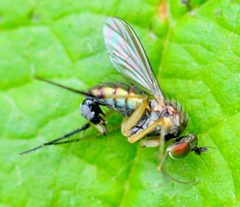
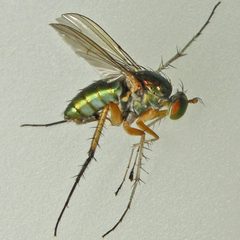
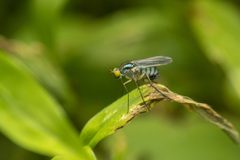
45Dolichopus is the largest in the Dolichopodidae, comprising over 600 worldwide. are small flies, typically less than 8 mm in length, with nearly all species exhibiting metallic greenish-blue to greenish-bronze coloration. The genus name derives from Greek words meaning 'long foot,' referring to the elongated legs characteristic of its species. Members of this genus are predatory on other small insects and display complex courtship involving specialized leg ornaments in males.
Pronunciation
How to pronounce Dolichopus: //dɒˈlɪkəpəs//
These audio files are automatically generated. While they are not always 100% accurate, they are a good starting point.
Identification
Identification to is possible based on the combination of small size (<8 mm), metallic greenish-blue to greenish-bronze coloration, and characteristically long legs with elongated . -level identification is difficult and generally requires examination of male genitalia; the male's claspers and associated structures are visible as forward-protruding appendages at the abdominal tip. Females are particularly challenging to identify as they lack the sexually dimorphic leg ornaments that distinguish males and are morphologically similar across species. Geometric morphometry of wing shape and ratios of leg segment lengths have been developed as alternative diagnostic tools for females in some species groups. Members of the Dolichopus latipennis species group (sometimes treated as subgenus Hygroceleuthus) can be distinguished by specific leg setation and coloration patterns, though these characters show variability that can complicate identification.
Images
Habitat
Found in diverse including sunny spots on foliage, forest edges, gardens, and near water. Some occur on the surface film of puddles, intermittent streams, lakes, and , where they can behave similarly to water striders. The Dolichopus latipennis species group is associated with wet or moist environments. Arctic and subarctic regions are inhabited by some species, including those in the D. latipennis group. In the Palaearctic region, species occupy a range of habitats from lowlands to alpine zones.
Distribution
distribution with over 600 worldwide. Present across the Palaearctic Region including Europe, Siberia (Taimyr and Yamal peninsulas), and Asia. In North America, occurs from Alaska and the Yukon Territory through the Northwest Territories to Greenland. Distributed in the Nearctic, Palearctic, and other biogeographic regions. In China, found in Inner Mongolia and other provinces, with some species groups restricted to specific regions (e.g., D. tewoensis species group with 3 species in China).
Diet
are predatory on other small insects. Prey is captured using a modified lower lip () extended as an appendage equipped with flaring, opposable lobes that crush or tear victims; this structure replaces the beak-like mouthparts seen in related predatory flies. Adults have been observed preying on mosquito larvae at the water surface. Larval diet presumed predatory based on limited observations; most larvae are aquatic or semi-aquatic, with at least some known to feed on bark beetle in their galleries.
Life Cycle
Larvae of most remain poorly known. Where described, larvae are aquatic or semi-aquatic. Some species have larvae that inhabit bark beetle galleries. Developmental stages and detailed information are lacking for the majority of species.
Behavior
are active, fast-moving flies that rarely stop moving, making observation and photography challenging. Males perform complex courtship dances using leg ornaments to display to females. Some can be seen running up and down tree trunks or skating across water surfaces. Adults are sensitive to disturbance and will depart quickly when approached. Members of the can be sensitive to camera pre-flash, resulting in empty frames or out-of-focus images of departing flies.
Ecological Role
of other small insects in their , including potential agents for pest insects such as mosquitoes (preying on larvae) and bark beetles (larval stage). As part of the diverse Dolichopodidae , they contribute to predator diversity in terrestrial and freshwater .
Human Relevance
Valued as garden allies due to predatory habits. Subject of interest in entomological photography, though their makes them challenging subjects. Some have been studied for potential use in . Taxonomic research on the has contributed to understanding of , morphometric identification methods, and evolutionary patterns in structural ornamentation.
Similar Taxa
- CondylostylusAlso in Dolichopodidae; typical garden and forest-edge dolichopodid with similar metallic coloration and predatory habits, but differs in specific leg and wing ; Condylostylus is often the most commonly encountered dolichopodid in gardens
- HydrophorusDolichopodid with that skate across water surfaces; Hydrophorus is more specialized for aquatic surface and differs in leg proportions and from Dolichopus
- MedeteraDolichopodid known as 'woodpecker flies' for their habit of standing on tiptoe on tree trunks; differs in use and posture from Dolichopus, with larvae specialized in bark beetle galleries
- LiancalusDolichopodid with found in similar ; differs in specific morphological features including leg and wing characteristics
- TachytrechusDolichopodid with similar overall appearance; requires examination of specific morphological characters for separation from Dolichopus
More Details
Taxonomic complexity
Dolichopus is divided into multiple groups based on morphological similarities, including the D. latipennis, D. lonchophorus, D. longisetus, D. planitarsis, D. plumipes, D. sagittarius, D. salictorum, D. signifer, D. sublimbatus, and D. tewoensis groups. The D. latipennis group is sometimes treated as the subgenus Hygroceleuthus. Species-level remains challenging due to morphological similarity, particularly among females, and requires specialized techniques including examination of male genitalia or morphometric analysis.
Sexual selection and leg ornament evolution
Male leg ornaments in Dolichopus have evolved independently multiple times within the . The evolutionary pattern in ornament formation is associated with coordinated changes in leg and wing morphometric features. These traits appear to be primarily under pressure rather than for locomotion or other functions. The independent evolution of similar ornaments in non-sister has resulted in morphometric clustering of unrelated species with similar modifications.
Nematode infections and taxonomy
in Dolichopus can cause demasculinization of males, leading to misidentification and erroneous species descriptions. This phenomenon has historically caused taxonomic confusion, with infected specimens of D. lepidus described as separate species (D. lapponicus and D. cruralis). Nematode-infected specimens have been reported from Scandinavia, the Alps, Belgium, and other regions, indicating a broader distribution than initially recognized.
Sources and further reading
- BugGuide
- Wikipedia
- iNaturalist taxon
- NCBI Taxonomy
- Catalogue of Life
- Bug Eric: Long-legged Flies
- NEW DATA ON THE DISTRIBUTION AND SYSTEMATIC OF DOLICHOPUS SIMIUS PARENT, 1927 (DOLICHOPODIDAE, DIPTERA)
- On the distribution of Dolichopus humilis Van Duzee in the Palaearctic Region and a new synonym (Diptera: Dolichopodidae: Dolichopus latipennis species group)
- Morphometric characters in the taxonomic recognition of the species of Dolichopus pennatus group (Diptera: Dolichopodidae)
- The Dolichopus latipennis species group (=Hygroceleuthus Loew) in the Palearctic Region (Diptera: Dolichopodidae)
- The synonymies of Dolichopus lepidus lepidus Staeger, 1842 — demasculinisations, lectotype designations and a nomen oblitum (Diptera, Dolichopodidae)
- Legs morphometric characters of the <i>Dolichopus</i> Latreille species, 1796 (Diptera, Dolichopodidae)
- The genome sequence of Dolichopus griseipennis Stannius, 1831.
- Morphological Description and Potential Geographic Distribution of the Genus Dolichopus Latreille (Diptera, Dolichopodidae, Dolichopodinae) in Inner Mongolia, China.
- The complete mitochondrial genome of Dolichopus galeatus Loew, 1871 (Diptera: Dolichopodidae).