
Dolichopus plumipes
Scopoli, 1763
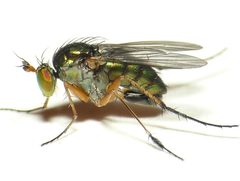
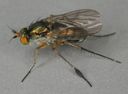
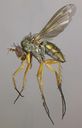
Dolichopus plumipes is a long-legged fly in the Dolichopodidae, characterized by modified male mid tibiae bearing a longitudinal narrow dark streak. The belongs to the D. plumipes species group, which comprises eleven Palaearctic species distinguished by modified male mid tibiae and/or mid basitarsi. It is a predatory fly active in sunny .
Pronunciation
How to pronounce Dolichopus plumipes: /ˌdɒlɪˈkoʊpəs ˈpluːmɪpiːz/
These audio files are automatically generated. While they are not always 100% accurate, they are a good starting point.
Identification
Males are distinguished from other Dolichopus by the thin mid tibia with a longitudinal narrow dark streak. The mid basitarsus is pennate or bears elongate setae. These modified leg structures are used in . Species-level identification generally requires examination of male genitalia.
Images
Habitat
Found in sunny, open including forest edges and gardens. As a member of Dolichopodidae, it likely frequents vegetation surfaces where it hunts small prey.
Distribution
Palaearctic Region, including most of northern Europe and Asia. Records confirm presence in Belgium, Denmark, and Iran. Not recorded from the eastern United States or Manitoba, Canada.
Diet
are predatory on other small insects. Larval diet unknown, though dolichopodid larvae are generally predatory.
Behavior
Males perform complex courtship dances using ornamented front to display to females. are agile, fast-moving, and rarely stop moving when active.
Similar Taxa
- Other Dolichopus speciesDistinguished by the specific pattern of male mid tibial modification; D. plumipes has a thin mid tibia with longitudinal narrow dark streak rather than clear whitish yellow area or simple/unmodified structure found in related .
- Condylostylus speciesCommon garden dolichopodids with bright metallic coloration, but belong to different with different body proportions and lack the specific male leg modifications of Dolichopus.
More Details
Taxonomic Note
Authorship has been cited as both Scopoli, 1763 and Fallén, 1823 in different sources; Scopoli, 1763 appears to be the original combination as Musca plumipes.
Species Group Affiliation
Member of the Dolichopus plumipes group, redefined in 2014 to include eleven Palaearctic species characterized by modified male mid legs.
Sources and further reading
- BugGuide
- Wikipedia
- GBIF taxonomy match
- iNaturalist taxon
- NCBI Taxonomy
- Catalogue of Life
- Bug Eric: Long-legged Flies
- Gardening for Solitary Bees - Buglife Blog - Buglife
- Spring is sprung… - Buglife Blog - Buglife
- Group mimicry in Cerambycidae… and more | Beetles In The Bush
- Bug Eric: Spider Sunday: Dewdrop Spiders
- Bees of the Changing Chalk Partnership Area - Buglife Blog - Buglife
- The Dolichopus plumipes species group (Diptera, Dolichopodidae) in the Palaearctic Region with the description of a new species from Iran