Medetera arnaudi
Harmston, 1951
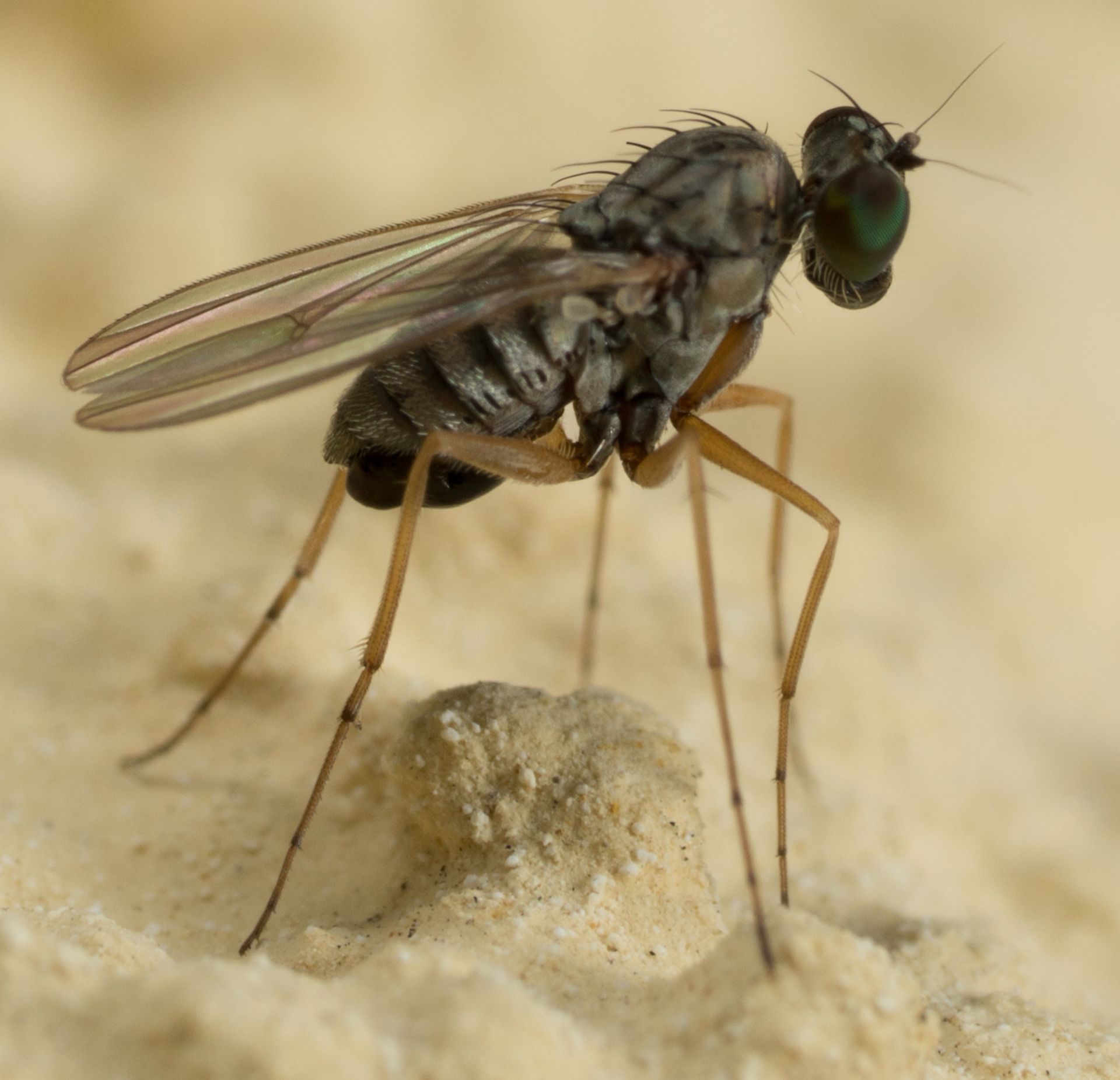
Medetera arnaudi is a of long-legged fly in the Dolichopodidae, to California's Central Valley and Coast Ranges. It was described by Harmston in 1951 and named in honor of entomologist Paul H. Arnaud, Jr., who collected the . The species belongs to the diadema-veles species group as defined by Bickel (1985). As a member of the Medetera, it shares the characteristic of perching on tree trunks in a distinctive upright posture.
Pronunciation
How to pronounce Medetera arnaudi: /mɛˈdɛtɛra ɑrˈnaudi/
These audio files are automatically generated. While they are not always 100% accurate, they are a good starting point.
Identification
Medetera arnaudi can be distinguished from other Medetera by male genitalia characteristics, which typically require microscopic examination for definitive identification. The species is placed in the diadema-veles species group based on morphological features defined in Bickel (1985). Field identification to species level is generally not feasible without specimen examination.
Images
Habitat
Found in California's Central Valley and Coast Ranges. Based on -level , Medetera are typically associated with tree trunks and woody vegetation.
Distribution
to California, USA; specifically recorded from the Central Valley and Coast Ranges.
Behavior
As a member of Medetera, likely exhibit the characteristic "woodpecker fly" of perching vertically on tree trunks in an upright, tiptoe posture while actively foraging. Specific behavioral observations for M. arnaudi have not been documented.
Ecological Role
As a predatory dolichopodid, likely functions as a of small insects. Larvae of some Medetera are known to inhabit bark beetle galleries and prey on , though this has not been confirmed for M. arnaudi specifically.
Similar Taxa
- Other Medetera speciesCo-occurring in California require examination of male genitalia for separation; M. arnaudi is distinguished by characteristics defined in Bickel (1985) revision.
- Other DolichopodidaeMedetera are distinguished from other long-legged flies by their characteristic vertical perching posture on tree trunks and specific leg proportions.
More Details
Etymology
Named after Paul H. Arnaud, Jr., the entomologist who collected the .
Taxonomic placement
Assigned to the diadema-veles group in Bickel's 1985 revision of Nearctic Medetera.