
Medeterinae
Genus Guides
3- Medetera(Woodpecker Flies)
- Systenus
- Thrypticus
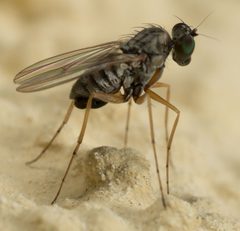
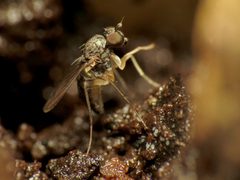
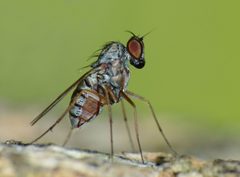
Medeterinae is a of long-legged flies (Dolichopodidae) comprising approximately 40 arranged in four tribes: Medeterini, Systenini, Thrypticini, and Udzungwomyiini. The group includes both extant and fossil genera, with several described from amber deposits. The subfamily is most diverse in tropical and subtropical regions, with particular richness in the Afrotropical and Oriental realms.
Pronunciation
How to pronounce Medeterinae: /ˌmɛdɪtəˈraɪni/
These audio files are automatically generated. While they are not always 100% accurate, they are a good starting point.
Identification
Medeterinae can be distinguished from other Dolichopodidae by combinations of wing venation patterns, male genitalic structures, and leg chaetotaxy. The tribe Thrypticini is characterized by reduced wing venation with a distinctively shortened M1+2 . Systenini typically exhibit elongated postpedicels and modified male terminalia. Medeterini show considerable variation in body size and leg proportions, with some exhibiting metallic coloration.
Images
Habitat
Members of Medeterinae occupy diverse including forest understories, riparian zones, and grassland edges. Many are associated with decaying wood, leaf litter, or moist soil substrates. The Thrypticus is known to inhabit bamboo and grass stems. Udzungwomyiini is restricted to montane forest habitats in East Africa.
Distribution
The has a distribution with highest diversity in tropical regions. The tribe Udzungwomyiini is to the Udzungwa Mountains of Tanzania. Several including Medetera and Systenus are widespread across multiple continents. The fossil genera Eridanomyia, Kashubia, Medeterites, Plesiomedetera, Salishomyia, Palaeosystenus, and Systenites have been described from Eocene to Miocene deposits in Europe and North America.
Ecological Role
Predatory has been documented in multiple , particularly Medetera, which has been observed preying on bark beetle larvae (Scolytinae) and other small arthropods. Some are considered biocontrol agents in forest . The role of most genera in remains poorly characterized.
Human Relevance
of Medetera have been investigated for of forest pests, particularly conifer bark beetles. The otherwise has minimal direct economic importance. Several fossil provide calibration points for molecular dating of Dolichopodidae evolution.
Similar Taxa
- DolichopodinaeLarger body size, typically more robust build, and different male genitalic structures; lacks the reduced wing venation seen in Thrypticini
- HydrophorinaeAssociated with aquatic or semi-aquatic , distinct tarsal pad , and different wing microtrichia patterns
- RhaphiinaeGenerally smaller body size, different antennal proportions, and distinct larval preferences
More Details
Fossil Record
Medeterinae has an extensive fossil record with seven described extinct : Eridanomyia and Kashubia (Baltic amber, Eocene), Medeterites (Rovno amber, Eocene), Plesiomedetera (Baltic amber, Eocene), Salishomyia (Klondike Mountain Formation, Eocene), Palaeosystenus and Systenites (Rovno amber, Eocene). These fossils indicate the was already diverse by the Eocene.
Taxonomic History
The classification of Medeterinae has undergone substantial revision. Hurleyella was described with uncertain placement (incertae sedis). Several were erected to accommodate groups previously placed in Medetera, including Demetera, Medeterella, and Saccopheronta. The tribe Udzungwomyiini was established in 2019, representing one of the most recently described tribes in Dolichopodidae.
Phylogenetic Relationships
Molecular phylogenetic studies suggest Medeterinae is not monophyletic as currently defined, with Systenini and Thrypticini potentially representing separate lineages. The position of fossil relative to extant tribes remains unresolved due to limited morphological overlap in preserved characters.