
Systenus
Loew, 1857
Species Guides
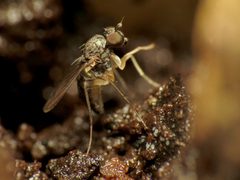
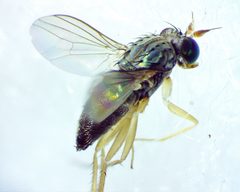
2Systenus is a of long-legged flies (Dolichopodidae: Medeterinae) characterized by larvae that develop in dendrotelme —water-filled hollow tree cavities lined with organic soil. The genus is globally uncommon in collections, likely due to its arboreal associations and specialized larval habitat requirements. Despite this rarity, some localities show remarkable ; for example, eight were collected from a single site in Rica. The genus occurs in both tropical and temperate regions, with records from Central America, South America, Europe, and North America.
Pronunciation
How to pronounce Systenus: /sɪsˈtiːnəs/
These audio files are automatically generated. While they are not always 100% accurate, they are a good starting point.
Identification
Palearctic can be distinguished using keys to females; for example, S. slovakiensis is distinguished from all other Palearctic species by snow-white combined with black . Colombian species can be identified using male-specific keys.
Images
Habitat
Larval is dendrotelme—water-filled hollow tree cavities (cavities d'arbres creux remplies d'eau) containing dark brown to blackish fine organic soil (terreau fin brun noirâtre) lining the bottom and walls. Favorable tree include Liriodendron, Fagus, Tilia, Aesculus, Quercus, Ulmus, Betula, and Platanus. are arboreal and associated with tree . Some occupy anthropogenic habitats.
Distribution
Tropical countries (common) and temperate regions (much less common). Documented from Rica (Guanacaste Province), Colombia, Slovakia (Prešov), and Europe (including Scandinavia: Denmark, Norway, Sweden). North American records include associations with Liriodendron tulipifera. The is considered globally uncommon in collections.
Life Cycle
Larval development occurs in the soil substrate within dendrotelme cavities. Larvae of S. adpropinquans and S. scholtzii have been found in decomposed sap or wood-pulp filling wounds of elm and horse-chestnut trees.
Behavior
are arboreal and less likely to be captured by ground-level trapping methods. High local sympatry has been observed, with up to eight co-occurring at a single Rican site.
Similar Taxa
- RhaphiumSystenus americanus was synonymized with Rhaphium melampus, indicating historical confusion between
- SybistromaMultiple Systenus (S. lamelliger, S. obscurior) were synonymized with Sybistroma inornatus, suggesting morphological similarity
- OncopygiusS. ornatus was synonymized with Oncopygius distans, indicating potential identification challenges
More Details
Parasite Host
Larvae of S. adpropinquans and S. scholtzii serve as for gregarine including Schizocystis legeri and Dendrorhynchus systeni, which often completely fill the host's without causing visible signs of .
Collection Bias
The is underrepresented in collections due to arboreal and specialized larval in tree cavities, making detection difficult with standard ground-level sampling methods.
Species Diversity
Recent taxonomic work has substantially expanded known diversity, with nine new described from Rica and four from Colombia, suggesting many cryptic species remain undiscovered in arboreal .
Sources and further reading
- BugGuide
- Wikipedia
- GBIF taxonomy match
- iNaturalist taxon
- NCBI Taxonomy
- Catalogue of Life
- Les Systenus et leur habitat dendrotelme [Dipt. Dolichopodidae]
- A new species of Systenus Loew (Dolichopodidae, Diptera) from Slovakia
- The Costa Rican Systenus Loew (Diptera: Dolichopodidae): rich local sympatry in an otherwise rare genus
- On a New Schizogregarine:Schizocystis legerin. sp, an Intestinal Parasite of Dipterous Larvae (Systenus)
- First record of the genus Systenus Loew (Diptera: Dolichopodidae) from Colombia, with description of four new species
- On Two New Gregarines, Allantocystis dasyhelei n.g., n.sp., and Dendrorhynchus systeni n.g., n.sp, Parasitic in the Alimentary Canal of the Dipterous Larvae, Dasyhelea obscura Winn. and Systenus sp