
Boridae
C.G. Thomson, 1859
Conifer Bark Beetles
Genus Guides
2is a small of tenebrionoid beetles comprising three : Boros (North America and northern Eurasia), Lecontia ( to North America), and Synercticus (Australia and New Guinea). These saproxylic beetles are strongly associated with coniferous trees, particularly standing dead pines. The family was previously classified within Salpingidae before being recognized as distinct. Despite their , they are not destructive forest pests but rather occupy specialized in dead wood decomposition.
Pronunciation
How to pronounce Boridae: //ˈbɔːrɪˌdeɪ//
These audio files are automatically generated. While they are not always 100% accurate, they are a good starting point.
Identification
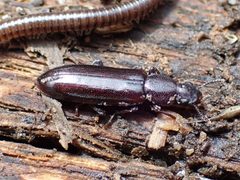
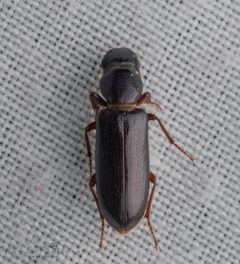
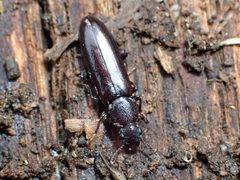
are convex, bullet-shaped beetles with a shiny black, non-metallic coloration. are bead-like () with the base concealed by a ridge—this concealed antennal base is a key diagnostic character distinguishing them from superficially similar darkling beetles (Tenebrionidae). The body is narrow and somewhat elongated compared to most tenebrionids. Lecontia discicollis ranges 12–23 mm in length. Boros are similarly sized. The slow, deliberate movement of adults contrasts with the agile of bark-gnawing beetles (Trogossitidae), which they may resemble in general form.
Images
Habitat
Strictly saproxylic, associated with dead coniferous wood. Boros larvae inhabit standing dead trees (snags), particularly pines, under loose bark in old-growth forests. Lecontia larvae occupy damp, decayed areas in the root systems of fire-killed or bark beetle-killed standing conifers. Boros schneideri specifically requires dead Pinus sylvestris with loose, fragmented bark; bark thickness must exceed 5 mm with at least 0.08 m² of bark area available. Optimal includes medium- pine forests with 60–80% cover, in stands 40–80 years old, with tree diameters of 10–20 cm at breast height.
Distribution
Holarctic and Australasian. Boros: North America and northern Eurasia (including Lithuania, Białowieża Forest, and Atlantic Canada). Lecontia: to North America (recorded from Colorado, Black Hills of South Dakota, and ponderosa pine forests of Arizona). Synercticus: Australia and New Guinea. Boros unicolor is newly recorded in New Brunswick and Nova Scotia, Canada.
Host Associations
- Pinus sylvestris - larval Dead standing trees, primary for Boros schneideri
- Pinus ponderosa - and larval associationLecontia discicollis found on trunks and in fire-killed trees
- Picea abies - negative associationPresence reduces probability of Boros schneideri occupancy; only 6% of inhabited trees in mixed pine-spruce forests
Life Cycle
Larvae develop under bark of dead conifers. Developmental timing appears tied to tree death, with Lecontia particularly associated with trees 3–5 years post-fire. are and found on tree trunks at night. Specific sites and developmental duration remain undocumented.
Behavior
are slow-moving and , found crawling on trunks of dead or dying conifers after dark. They are not attracted to light traps. Larvae are confined to specific microhabitats: under loose bark for Boros, in moist white-rotted root wood near and below ground level for Lecontia. The beetles exhibit strong fidelity to particular stages of wood decay and specific tree diameters.
Ecological Role
Saproxylic decomposers contributing to nutrient cycling in coniferous forest . As on standing dead wood, they occupy a narrow in the successional sequence of wood decomposition. Their presence indicates particular stages of tree decay and forest structural complexity. The is discussed in conservation contexts regarding forest management impacts on saproxylic .
Human Relevance
Of conservation concern in Europe. Boros schneideri is legally protected in multiple countries and classified as endangered; forest management practices that remove standing dead wood threaten . The has been intensively studied to inform conservation measures, including retention of dead trees with specific characteristics (diameter >10 cm, loose bark >5 mm thick) during forestry operations. In North America, Lecontia discicollis is considered uncommon but not rare where suitable fire-killed pine exists.
Similar Taxa
- TrogossitidaeBark-gnawing beetles share convex body form but are more agile, often iridescent or metallic, with exposed antennal bases and different larval habits
- TenebrionidaeDarkling beetles share and black coloration but typically have broader bodies, exposed antennal bases, and are not specialized saproxylic bark inhabitants
- SalpingidaeHistorically confused with ; narrow-waisted bark beetles differ in body shape and antennal structure
- PythidaeRelated with similar saproxylic habits but distinct morphological features including different antennal and tarsal structures
Misconceptions
The 'conifer bark beetles' misleadingly suggests destructive pest status. are not economically damaging; they are late-successional saproxylic that colonize already-dead wood rather than killing living trees. The name 'burnt conifer bark beetle' for Lecontia discicollis refers to preference for fire-killed trees, not to the itself being charred or fire-adapted in physiology.
Sources and further reading
- BugGuide
- Wikipedia
- GBIF taxonomy match
- iNaturalist taxon
- NCBI Taxonomy
- Catalogue of Life
- Bug Eric: Borids Are Not Bor-ing
- Chrysididae | Beetles In The Bush
- Distribution of Boros schneideri (Panzer, 1796) (Coleoptera, Boridae) in Lithuania
- Relationships of the Australian GenusSynercticusNewman (Coleoptera: Boridae)
- The Mycteridae, Boridae, Pythidae, Pyrochroidae, and Salpingidae (Coleoptera: Tenebrionoidea) of the Maritime Provinces of Canada
- Habitat requirements of the endangered beetle Boros schneideri (Panzer, 1796) (Coleoptera: Boridae)
- Habitat Preferences of Boros schneideri (Coleoptera: Boridae) in the Natural Tree Stands of the Białowieża Forest
- Ecology and calculation of population density of the protected saproxylic beetle species Boros schneideri (Panzer, 1796) (Coleoptera, Boridae) in capercaillie lek areas