
Ips confusus
Wood & Bright, 1992
pinyon pine beetle, pinyon ips, pinyon engraver beetle
Ips confusus is a bark beetle in the Curculionidae, commonly known as the pinyon pine or pinyon ips. It is a significant pest of pinyon pine (Pinus edulis) and ponderosa pine (Pinus ponderosa) in the southwestern United States and Mexico. The beetle colonizes stressed or weakened trees, creating galleries beneath the bark where larvae feed on phloem tissues. can cause extensive tree mortality, particularly during drought conditions.
Pronunciation
How to pronounce Ips confusus: /ɪps kənˈfjuːsəs/
These audio files are automatically generated. While they are not always 100% accurate, they are a good starting point.
Identification
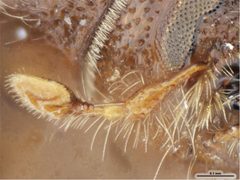
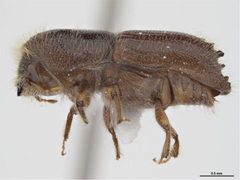
Distinguished from similar Ips by the number and arrangement of abdominal spines: I. confusus has five spines, while related species such as I. grandicollis (fivespined engraver) and I. paraconfusus (California fivespined ips) have different spine counts or geographic ranges. Examination of the declivity ( slope of ) under magnification is required for definitive identification. Distinguishable from Dendroctonus bark beetles by smaller size and different gallery patterns.
Images
Appearance
Small, cylindrical bark beetle measuring 3.2–6.4 mm in length. Body coloration is brown. The portion of the bears five spines arranged in two rows, a diagnostic feature of the . have hardened forewings () typical of beetles. in size and muscle development has been documented, with females showing more pronounced flight muscle degeneration during .
Habitat
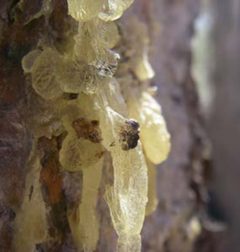
Associated with pinyon-juniper woodlands and ponderosa pine forests. Colonizes the inner bark (phloem and cambium) of living or recently dead pine trees. Requires stressed, weakened, or damaged trees for successful establishment; healthy trees typically resist attack through resin defense.
Distribution
Native to North America and Central America. Documented in the southwestern United States (Arizona, New Mexico, Colorado, Utah, Nevada, California) and Mexico. GBIF records confirm presence in Middle America and North America.
Seasonality
are active primarily in spring and summer. First typically occurs in April or May, depending on temperature. The produces three to four generations per year in favorable conditions. Adults overwinter within trees in sinuous feeding galleries. Emergence patterns are temperature-dependent: above 72°F (22°C), peak male emergence occurs mid-morning to noon, while females show bimodal emergence with peaks in mid-to-late morning and mid-to-late afternoon; below 72°F, female emergence becomes unimodal.
Diet
and larvae feed on phloem and xylem tissues of trees, disrupting transport of water, nutrients, and sugars. Adults also consume fungal associates that colonize galleries.
Host Associations
- Pinus edulis - primary pinyon pine, preferred
- Pinus ponderosa - ponderosa pine, documented in laboratory and field studies
Life Cycle
Holometabolous with complete . Males typically initiate and excavate chambers. Females construct galleries radiating from the nuptial chamber, laying 20–30 eggs in individual packed with debris. Eggs hatch in approximately 7 days. Larvae feed in galleries, pupate after 3–6 weeks, and emerge as . Multiple per year (typically 3–4) with overlapping . Spring-attacked parent adults show high re- rates (62%), potentially contributing to severity. muscle volume changes dramatically through : muscles develop from to emerged adult, then degenerate rapidly (>90% volume loss) after entry, with before re-emergence.
Behavior
Males produce by bio-oxidizing terpenes from resin, attracting conspecifics to colonize trees. Pheromone plumes can attract beetles from distances exceeding 11 miles under favorable conditions. Males construct chambers and may mate with multiple females (). activity occurs between 25–40°C, with optimal take-off at 30°C for males and 32.5°C for females. Light intensities below 431 lux suppress flight. Both sexes show reduced flight attempts when exposed to attractive odors. Re-emerging are responsive to flight stimuli; darkened callows and gallery-removed adults cannot be induced to fly. Temperature and humidity affect survival and : storage at 8°C and 100% RH preserves response capacity, while low humidity and 21°C are detrimental.
Ecological Role
Functions as a disturbance agent in pinyon-juniper . Kills weakened or damaged trees, creating gaps that allow shade-intolerant understory to establish. Provides snag and contributes organic material to soil. Heavy , particularly during drought or booms, can cause widespread tree mortality and alter forest structure.
Human Relevance
Significant forestry pest causing economic losses through tree mortality. reduce timber value and alter watershed and recreational values. Management strategies include removal of slash and stressed material to reduce breeding substrate. -based monitoring and anti- techniques have been explored for related Ips . Climate change and drought stress are exacerbating outbreak severity and geographic range.
Similar Taxa
- Ips grandicollisSimilar size and ; distinguished by spine arrangement and preferences (eastern white pine and other Pinus in eastern North America)
- Ips paraconfususPreviously confused with I. confusus; distinguished by chemistry and geographic range (California and coastal regions)
- Dendroctonus pseudotsugaeDouglas-fir beetle, similar bark beetle but larger size, different gallery architecture, and primary in Pseudotsuga rather than Pinus
More Details
Phoretic mite associations
carry diverse phoretic mite . In Arizona, 95% of beetles carried mites, with an average of 18 mites per (maximum 147). include Iponemus confusus confusus, Dendrolaelaps quadrisetosimilis, and Trichouropoda californica. Mite attachment locations vary by , and mite abundance changes with beetle timing.
Flight muscle plasticity
Remarkable muscle degeneration occurs after entry, with females showing more extensive degeneration than males. This trait may facilitate reproductive investment in females and gallery maintenance in males. Muscle before re- suggests selection for capability in successful colonizers.
Pheromone biology
Male attractant production declines after mating in correlation with harem size. attractiveness degrades rapidly in open air (significant loss within 15 minutes, minimal after 1 hour). Seasonal variation in response occurs, with female response to male frass lowest in January–February (24.2%) and peaking in May–June (76.6%).
Sources and further reading
- BugGuide
- Wikipedia
- GBIF taxonomy match
- iNaturalist taxon
- NCBI Taxonomy
- Catalogue of Life
- Pasture Grasshopper
- Grasshoppers of Colorado
- Grasshoppers of Colorado
- Bug Eric: Pinyon Problems? Maybe, Maybe Not
- Pheromone Treatment Puts Up the "No Vacancy" Sign for Douglas-Fir Beetles
- Unhappy Christmas tree - Fivespined engraver, Ips grandicollis — Bug of the Week
- VARIATION IN CAPACITY OF IPS CONFUSUS TO REACH ATTRACTIVE HOSTS
- Flight muscle volume change in Ips confusus (Coleoptera: Scolytidae)
- EMERGENCE PATTERNS OF IPS CONFUSUS (COLEOPTERA: SCOLYTIDAE) FROM PONDEROSA PINE
- Phoretic mite assemblage of the pinyon pine beetle, Ips confusus (Curculionidae: Scolytinae), in Arizona
- FACTORS INFLUENCING THE RESPONSE OFIPS CONFUSUS(COLEOPTERA: SCOLYTIDAE) TO MALE ATTRACTANT
- Fine structure of degenerating and regenerating flight muscles in a bark beetle, Ips confusus: I. degeneration