
Ips paraconfusus
Lanier, 1970
California fivespined ips, California fivespined ip
Ips paraconfusus is a bark beetle native to western North America, notable as the first bark beetle from which a was identified in 1967. Males produce pheromones ipsenol and ipsdienol primarily through de novo biosynthesis, with minor contribution from -tree myrcene conversion. The species colonizes various pine species, with strong preference for ponderosa pine over non-host trees such as white fir.
Pronunciation
How to pronounce Ips paraconfusus: /ˈɪps ˌpæɹəˈkɒnfjʊsəs/
These audio files are automatically generated. While they are not always 100% accurate, they are a good starting point.
Identification
Distinguished from related Ips by the presence of five spines arranged in two rows on the declivity. Similar to other fivespined Ips species; precise identification requires examination of spine arrangement and subtle morphological characters. Distinguished from Ips confusus by specific taxonomic characters established in the original description.
Images
Habitat
Bark of living or recently dead pine trees, particularly in the phloem layer beneath the outer bark. Colonizes trees stressed by drought, lightning damage, or other factors compromising defensive resin production.
Distribution
Western North America. Associated with pines in California and surrounding regions.
Diet
Phloem tissue of pine trees. Feeding occurs exclusively in the phloem layer, not in outer bark.
Host Associations
- Pinus ponderosa - primary strongly preferred; extensive boring and occur
- Pinus lambertiana - supports ; higher parasitization rates than in ponderosa pine
- Pinus jeffreyi - high titers produced due to elevated myrcene content
- Pinus sabiniana - supports production despite minimal detectable myrcene
- Pinus contorta - documented for biosynthesis studies
- Pinus radiata - documented for within-tree distribution studies
- Abies concolor - non-boring ceases after minimal phloem penetration; beetles re-emerge and depart
Life Cycle
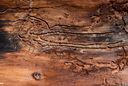
deposited in along galleries constructed in phloem. Larvae tunnel through phloem tissue, creating characteristic engraving patterns. occurs within bark. Newly emerged disperse to locate new host material.
Behavior
Males initiate and construct chambers. Males produce in when feeding on suitable host phloem; pheromone production requires feeding and does not occur in unfed individuals. Pheromones attract both sexes, facilitating mass aggregation. Mating terminates aggregation . Beetles bore preferentially in fissured versus smooth outer bark.
Ecological Role
Contributes to pine mortality during , particularly following disturbances that provide stressed material. influenced by hymenopterous , with parasitization rates varying by host tree and bark thickness.
Human Relevance
Historical significance as the first bark beetle from which a was identified (1967), catalyzing extensive research on bark beetle chemical . Subject of research on pheromone biosynthesis and potential management applications. Can contribute to timber loss during .
Similar Taxa
- Ips confususclosely related with similar and ; distinguished by specific taxonomic characters in original description
- Ips grandicollisanother fivespined engraver with similar spine arrangement; differs in geographic distribution and associations
- Dendroctonus pseudotsugaesympatric bark beetle with similar ecological role; distinguished by different chemistry and preferences (Douglas-fir)
Sources and further reading
- BugGuide
- Wikipedia
- GBIF taxonomy match
- iNaturalist taxon
- NCBI Taxonomy
- Catalogue of Life
- Congrats to Antoine Abrieux, Innovator Fellow Award | Bug Squad
- Beetle Mania to Descend on the Bohart | Bug Squad
- Pheromone Treatment Puts Up the "No Vacancy" Sign for Douglas-Fir Beetles
- Unhappy Christmas tree - Fivespined engraver, Ips grandicollis — Bug of the Week
- A thrips is a thrips… | Beetles In The Bush
- Insect-resistant Maize Could Increase Yields and Decrease Pesticide Use in Mexico
- ADVERSE EFFECT OF FENOXYCARB ON REPRODUCTION BY THE CALIFORNIA FIVESPINED IPS,IPS PARACONFUSUSLANIER (COLEOPTERA: SCOLYTIDAE)
- Pheromone production by the bark beetle,Ips paraconfusus, in the nonhost, white fir
- Host-Tree Monoterpenes and Biosynthesis of Aggregation Pheromones in the Bark BeetleIps paraconfusus
- Relationship between a host plant compound, myrcene and pheromone production in the bark beetle, IPS paraconfusus
- Effect of mating on terminating aggregation during host colonization in the bark beetle,Ips paraconfusus
- Feeding and boring behavior of the bark beetle,Ips paraconfusus, in extracts of ponderosa pine phloem
- The composition and metabolism of fatty acids in Ips paraconfusus Lanier (Coleoptera: Scolytidae)
- Functional expression of Ips paraconfusus cytochromes P450 exhibiting conspicuous up-regulation with feeding on host phloem.
- Pheromone biosynthesis in the bark beetle, Ips paraconfusus, during feeding or exposure to vapours of host plant precursors
- Influence of sex, maturity and host substances on pheromones in the guts of the bark beetles, Ips paraconfusus and Dendroctonus brevicomis
- The within-Tree Distributions of Ips paraconfusus (Coleoptera: Scolytidae) and Its Insect Associates in Monterey Pine (Pinus radiata)
- Electrophysiological response of Dendroctonus pseudotsugae and Ips paraconfusus (Coleoptera: Scolytidae) to selected wavelength regions of the visible spectrum
- In vivo conversion of a labelled host plant chemical to pheromones of the bark beetle Ips paraconfusus
- HYMENOPTEROUS PARASITES OF IPS PARACONFUSUS (COLEOPTERA: SCOLYTIDAE) LARVAE AND THEIR CONTRIBUTION TO MORTALITY: I. INFLUENCE OF HOST TREE AND TREE DIAMETER ON PARASITIZATION
- FEEDING AND BORING BEHAVIOR OF THE BARK BEETLEIPS PARACONFUSUS(COLEOPTERA: SCOLYTIDAE) ON THE BARK OF A HOST AND NON-HOST TREE SPECIES