
Sibinia
Germar, 1817
leguminous seed weevils
Species Guides
13- Sibinia fulva
- Sibinia hispida
- Sibinia inermis(huisache sibinia weevil)
- Sibinia maculata
- Sibinia ochreosa(Ochre Sibinia Weevil)
- Sibinia pallida(Ebony Sibinia Weevil)
- Sibinia ruidula
- Sibinia sellata
- Sibinia setosa(leguminous seed weevil)
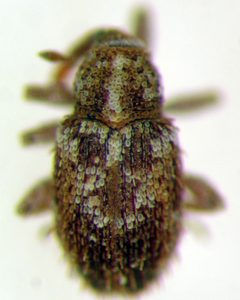
Sibinia is a of seed weevils in the Curculionidae containing at least 20 described . The genus is divided into three subgenera: Sibinia (s. str.), Dichotychius, and Microtychius. Species develop as larvae within seeds of plants, primarily in the families Caryophyllaceae and Plumbaginaceae. The genus has been studied for its potential use in of plants.
Pronunciation
How to pronounce Sibinia: //sɪˈbɪ.ni.ə//
These audio files are automatically generated. While they are not always 100% accurate, they are a good starting point.
Identification
Sibinia can be distinguished from the closely related Tychius by larval morphological characters. are small weevils with the characteristic elongated rostrum typical of Curculionidae. Subgeneric classification relies on adult morphological characters supported by larval traits.
Images
Habitat
Terrestrial environments where plants occur. Larval development occurs entirely within seeds of host plants.
Distribution
Palaearctic region; Americas (subgenus Microtychius); Bulgaria; Australia (S. fastigiata for biocontrol research). Distribution records from GBIF include Denmark, Norway, and Sweden.
Diet
Seeds of plants. Documented host include Caryophyllaceae (five Palaearctic ) and Plumbaginaceae (S. sodalis). Sibinia fastigiata has been investigated for of Mimosa pigra.
Host Associations
- Caryophyllaceae - larval (seeds)Five Palaearctic : S. attalica, S. femoralis, S. tibialis, S. viscariae, S. sicana
- Plumbaginaceae - larval (seeds)S. sodalis
- Dianthus giganteus - plantS. subelliptica in Bulgaria
- Mimosa pigra - plantS. fastigiata investigated for biocontrol
Life Cycle
Larvae and pupae develop within seeds of plants. emerge from seeds. traits are highly homogeneous across in the .
Ecological Role
Seed . Serves as for chalcidoid (Hymenoptera: Chalcidoidea), including Eulophidae, Eupelmidae, Eurytomidae, Pteromalidae, and Torymidae. Investigated as agent for plants.
Human Relevance
Investigated for of plant , particularly Mimosa pigra in Australia. Some species may impact leguminous crops or native plants through seed .
Similar Taxa
- TychiusClosely related ; distinguished by larval morphological characters
More Details
Subgeneric classification
Three subgenera recognized: Sibinia (s. str.), Dichotychius Bedel 1885, and Microtychius Casey 1910. Larval characters support this classification, particularly for distinguishing Sibinia s. str. groups.
Parasitoid complex
S. subelliptica in Bulgaria a diverse complex of chalcidoid including Aprostocetus venustus, Baryscapus sp., Eupelmus barai, E. microzonus, Aximopsis augasmae, A. collina, Eurytoma coleophorae, E. coleopterae, Catolaccus crassiceps, Pteromalus ochrocerus, and Exopristus trigonomerus.
Sources and further reading
- BugGuide
- Wikipedia
- GBIF taxonomy match
- iNaturalist taxon
- NCBI Taxonomy
- Catalogue of Life
- Parasitoides calcidoides (Hymenoptera: Chalcidoidea) asociados con Sibinia subelliptica (Desbrochers, 1873) (Coleoptera: Curculionidae) en Bulgaria
- Biology and Host Range of the Green-seed Weevil, Sibinia fastigiata , for Biological Control of Mimosa pigra
- Immatures of Palaearctic species of the weevil genus Sibinia (Coleoptera, <br />Curculionidae): new descriptions and new bionomic data with suggestions on their potential value in a phylogenetic reconstruction of the genus