
Eurytoma
Illiger, 1807
Species Guides
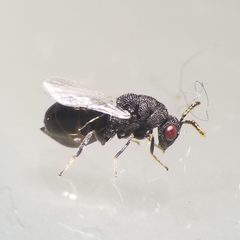
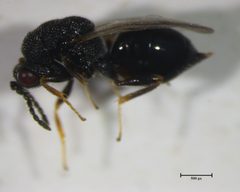
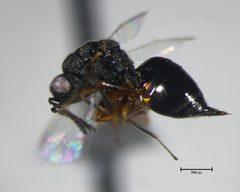
5Eurytoma is a large of chalcid wasps in the Eurytomidae, containing at least 620 described . Members are primarily , attacking a diverse range of including gall-forming insects and seeds of fruit crops. The genus is currently recognized as polyphyletic based on morphological and phylogenomic studies, indicating that extensive taxonomic revision is required. Species occupy varied from agricultural orchards to natural gall systems on wild plants.
Pronunciation
How to pronounce Eurytoma: /ˈjurɪˌtoʊmə/
These audio files are automatically generated. While they are not always 100% accurate, they are a good starting point.
Images
Habitat
are diverse and -dependent, ranging from plum orchards where larvae develop inside fruit stones, to galls formed by tephritid flies on Cirsium and other plant . Specific habitat requirements vary by and are determined by host availability rather than fixed environmental conditions.
Distribution
Records from multiple continents including North America (Alabama, British Columbia), Europe (Czech Republic, Moldova, Romania, Turkey, Greece, Bulgaria, Russia), and Asia (India: Andhra Pradesh, Assam, Bihar). Distribution is global but patchy, reflecting collection effort and plant distribution rather than continuous range.
Host Associations
- Urophora cardui - primary (for E. serratulae and E. robusta)tephritid gall-former on Cirsium
- Prunus domestica - plantplum; larval development in seeds
- Prunus domestica insititia - plantmirabelle plum
- Prunus domestica syriaca - plantmyrobalan
- Prunus cerasifera - plant
- Prunus armeniaca - plantapricot
- Prunus spinosa - plantblackthorn, less preferred
- Eurytoma serratulae - (hyperparasitized)by E. robusta
- Syntomaspis eurytomae - Torymidae, of E. schreineri with 1.6-3.4% rate
Life Cycle
varies by . Eurytoma schreineri is : larvae overwinter in seeds, pupate when temperatures exceed 10°C, and emerge at 15.6°C; adults live 6-8 days (maximum 15-18 days). Larval development for this species completes during summer followed by . Other species likely follow similar patterns tied to , but specific details are not established for the as a whole.
Behavior
are -specific and tied to exploitation strategy. Some species detect host larvae before visible gall formation; others oviposit only after distinct gall chambers have formed. Eurytoma robusta hyperparasitizes congeneric species within shared galls. of some species are attracted to yellow visual traps. Adults of E. schreineri bore exit holes (1.0-1.8 mm diameter) in stone walls using .
Ecological Role
Primarily of other insects, with roles ranging from primary parasitoid of gall-formers to seed . Some act as hyperparasitoids. Coexisting species may exhibit complementary exploitation strategies that facilitate coexistence through -dependent dominance shifts. Some species are significant agricultural pests causing up to 90% yield loss in fruit crops.
Human Relevance
Eurytoma schreineri is an agricultural pest of plum orchards causing premature fruit drop and severe yield losses; is 1.2 larvae per tree in spring. Management relies on yellow sticky traps for monitoring and spinosad applications. The is taxonomically problematic due to polyphyly, complicating identification and pest management efforts.
Similar Taxa
- CynipidaeBoth contain gall-associated ; Eurytoma larvae have been mistaken for cynipid larvae in galls, but differ in being rather than gall-formers and belong to Chalcidoidea rather than Cynipoidea
- TorymidaeRelated chalcid with similar ; Syntomaspis eurytomae (Torymidae) parasitizes Eurytoma schreineri, indicating close ecological and taxonomic relationship
Sources and further reading
- BugGuide
- Wikipedia
- GBIF taxonomy match
- iNaturalist taxon
- NCBI Taxonomy
- Catalogue of Life
- ID Challenge #3 | Beetles In The Bush
- Figure 5 from: Zwölfer H, Böheim M, Beck E (2015) Eurytoma serratulae and E. robusta (Hymenoptera, Eurytomidae): complementary host exploitation strategies of coexisting parasitoids and their impact on the host Urophora cardui. Journal of Hymenoptera Research 42: 47-62. https://doi.org/10.3897/JHR.42.8847
- A New Invasive Pest in Plums: Monitoring and Control of Eurytoma schreineri.