
Eurytoma obtusiventris
Gahan, 1934
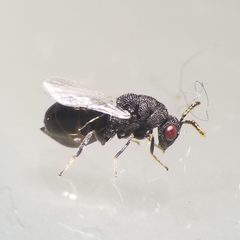
Eurytoma obtusiventris is a chalcid in the Eurytomidae, first described by Gahan in 1934. It is a of Eurosta solidaginis, the goldenrod gall fly. The wasp exhibits a distinctive in which it manipulates development to create a pupal chamber for its own use.
Pronunciation
How to pronounce Eurytoma obtusiventris: /ˈjuːrɪˌtəʊmə əbˌtjuːsɪˈvɛntrɪs/
These audio files are automatically generated. While they are not always 100% accurate, they are a good starting point.
Identification
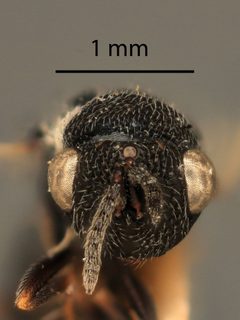
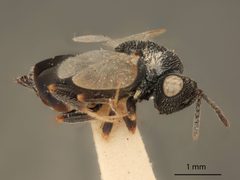
As a member of Eurytomidae, E. obtusiventris is a small , likely under 5 mm in length. Specific diagnostic features distinguishing it from are not documented in available sources. Identification to level requires examination and is not supported by the provided context.
Images
Habitat
Associated with goldenrod (Solidago) stands, the plant of its prey. The 's is thus tied to open fields, meadows, and prairie edges where goldenrod grows.
Distribution
Recorded from California, Colorado, Indiana, Kansas, and Louisiana. The is described as occurring in North America generally, though precise range boundaries are undocumented.
Seasonality
emerge in summer. The consumes its in autumn and overwinters within the gall as a larva or pupa.
Diet
; feeds on Eurosta solidaginis larvae. The does not consume plant material.
Host Associations
- Eurosta solidaginis - . Attacks after oviposition but before gall formation. Manipulates host to create pupal chamber.
Life Cycle
The oviposits into young Eurosta solidaginis larvae within goldenrod stems before gall tissue hardens. After consuming the , the wasp larva induces the host larva to form a , which the wasp then occupies. Development completes through autumn; the wasp overwinters inside the gall and emerges the following summer.
Behavior
Eurytoma obtusiventris exhibits manipulation: after partially consuming its host, it prompts the living Eurosta solidaginis larva to construct a pupal chamber that the subsequently uses for its own . Oviposition timing is critical—the wasp must attack after the fly lays but before gall tissue forms.
Ecological Role
As a , it functions as a control agent for Eurosta solidaginis. Its manipulation represents a complex behavioral that may influence gall structure.
Similar Taxa
- Other Eurytoma speciesNumerous Eurytoma are associated with gall insects; identification requires detailed morphological examination not possible from general descriptions.
- Other Eurytomidae members share small size and lifestyles; association with Eurosta solidaginis is the primary distinguishing feature for E. obtusiventris.
More Details
Host manipulation mechanism
The specific physiological or behavioral mechanism by which E. obtusiventris induces formation in its still-living has been described as 'prompting' but remains poorly characterized in available sources.