
Eurosta solidaginis
(Fitch, 1855)
Goldenrod Gall Fly, Goldenrod Ball Gall Fly
Eurosta solidaginis is a tephritid fruit fly that induces spherical stem galls on goldenrod plants (Solidago spp.). The is notable for its freeze , surviving temperatures down to -80°C through the production of unique acetylated triacylglycerols that remain liquid at low temperatures. exhibit -race formation, with genetically differentiated populations associated with different Solidago host species showing assortative mating. The galls serve as nutrient-rich chambers and have been demonstrated to accumulate environmental contaminants at higher concentrations than surrounding plant tissues, making them useful as biological pollution detectors.
Pronunciation
How to pronounce Eurosta solidaginis: /jʊˈɹoʊstə sɒlɪˈdædʒɪnɪs/
These audio files are automatically generated. While they are not always 100% accurate, they are a good starting point.
Identification
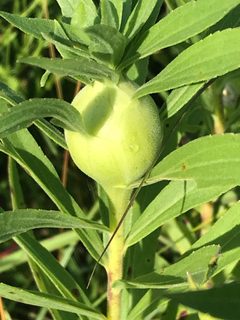
Spherical (ball-shaped) galls on goldenrod stems distinguish this from the elongate galls formed by Gnorimoschema gallaesolidaginis (goldenrod gall moth) on the same plants. The gall shape is diagnostic: Eurosta solidaginis produces nearly round galls while other goldenrod gall-formers create distinctly different gall morphologies.
Images
Habitat
Associated with goldenrod (Solidago) plants in meadows, fields, and open areas where plants grow; specifically requires living goldenrod stems for gall formation
Distribution
North America; recorded from Vermont and throughout the United States; distribution closely follows that of Solidago
Seasonality
emerge in spring; larvae develop through summer forming galls; overwinter as larvae inside galls
Host Associations
- Solidago altissima - primary Tall goldenrod; most studied ; significant variation in host suitability among
- Solidago - Multiple Solidago used; -race formation documented between on different species
Life Cycle
emerge in spring. Males perch on goldenrod and emit volatiles to attract females. After mating, females oviposit into buds of goldenrod plants. Larvae induce spherical stem galls and develop within. Larvae overwinter inside galls, surviving freezing temperatures. occurs within the gall, with adults emerging the following spring.
Behavior
Males produce volatile emissions to attract females from perches on goldenrod plants. Females exhibit choice, discriminating among naturally occurring of Solidago altissima and selecting more susceptible genotypes. associated with different host plant show assortative mating, contributing to host-race formation.
Ecological Role
Gall-forming herbivore that manipulates plant development to create nutrient-rich protective tissues. Non-outbreaking are regulated by -dependent mortality, particularly early larval death mediated by host plant defensive responses. Galls accumulate soil contaminants at concentrations thousands of times higher than other plant tissues, creating potential for use as phytoscreening tools for pollution detection.
Human Relevance
Research subject for studies of freeze , , and - . Galls used as biological indicators for detecting soil contaminants including 1,4-dioxane, hexavalent chromium, and volatile organic compounds; gall tissue shows higher sensitivity to pollutants than conventional groundwater testing in some cases.
Similar Taxa
- Gnorimoschema gallaesolidaginisAlso forms galls on goldenrod, but produces elongate (spindle-shaped) galls rather than the spherical galls of Eurosta solidaginis
- Hemadas nubilipennisForms peanut-shaped stem galls on blueberry; different plant and gall
- Daktulosphaira vitifoliaeForms galls on grape; used in similar phytoscreening research but on different plant
More Details
Freeze Tolerance Mechanism
Produces acetylated triacylglycerols, a rare fat found elsewhere only in trace amounts in Japanese deer antlers and cow udders. These fats remain liquid at much lower temperatures than standard triacylglycerols, enabling metabolic activity during freezing. Production increases after freeze-thaw cycles.
Host Plant Resistance
Some Solidago altissima exhibit hypersensitive response to larval presence, causing necrotic tissue formation that kills 73% of larvae in . Susceptible clones grow faster at oviposition time.
Population Regulation
-dependent mortality maintains stable, non-outbreaking . When experimental populations were reduced, mortality decreased proportionally, demonstrating compensatory regulation primarily through early larval mortality.
Sources and further reading
- BugGuide
- GBIF taxonomy match
- iNaturalist taxon
- NCBI Taxonomy
- Catalogue of Life
- Unforeseen Trophic Interactions in Ag Systems: What-Eats-What in the Food Chain | Bug Squad
- How Some Insects Turn Plants Into Pollution Detectors
- Rare Form of Fat Allows Flies to Survive at -80° Celsius
- goldenrod gall - Entomology Today
- acetylated triacylglycerols Archives - Entomology Today
- Eurosta solidaginis Archives - Entomology Today
- Behavioral Evidence for Host-Race Formation in Eurosta solidaginis
- Host Genotype Choice by the Ball Gallmaker Eurosta Solidaginis (Diptera: Tephritidae)
- BEHAVIORAL EVIDENCE FOR HOST‐RACE FORMATION IN EUROSTA SOLIDAGINIS
- Geographic and Host Species Effects in Eurosta solidaginis (Diptera: Tephritidae) Mortality
- DIVERGENCE OF EUROSTA SOLIDAGINIS IN RESPONSE TO HOST PLANT VARIATION AND NATURAL ENEMIES
- GENETICS, EXPERIENCE, AND HOST-PLANT PREFERENCE IN EUROSTA SOLIDAGINIS: IMPLICATIONS FOR HOST SHIFTS AND SPECIATION
- Genetic Differentiation Among Host-Associated Populations of the Gallmaker Eurosta solidaginis (Diptera: Tephritidae)
- The Nature of Population Stability in Eurosta Solidaginis, A Nonoutbreaking Herbivore of Goldenrod
- Mitochondrial DNA Phylogeography of Host Races of the Goldenrod Ball Gallmaker, Eurosta solidaginis (Diptera: Tephritidae)
- Cryobiology of the freeze-tolerant gall fly Eurosta solidaginis: overwintering energetics and heat shock proteins
- Hybridization Studies on the Host Races of Eurosta solidaginis: Implications for Sympatric Speciation
- GENETICS, EXPERIENCE, AND HOST-PLANT PREFERENCE IN EUROSTA SOLIDAGINIS: IMPLICATIONS FOR HOST SHIFTS AND SPECIATION