
Hemadas nubilipennis
(Ashmead, 1887)
Blueberry Stem Gall Wasp
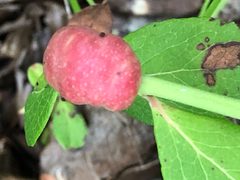
Hemadas nubilipennis is a tiny chalcid in the Ormyridae that induces distinctive kidney-shaped (), multichambered stem galls on lowbush blueberry (Vaccinium angustifolium). The female oviposits into shoot tissue 5–15 mm below the apex, then destroys the shoot tip by stinging it with her ovipositor. This structural damage terminates shoot growth and redirects nutrients to gall tissue and larval development—a rare example of through deliberate tissue damage. The wasp has been studied for its economic impact on blueberry production and, more recently, for the galls' ability to accumulate environmental contaminants, making them useful as pollution detectors.
Identification
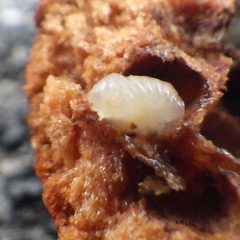
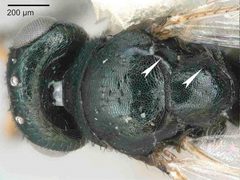
Distinguished from other gall-inducing insects by the characteristic (kidney-shaped), multichambered galls produced on lowbush blueberry shoots. The galls are terminally positioned on vegetative shoots and contain thick layers of parenchymatous surrounding larval chambers, with sclerenchymatous cell layers circumscribing each chamber. The galls increase shoot diameter while reducing shoot length and leaf production. The itself is minute and difficult to identify without microscopic examination; gall and association are primary field identification cues.
Images
Habitat
Lowbush blueberry (Vaccinium angustifolium) stands, specifically on adventitious vegetative shoots of the plant. Occurs in commercial and wild blueberry fields.
Distribution
Canada: recorded from New Brunswick, Newfoundland, Nova Scotia, and Ontario. reports from Nova Scotia indicate increasing abundance during the 1990s.
Host Associations
- Vaccinium angustifolium Aiton - obligate lowbush blueberry; induces stem galls on adventitious vegetative shoots
Life Cycle
Female oviposits into shoot tissue 5–15 mm below the shoot apex. Following oviposition, the female destroys the shoot apex by repeated stinging with her ovipositor, terminating shoot growth. Gall proliferation begins before eggs hatch; by the time larvae begin feeding, they are surrounded by thick layers of parenchymatous cells. Nutritive cells differentiate from gall parenchyma, and mature galls develop sclerenchymatous cell layers circumscribing each larval chamber. Gall growth supersedes normal shoot development.
Behavior
Females perform deliberate structural damage to plant tissue by stinging the shoot apex with their ovipositor after laying . This is a causal factor in gall induction and represents a rare case of through host tissue damage. The resulting gall formation produces a pruning effect on the host plant.
Ecological Role
Gall inducer on lowbush blueberry. Serves as for multiple including Torymus sp., Eurytoma sp., and Pteromalus sp. The pruning effect of gall formation may influence host plant growth and productivity. Galls accumulate nutrients and environmental contaminants from host plant vascular flow at concentrations thousands of times higher than other plant tissues, making them useful as phytoscreening tools for pollution detection.
Human Relevance
Economic pest of lowbush blueberry production; gall formation reduces shoot length, leaf number, leaf area, and berry production, with potential for significant crop loss. Recently recognized for environmental monitoring applications: galls accumulate toxic soil contaminants including heavy metals, 1,4-dioxane, and hexavalent chromium at higher concentrations than other plant tissues, making them sensitive pollution detectors for phytoscreening programs.
Similar Taxa
- Cynipid gall waspsAlso induce plant galls, but H. nubilipennis is distinguished by being a chalcid (Ormyridae) rather than a cynipid; gall anatomy and specificity differ despite some convergent developmental similarities
- Other Ormyridae members share general , but H. nubilipennis is specifically associated with lowbush blueberry galls; other ormyrids typically parasitize cynipid galls rather than inducing their own
More Details
Family placement note
Hemadas nubilipennis has been placed in both Pteromalidae and Ormyridae in different sources. GBIF and NCBI currently recognize Ormyridae as the accepted , though some literature (particularly older Canadian sources) lists it as Pteromalidae. Ormyridae is now widely accepted as correct.
Pollution detection applications
Research at Wayne State University has demonstrated that H. nubilipennis galls on blueberry can accumulate 1,4-dioxane and other contaminants at concentrations detectable when traditional groundwater testing shows negative results, suggesting superior sensitivity for environmental monitoring.
Sources and further reading
- BugGuide
- GBIF taxonomy match
- iNaturalist taxon
- NCBI Taxonomy
- Bembicid Holdings | Entomology Research Museum
- Encyrtid Holdings | Entomology Research Museum
- How Some Insects Turn Plants Into Pollution Detectors
- Hemadas nubilipennis Archives - Entomology Today
- Advocacy in Action: A Symposium for Everyone Interested in Science Advocacy and Invasive Species
- Role of Parasitoids Associated with Galls Induced by Hemadas nubilipennis (Hymenoptera: Pteromalidae) on Lowbush Blueberry
- The impact of stem galls induced by Hemadas nubilipennis Ashmead on shoot characteristics of lowbush blueberry
- STRUCTURAL DAMAGE BY FEMALEHEMADAS NUBILIPENNIS(HYMENOPTERA: PTEROMALIDAE) AS A FACTOR IN GALL INDUCTION ON LOWBUSH BLUEBERRY
- Initiation and development of the stem gall induced by Hemadas nubilipennis (Hymenoptera: Pteromalidae) on lowbush blueberry, Vaccinium angustifolium (Ericaceae)