
Hemadas
Crawford, 1909
Species Guides
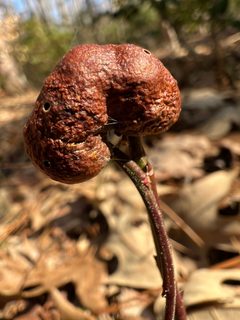
1- Hemadas nubilipennis(Blueberry Stem Gall Wasp)
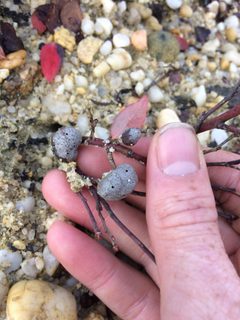
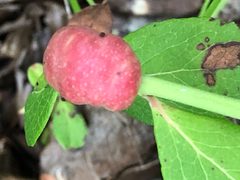
Hemadas is a of small chalcidoid wasps in the Ormyridae, established by Crawford in 1909. The genus contains gall-inducing , most notably Hemadas nubilipennis, which forms distinctive kidney-shaped (), multichambered stem galls on lowbush blueberry (Vaccinium angustifolium). These exhibit a rare behavioral trait: females damage plant tissues after oviposition to benefit offspring. Research has demonstrated that galls induced by Hemadas species accumulate environmental contaminants at concentrations significantly higher than surrounding plant tissues, suggesting potential applications in environmental monitoring.
Pronunciation
How to pronounce Hemadas: //ˈhɛ.mə.dæs//
These audio files are automatically generated. While they are not always 100% accurate, they are a good starting point.
Identification
Hemadas are small chalcidoid wasps. The is distinguished from related ormyrid genera by gall and associations. Hemadas nubilipennis induces (kidney-shaped), multichambered galls at shoot tips of lowbush blueberry, with thick layers of parenchymatous surrounding larval chambers and sclerenchymatous cell layers circumscribing each chamber. The galls terminate shoot growth and are often peanut-shaped on blueberry stems.
Images
Habitat
Associated with lowbush blueberry (Vaccinium angustifolium) in blueberry fields and natural stands. Galls form on adventitious vegetative shoots. Recorded from Vermont and other parts of the United States, with substantial research conducted in Nova Scotia, Canada.
Distribution
United States (Vermont, southeastern Michigan); Canada (Nova Scotia). GBIF records indicate distribution in the US, though specific range boundaries are not well documented in available sources.
Seasonality
Gall formation occurs during vegetative growth of plants. In Nova Scotia studies, galls were observed and measured during June vegetative growth and through the reproductive season (bloom and post-harvest).
Host Associations
- Vaccinium angustifolium - gall inducerlowbush blueberry; induces multichambered stem galls on adventitious shoots
Life Cycle
Females oviposit into shoot tissue 5–15 mm below the apex. After -laying, the female punctures and destroys the shoot apex with her ovipositor, terminating shoot growth. Eggs hatch into larvae that develop within gall tissue surrounded by nutritive differentiated from gall parenchyma. Gall cell proliferation begins before eggs hatch. Mature galls contain sclerenchymatous cell layers circumscribing each larval chamber.
Behavior
Females exhibit a rare of damaging plant tissues for offspring benefit: after oviposition, they stab the shoot apex with the ovipositor to terminate growth, diverting nutrient flow to gall tissue and larvae. This structural damage facilitates gall formation and produces a pruning effect on the host plant. Gall induction mechanisms share some similarities with distantly related cynipid .
Ecological Role
Gall inducer that alters plant and resource allocation. Galled shoots show reduced leaf and stem dry weights and decreased berry production compared to non-galled shoots. The galling interaction creates for associated . Galls accumulate soil contaminants at concentrations thousands of times higher than other plant tissues, potentially serving as phytoscreening tools for environmental monitoring.
Human Relevance
Economic pest of lowbush blueberry: gall increased in Nova Scotia during the 1990s, with potential for significant crop loss. Galls reduce berry production on affected shoots. Research demonstrates that Hemadas-induced galls accumulate toxic contaminants (heavy metals, 1,4-dioxane, hexavalent chromium, volatile organic compounds) at higher concentrations than other plant tissues, suggesting applications in pollution detection and environmental monitoring.
Similar Taxa
- Eurosta solidaginisBoth are gall-inducing insects on plant stems, but Eurosta is a tephritid fly inducing spherical galls on goldenrod rather than galls on blueberry.
- Gnorimoschema gallaesolidaginisBoth induce stem galls, but this gelechiid forms elongate galls on goldenrod, distinct from Hemadas in plant and gall .
- Daktulosphaira vitifoliaeBoth are gall-inducing insects used in phytoscreening research, but grape phylloxera is an -like hemipteran inducing galls on grape leaves and roots, not blueberry stems.
More Details
Taxonomic placement
Hemadas has been placed in both Pteromalidae and Ormyridae in different sources. Catalogue of Life and NCBI classify it in Ormyridae ( Hemadinae), while some older literature references it as Pteromalidae. The is the type genus of subfamily Hemadinae within Ormyridae.
Research significance
Hemadas nubilipennis was instrumental in pioneering research on galls as pollution detectors. A nearly 30-year-old study on blueberry stem galls inspired current research demonstrating that insect-induced galls accumulate contaminants at concentrations 85% higher than other plant tissues, regardless of plant , tissue type, or gall-inducing insect species.
Sources and further reading
- BugGuide
- GBIF taxonomy match
- iNaturalist taxon
- NCBI Taxonomy
- Catalogue of Life
- Hemadas nubilipennis Archives - Entomology Today
- How Some Insects Turn Plants Into Pollution Detectors
- Role of Parasitoids Associated with Galls Induced by Hemadas nubilipennis (Hymenoptera: Pteromalidae) on Lowbush Blueberry
- The impact of stem galls induced by Hemadas nubilipennis Ashmead on shoot characteristics of lowbush blueberry
- STRUCTURAL DAMAGE BY FEMALEHEMADAS NUBILIPENNIS(HYMENOPTERA: PTEROMALIDAE) AS A FACTOR IN GALL INDUCTION ON LOWBUSH BLUEBERRY
- Initiation and development of the stem gall induced by Hemadas nubilipennis (Hymenoptera: Pteromalidae) on lowbush blueberry, Vaccinium angustifolium (Ericaceae)