
Ormyridae
Förster, 1856
Genus Guides
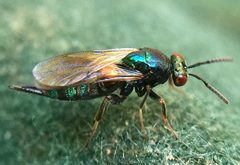
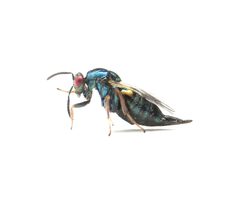
2is a small of parasitic in the superfamily Chalcidoidea. Members are or hyperparasitoids of gall-forming insects, primarily cynipid wasps and tephritid flies. The family comprises approximately 153 across three (Asparagobiinae, Hemadinae, Ormyrinae) and several , with the majority in the genus Ormyrus. Ormyridae has a distribution but is almost entirely absent from South America. of many species exhibit iridescent coloration and distinctive metasomal sculpturing.
Pronunciation
How to pronounce Ormyridae: /ɔːrˈmɪrɪˌdiː/
These audio files are automatically generated. While they are not always 100% accurate, they are a good starting point.
Identification
Scalloped sculpturing of metasomal tergites provides a diagnostic feature for some . Identification to species level often requires examination of terminal-instar larval or molecular analysis, as cryptic exist (e.g., the Ormyrus labotus complex comprises 16–18 morphologically identical but genetically distinct species).
Images
Habitat
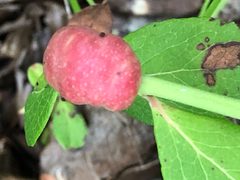
Associated with supporting gall-forming insects. Collections have been made from cloud forests, oak-dominated , and areas with hackberry (Celtis bungeana) and fig (Ficus microcarpa) trees. Specific habitat requirements vary with gall availability.
Distribution
distribution worldwide, with confirmed records from North America, Europe, Asia (China, Iran, Turkey, Central Asia), Africa (Cameroon), and Panama. Notable absence from South America, though recent collections from Panama extend the known neotropical range. Records from Denmark, Norway, and Sweden in GBIF.
Seasonality
Activity patterns correspond to gall . have been documented in some (e.g., Ormyrus coccotori). Seasonal varies by host gall type and geographic location.
Host Associations
- Cynipidae (gall wasps) - primary Primary group; parasitize gall inducers and
- Tephritidae (fruit flies) - Secondary group
- Curculionidae (weevils) - larval ectoparasitoidFirst record for : Ormyrus coccotori parasitizes Coccotorus chaoi on Celtis bungeana
- Eurytomidae - /hyperparasitoidAssociated with galls on Ephedra nebrodensis
- Epichrysomallidae - likely Ormyrus microcarpae likely of Meselatus bicolor in figs
- AgaonidaeCo-occur in fig microhabitat
Life Cycle
Larval development occurs within or on insects in galls. cycles documented in some . Terminal-instar larvae have been systematically described for west European species. Developmental timing synchronized with host gall .
Behavior
Females locate and oviposit into galls containing suitable larvae. Some previously considered (e.g., Ormyrus labotus with >65 recorded host galls) have been shown to comprise complexes of cryptic , each attacking 1–6 host gall types. Hyperparasitoid occurs in some species. Ormyrus nkoloensis may function as in addition to role.
Ecological Role
Regulate of gall-forming insects through . Contribute to gall structure and complexity. Potential agents for gall-forming pests (e.g., Ormyrus coccotori for Coccotorus chaoi weevil). Presence in diverse gall systems suggests importance in maintaining stability.
Human Relevance
Potential for of gall-forming agricultural and forest pests. The discovery of cryptic within supposed has implications for biocontrol selection—matching specific species to target pests requires genetic or detailed ecological characterization. Taxonomic revisions ongoing (2024) with description of new and .
Similar Taxa
- EurytomidaeAlso Chalcidoidea associated with galls; distinguished by different larval and sculpturing patterns
- PteromalidaeCo-occur in fig and gall ; distinguished by metasomal sculpturing and larval characteristics
- TorymidaeSimilar size and gall-associated lifestyle; differ in structure and ovipositor
Misconceptions
Ormyrus labotus was long considered a exploiting over 65 gall types. Molecular, morphological, and ecological data revealed it comprises 16–18 cryptic , each restricted to 1–6 host galls. This illustrates the broader problem of assuming generalist based on morphological species concepts alone.
More Details
Taxonomic revision 2024
revised in 2024 with establishment of three : Asparagobiinae, Hemadinae, and Ormyrinae. New described include Asparagobius, Halleriaphagus, Eubeckerella, Ouma, and Gallastichus (the latter in Eulophidae but associated with Ormyrus ). Ormyrus remains the largest genus with over 140 species.
Cryptic diversity
Cryptic have been identified within at least two other named Ormyrus besides O. labotus, suggesting hidden diversity is widespread in the . Genetic analysis combined with and is essential for accurate species delimitation.
Sources and further reading
- BugGuide
- Wikipedia
- GBIF taxonomy match
- iNaturalist taxon
- NCBI Taxonomy
- Catalogue of Life
- The Best of 2022 on Entomology Today
- Hidden Diversity: When One Wasp Species is Actually 16
- The species of Ormyrus Westwood (Hymenoptera: Ormyridae) in Iran with description of an unusual new species
- A new species of Ormyridae (Hymenoptera: Chalcidoidea) parasitizing a gall-making weevil on twigs of the bunge hackberry tree in China
- Ormyrus labotus Walker (Hymenoptera: Ormyridae): another generalist that should not be a generalist is not a generalist
- A new species of Ormyrus Westwood (Hymenoptera, Ormyridae) developing in figs of Ficus microcarpa in Europe
- Terminal-instar larval systematics and biology of west European species of Ormyridae associated with insect galls (Hymenoptera, Chalcidoidea)
- Ormyridae (Hymenoptera, Chalcidoidea) de Panamáasociados Con Agallas de Cinípidos (Hymenoptera, Cynipidae) Sobre Especies de Quercus (Fagaceae)
- A new Afrotropical genus and species of Tetrastichinae (Hymenoptera: Eulophidae) inducing galls on Bikinia (Fabaceae: Caesalpinioideae) and a new species of Ormyrus (Hymenoptera: Ormyridae) associated with the gall
- Ormyrus labotus (Hymenoptera: Ormyridae): Another Generalist That Should not be a Generalist is not a Generalist
- Two new species of Ormyrus Westwood (Hymenoptera: Ormyridae) from Cynipidae (Hymenoptera) galls on Silphium L. (Asteraceae: Heliantheae)
- Figure 6 from: Gómez JF, Nieves MH, Gayubo SF, Nieves-Aldrey JL (2017) Terminal-instar larval systematics and biology of west European species of Ormyridae associated with insect galls (Hymenoptera, Chalcidoidea). ZooKeys 644: 51-88. https://doi.org/10.3897/zookeys.644.10035
- Figure 5 from: Gómez JF, Nieves MH, Gayubo SF, Nieves-Aldrey JL (2017) Terminal-instar larval systematics and biology of west European species of Ormyridae associated with insect galls (Hymenoptera, Chalcidoidea). ZooKeys 644: 51-88. https://doi.org/10.3897/zookeys.644.10035
- Figure 3 from: Gómez JF, Nieves MH, Gayubo SF, Nieves-Aldrey JL (2017) Terminal-instar larval systematics and biology of west European species of Ormyridae associated with insect galls (Hymenoptera, Chalcidoidea). ZooKeys 644: 51-88. https://doi.org/10.3897/zookeys.644.10035
- Figure 10 from: Gómez JF, Nieves MH, Gayubo SF, Nieves-Aldrey JL (2017) Terminal-instar larval systematics and biology of west European species of Ormyridae associated with insect galls (Hymenoptera, Chalcidoidea). ZooKeys 644: 51-88. https://doi.org/10.3897/zookeys.644.10035
- Figure 4 from: Gómez JF, Nieves MH, Gayubo SF, Nieves-Aldrey JL (2017) Terminal-instar larval systematics and biology of west European species of Ormyridae associated with insect galls (Hymenoptera, Chalcidoidea). ZooKeys 644: 51-88. https://doi.org/10.3897/zookeys.644.10035
- Supplementary material 1 from: Gómez JF, Nieves MH, Gayubo SF, Nieves-Aldrey JL (2017) Terminal-instar larval systematics and biology of west European species of Ormyridae associated with insect galls (Hymenoptera, Chalcidoidea). ZooKeys 644: 51-88. https://doi.org/10.3897/zookeys.644.10035