
Eurosta
Loew, 1873
goldenrod gall flies
Species Guides
4- Eurosta comma
- Eurosta cribrata
- Eurosta fenestrata
- Eurosta solidaginis(Goldenrod Gall Fly)
Eurosta is a of seven North American gall-forming flies in the Tephritidae. All induce galls on goldenrod (Solidago) stems. The best-studied species, Eurosta solidaginis, creates spherical stem galls and has served as a model organism for research on freeze , -race formation, and plant-insect . Research has demonstrated that Eurosta galls accumulate environmental contaminants at higher concentrations than surrounding plant tissues, suggesting potential use as pollution biosensors.
Pronunciation
How to pronounce Eurosta: /juːˈrɒstə/
These audio files are automatically generated. While they are not always 100% accurate, they are a good starting point.
Identification
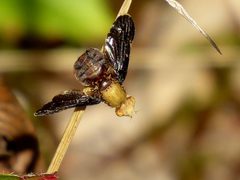
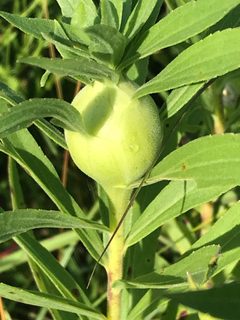
Spherical or ball-shaped galls on goldenrod stems distinguish Eurosta from other goldenrod gall-formers such as Gnorimoschema gallaesolidaginis (goldenrod gall moth), which produces elongate galls, and Asteromyia carbonifera, which produces rosette or bunch galls. flies are small with patterned wings typical of Tephritidae; -level identification requires examination of wing patterns and genitalia.
Images
Habitat
Stands of goldenrod (Solidago), particularly Solidago altissima and related . Galls form on stems of plants in meadows, fields, roadsides, and other open where goldenrod grows.
Distribution
North America; seven distributed across the continent. Specific range details for most species are poorly documented.
Seasonality
emerge in spring. Larvae induce galls during summer growing season and overwinter inside galls.
Diet
Larvae feed on nutritive tissue within the gall induced on goldenrod stems. do not feed.
Host Associations
- Solidago altissima - primary tall goldenrod; most studied for E. solidaginis
- Solidago - all Eurosta gall goldenrod species
Life Cycle
Female oviposits into goldenrod bud. Larva induces spherical stem gall in which it develops. Larva overwinters in gall, surviving freezing temperatures. occurs in spring; emerges to mate and oviposit.
Behavior
Male E. solidaginis perch on goldenrod plants and produce volatile emissions to attract females. Females exhibit selective oviposition , discriminating among plant based on suitability cues. Some show host-race formation with assortative mating and reproductive isolation between populations on different host plants.
Ecological Role
Gall-former that creates structure within goldenrod stands. Galls may serve as microhabitats for other organisms. Research indicates galls accumulate soil contaminants at concentrations thousands of times higher than other plant tissues, potentially serving as phytoscreening tools for pollution detection.
Human Relevance
E. solidaginis is a model organism for studies of freeze , cryobiology, and - interactions. Research has demonstrated that galls accumulate toxic contaminants including 1,4-dioxane and hexavalent chromium, suggesting potential application in environmental monitoring and pollution detection. The ' unique acetylated triacylglycerol metabolism has attracted interest for biofuel development.
Similar Taxa
- Gnorimoschema gallaesolidaginisAlso forms galls on goldenrod, but produces elongate spindle-shaped galls rather than spherical galls
- Asteromyia carboniferaForms rosette or bunch galls on goldenrod leaves and stems, not spherical stem galls
- Rhopalomyia solidaginisForms elliptical or spindle-shaped galls on goldenrod stems, distinct from Eurosta's spherical galls
Sources and further reading
- BugGuide
- Wikipedia
- GBIF taxonomy match
- iNaturalist taxon
- NCBI Taxonomy
- Catalogue of Life
- Unforeseen Trophic Interactions in Ag Systems: What-Eats-What in the Food Chain | Bug Squad
- Eurosta-solidaginis - Entomology Today
- Eurosta solidaginis Archives - Entomology Today
- How Some Insects Turn Plants Into Pollution Detectors
- Rare Form of Fat Allows Flies to Survive at -80° Celsius
- goldenrod gall - Entomology Today
- Behavioral Evidence for Host-Race Formation in Eurosta solidaginis
- Host Genotype Choice by the Ball Gallmaker Eurosta Solidaginis (Diptera: Tephritidae)
- BEHAVIORAL EVIDENCE FOR HOST‐RACE FORMATION IN EUROSTA SOLIDAGINIS
- Geographic and Host Species Effects in Eurosta solidaginis (Diptera: Tephritidae) Mortality
- Growth and Survivorship Differences in Eurosta (Diptera : Tephritidae) Galling Sympatric Host Plants
- DIVERGENCE OF EUROSTA SOLIDAGINIS IN RESPONSE TO HOST PLANT VARIATION AND NATURAL ENEMIES
- GENETICS, EXPERIENCE, AND HOST-PLANT PREFERENCE IN EUROSTA SOLIDAGINIS: IMPLICATIONS FOR HOST SHIFTS AND SPECIATION
- Genetic Differentiation Among Host-Associated Populations of the Gallmaker Eurosta solidaginis (Diptera: Tephritidae)
- Cryobiology of the freeze-tolerant gall fly Eurosta solidaginis: overwintering energetics and heat shock proteins
- Mitochondrial DNA Phylogeography of Host Races of the Goldenrod Ball Gallmaker, Eurosta solidaginis (Diptera: Tephritidae)
- The Nature of Population Stability in Eurosta Solidaginis, A Nonoutbreaking Herbivore of Goldenrod
- Evolution of Host-Plant Manipulation by Gall Makers: Ecological and Genetic Factors in the Solidago-eurosta System
- Hybridization Studies on the Host Races of Eurosta solidaginis: Implications for Sympatric Speciation