
Rhopalomyia solidaginis
(Loew, 1862)
Goldenrod Bunch Gall Midge, goldenrod bunch gall
Rhopalomyia solidaginis is a gall midge (Cecidomyiidae) that induces distinctive bunch galls on goldenrod plants. It is , producing separate spring and summer gall with different morphologies. The is the second-largest Rhopalomyia on goldenrods and can be identified by male structure and female ovipositor length. It has been documented across eastern North America.
Pronunciation
How to pronounce Rhopalomyia solidaginis: /ˌroʊ.pə.loʊˈmaɪ.i.ə ˌsɒl.ɪˈdædʒ.ɪ.nɪs/
These audio files are automatically generated. While they are not always 100% accurate, they are a good starting point.
Identification
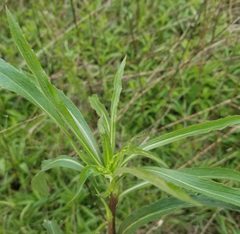
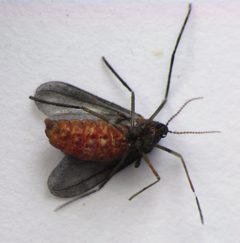
Males distinguished by large ; females by shortest ovipositor among goldenrod-associated Rhopalomyia. Spring smaller with reduced antennal flagellomeres compared to summer generation. Gall differs between generations: spring galls small and inconspicuous; summer galls form 3–5 cm rosette clusters of 2–5 subunits with white internal chambers.
Images
Habitat
Associated with goldenrod plants in open . Galls form on meristems of host shoots.
Distribution
Eastern North America. Documented from Vermont and other US states.
Seasonality
with distinct spring and summer . Spring galls appear early in growing season; summer galls appear mid-July.
Host Associations
- Solidago altissima - plantinduces bud galls
- Solidago canadensis - plantinduces bud galls
- Solidago rugosa - plantinduces bud galls
Life Cycle
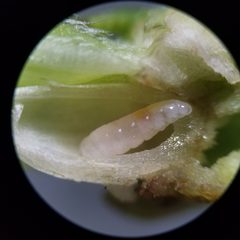
. Spring : small, difficult-to-locate bud galls, typically single-chambered with one larva, occasionally 2–3 chambers attached longitudinally. Summer generation: white chambers appear mid-July, each containing one larva facing downward, surrounded by short narrow leaves then longer wider leaves forming distinct subunits; 2–5 subunits clumped at shoot apex forming 3–5 cm rosette gall. Galled plants sometimes stunted.
Ecological Role
Gall formation modifies plant growth, sometimes causing stunting. Gall tissue may accumulate soil contaminants at higher concentrations than surrounding plant tissue, suggesting potential use in environmental monitoring.
Human Relevance
Research subject for gall and phytoscreening applications. Galls may serve as pollution detectors due to accumulation of soil contaminants.
Similar Taxa
- Eurosta solidaginisAlso a goldenrod gall inducer, but produces spherical stem galls rather than rosette bunch galls; different (Tephritidae)
- Other Rhopalomyia species on goldenrodsR. solidaginis is second-largest ; distinguished by male size and female ovipositor length
More Details
Pollution detection research
Insect-induced galls including those on goldenrod have been investigated for phytoscreening potential. Research by Glen Ray Hood at Wayne State University demonstrated that galls can accumulate toxic soil contaminants at higher concentrations than other plant tissues, with approximately 85% of showing elevated contaminant levels. This property may allow galls to serve as sensitive detectors for pollutants such as volatile organic compounds, 1,4-dioxane, and hexavalent chromium.