
Tychius
Germar, 1817
leguminous seed weevils
Species Guides
11- Tychius cuprifer
- Tychius liljebladi
- Tychius lineellus(leguminous seed weevil)
- Tychius meliloti(Sweet Clover Weevil)
- Tychius picirostris(Clover Seed Weevil)
- Tychius prolixus
- Tychius semisquamosus
- Tychius soltaui
- Tychius sordidus
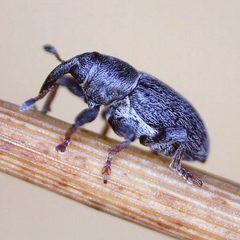
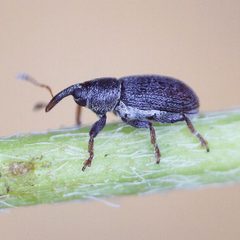
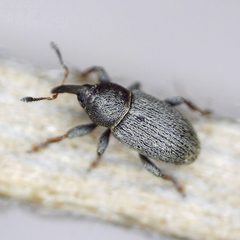
Tychius is a large of weevils (Curculionidae: Curculioninae: Tychiini) containing over 630 described . The genus is distributed across the Palearctic (approximately 240 species), Afrotropical (45 species, mainly South Africa), Nearctic, and Oriental regions. All species with documented are associated with legume plants in the Papilionoideae (Fabaceae), particularly tribes Genisteae, Loteae, Galegeae, Trifolieae, and Vicieae. Several species have been introduced from Europe to North America, where they feed on introduced and native legumes.
Pronunciation
How to pronounce Tychius: /ˈtɪkiəs/
These audio files are automatically generated. While they are not always 100% accurate, they are a good starting point.
Identification
are small weevils with the characteristic rostrum of Curculionidae. The has been divided into approximately 22 groups based on adult . stages show diagnostic features that support some groupings: larvae exhibit characters useful for phylogenetic reconstruction, though parallelisms and convergences weaken some relationships. The T. stephensi group (associated with Trifolieae) is supported by two distinctive larval character states; other groups are distinguishable by at least one unique larval character state. Species-level identification requires examination of rostrum, , tibia, genitalia, , and claw morphology.
Images
Habitat
Pasture and other environments where legumes grow. Specific habitat documented for T. amplicollis includes areas where Vicia macrocarpa occurs in Italy.
Distribution
Widespread across Palearctic, Afrotropical, Nearctic, and Oriental regions. Palearctic: approximately 240 . Afrotropical: 45 species, concentrated in South Africa. North America: native fauna plus introduced European species including T. picirostris (widespread), T. stephensi (widespread), T. cuprifer (Maryland only), and T. meliloti (scattered localities in Saskatchewan, Manitoba, Ontario, Quebec, Canada). China: 35 reported. Circum-Mediterranean region for species formerly placed in Apeltarius.
Diet
Herbivorous, feeding exclusively on Fabaceae (Papilionoideae). associations documented: Trifolium spp. (T. picirostris, T. stephensi, T. cuprifer), Melilotus spp. (T. meliloti), Teline monspessulana (T. cuprifer), Vicia macrocarpa (T. amplicollis), Astragalus onobrychis (T. subsulcatus), Astragalus spp., Oxytropis spp., Lotus spp. (native North American ).
Host Associations
- Fabaceae - primary Papilionoideae, tribes Genisteae, Loteae, Galegeae, Trifolieae, Vicieae
- Trifolium - T. picirostris, T. stephensi, T. cuprifer
- Melilotus - T. meliloti
- Teline monspessulana - T. cuprifer
- Vicia macrocarpa - T. amplicollis
- Astragalus onobrychis - T. subsulcatus
- Astragalus - multiple including native North American groups
- Oxytropis - T. liljebladi, T. tectus
- Lotus - semisquamosus group
Life Cycle
Mature larvae develop inside legume pods. Larvae exit pods and tunnel into soil or substrate (sand and peat moss documented) to form pupal . Development times and patterns vary according to single or double seasonal flowering of plants. Adults of some lack wings with (flightless). strategies vary with host plant .
Behavior
collected by beating plants. Larvae extracted from pods for laboratory rearing. Some adults flightless.
Ecological Role
Seed of legumes. May influence legume and seed . Several introduced to North America, where they have expanded geographic and ranges, sometimes at the expense of established congenerics.
Human Relevance
Several introduced to North America from Europe, likely unintentionally with agricultural materials. T. meliloti recorded as new to Canada in 1994. Some species may impact forage legume crops.
Similar Taxa
More Details
Taxonomic History
Formerly recognized subgenera and related have been synonymized based on integrative morphological, molecular, and biological data. Apeltarius was synonymized with Tychius in 2024 based on larval , COI , and matching with Fabaceae . Henonia and Miccotrogus were newly synonymized with Tychius; Lepidotychius was reduced to subgenus status. South American and Australian formerly assigned to Tychius were misidentified and belong to other tychiine genera or .
Phylogenetic Origins
Phylogenetic and plant relationships indicate Tychius arose in the Old World. North American fauna formed through several independent dispersals from Eurasia. T. sordidus and T. caesius are probable remnants of old Holarctic fauna associated with Arcto-Tertiary flora. T. lineellus likely dispersed via Beringia. T. liljebladi and T. tectus are more recently arrived, allied to Eurasian members of the semisquamosus group.
Morphological Study Value
stages provide phylogenetically informative characters, though larval characters are more useful than pupal characters. Larval supports some groups established on characters and suggests relationships among groups, though convergences limit resolution.
Sources and further reading
- BugGuide
- Wikipedia
- GBIF taxonomy match
- iNaturalist taxon
- NCBI Taxonomy
- Catalogue of Life
- TYCHIUS MELILOTI STEPHENS NEW TO CANADA WITH A BRIEF REVIEW OF THE SPECIES OF TYCHIUS GERMAR INTRODUCED INTO NORTH AMERICA (COLEOPTERA: CURCULIONIDAE)
- Morphological characters of the immature stages of Tychius (Apeltarius) amplicollis Aubé, 1850 (Coleoptera, Curculionidae, Curculioninae, Tychiini), supported by molecular and biological data, suggest that Apeltarius Desbrochers des Loges, 1873 is a new synonym of Tychius Germar, 1817
- The genus Tychius Germar (Coleoptera: Curculionidae: Curculioninae) in China, with description of three new species
- North American Tychius: New synonymy and observations on phylogeny and zoogeography (Coleoptera: Curculionidae)
- Review of genus-group taxa included in the genus Tychius Germar (Coleoptera: Curculionidae)
- The mature larva and pupa of Tychius subsulcatus Tournier, 1847 (Coleoptera, Curculionidae), with comments on its biology and phylogenetic relationships
- Immatures of Palaearctic species of the weevil genus Tychius (Coleoptera, Curculionidae): new descriptions and new bionomic data with an evaluation of their value in a phylogenetic reconstruction of the genus