
Delphastus catalinae
(Horn, 1895)
Whitefly Predatory Lady Beetle
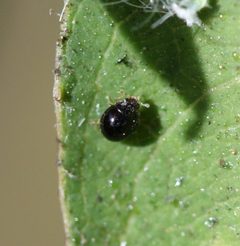
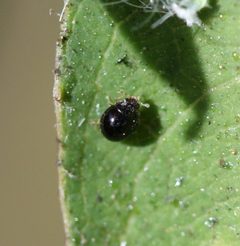
Delphastus catalinae is a minute predatory lady beetle (Coccinellidae) specialized in feeding on whiteflies (Aleyrodidae). measure 1.40–1.50 mm with a medium reddish-brown body and slightly darker pronotum. The name derives from Latin 'catalinae' meaning fierce, referring to its forbidding and mouthpart appearance. It is widely used as a agent against pest whiteflies including Bemisia argentifolii, Bemisia tabaci, and Aleurothrixus trachoides in agricultural systems. Mass rearing protocols have been developed using whitefly-infested poinsettia plants, with production costs estimated at $0.22 per adult .
Pronunciation
How to pronounce Delphastus catalinae: //dɛlˈfæs.təs ˌkætəˈlaɪni//
These audio files are automatically generated. While they are not always 100% accurate, they are a good starting point.
Identification
Distinguished from other coccinellids by its extremely small size (1.4–1.5 mm) and specialized association with whitefly prey. Among Delphastus , D. catalinae has been separated from D. pusillus based on taxonomic revision; D. pallidus is another congeneric whitefly found in Florida. The dark coloration of mature and whitefly-specific help distinguish it from larger, more generalized lady beetles. Microscopic examination may be required for definitive identification from similar minute coccinellids.
Images
Habitat
Agricultural and horticultural systems infested with whiteflies, including greenhouses, field crops, and ornamental plantings. Naturally occurs in supporting whitefly . Mass rearing conducted on poinsettia (Euphorbia pulcherrima) plants infested with Bemisia argentifolii in controlled greenhouse conditions.
Distribution
Native to western hemisphere with records from North America including California. Distributed in association with whitefly pests across agricultural regions. Mass reared in northern California for release in southern California. Present in Florida as a naturally occurring of whiteflies. GBIF records indicate presence in Azores and North America.
Seasonality
follow whitefly availability. In controlled greenhouse rearing, continuous production possible with 12-week plant cycles. Field activity corresponds to whitefly peaks in host crops.
Diet
Specialized of whiteflies (Hemiptera: Aleyrodidae). Preys on all life stages but prefers and nymphs. Documented prey includes Bemisia argentifolii (silverleaf whitefly), Bemisia tabaci (sweetpotato whitefly), Aleurothrixus trachoides (pepper/solanum whitefly), and Pealius kelloggi. Prey preference demonstrated for different whitefly and stages.
Host Associations
- Bemisia argentifolii - preysilverleaf whitefly, primary prey for mass rearing
- Bemisia tabaci - preysweetpotato whitefly
- Aleurothrixus trachoides - preypepper whitefly, solanum whitefly
- Pealius kelloggi - preydocumented feeding record
- Euphorbia pulcherrima - rearing plantpoinsettia, used for mass rearing on whitefly-infested plants
- Ficus benjamina - indirect association plant of whitefly prey in Florida landscapes
- Cucurbita pepo - indirect associationzucchini squash, crop where released for whitefly control
- Gossypium - indirect associationcotton, field evaluations conducted for whitefly suppression
Life Cycle
Complete with , larva, pupa, and stages. Eggs 0.2 mm long, clear, elongate. Larvae pale yellow and elongate. Development and affected by relative humidity, with oviposition, egg hatch, and survival responding to humidity levels. parameters established on collards infested with whiteflies. In mass rearing, poinsettia plants cycled through 12-week periods from rooted cuttings to disposal.
Behavior
Predatory influenced by plant and prey characteristics. Leaf tomentosity affects patterns and searching , with beetles showing preference for smooth prey phenotypes when foraging on hairy leaves. Experience-dependent prey selection observed. demonstrate behavioral responses to odors of Bemisia tabaci and virus-infected plants. Non-consumptive effects on whitefly use patterns documented. Slow and deliberate movement compared to faster-running coccinellids; not a strong flier.
Ecological Role
Specialized functioning as a agent for whitefly suppression in agricultural and horticultural . Contributes to natural biological control of whitefly pests including Bemisia argentifolii, Bemisia tabaci, and Aleurothrixus trachoides. Participates in intraguild interactions with such as Encarsia sophia and Baeoentodon balios. Compatible with fungus Cordyceps fumosorosea for integrated biocontrol.
Human Relevance
Widely used in programs for whitefly management in greenhouse and field crops. Mass rearing protocols established with production of 174,245 over 20 weeks at $0.22 per . Applied in cotton, squash, pepper, and ornamental systems. Effective in reducing whitefly when used alone or in combination with other biocontrol agents. Compatibility with and other natural enemies supports approaches.
Similar Taxa
- Delphastus pallidusCongeneric whitefly found in Florida; distinguished by coloration and geographic distribution
- Delphastus pusillusFormerly considered or closely related; separated by taxonomic revision, may require microscopic examination for distinction
- Nephaspis oculatusAnother minute coccinellid of Bemisia argentifolii; similar size and but different
- Serangium parcesetosumAnother whitefly-specific lady beetle used in biocontrol; larger and with different color pattern
More Details
Mass Rearing Economics
Computer simulation modeling indicated that harvesting approximately 50% of weekly ensures stable and maximum production; actual harvest rates of 40–60% achieved 174,245 adults over 20 weeks. Labor constitutes 86% of production costs.
Intraguild Interactions
Documented interactions with Encarsia sophia and fungus Cordyceps fumosorosea; generally compatible with other biocontrol agents though intraguild possible.
Humidity Sensitivity
and survival significantly affected by relative humidity, with implications for rearing and field establishment in different climates.
Sources and further reading
- BugGuide
- Wikipedia
- GBIF taxonomy match
- iNaturalist taxon
- NCBI Taxonomy
- Delphastus pallidus Archives - Entomology Today
- Don't Bet Your Hedges: IPM Guide Outlines Ficus Whitefly Management
- longhorned beetles | Beetles In The Bush | Page 10
- collecting whitefly natural enemies - Entomology Today
- REARING DELPHASTUS CATALINAE (COLEOPTERA: COCCINELLIDAE): PRACTICAL EXPERIENCE AND A MODELING ANALYSIS
- Whitefly Predatory Lady Beetle (suggested common name) Delphastus catalinae (Horn) (Insecta: Coleoptera: Coccinellidae)
- Life history and life table analysis of the whitefly predator Delphastus catalinae (Coleoptera: Coccinellidae) on collards
- Effects of plant and prey characteristics on the predatory behavior of Delphastus catalinae
- Intraguild interactions between an oligophagous predator, Delphastus catalinae (Coleoptera: Coccinellidae), and a parasitoid, Encarsia sophia (Hymenoptera: Aphelinidae), of Bemisia tabaci (Homoptera: Aleyrodidae)
- Searching and Feeding Behavior ofNephaspis oculatusandDelphastus catalinae(Coleoptera: Coccinellidae), Predators ofBemisia argentifolii(Homoptera: Aleyrodidae)
- Compatibility of the Predatory Beetle, Delphastus catalinae, with an Entomopathogenic Fungus, Cordyceps fumosorosea, for Biocontrol of Invasive Pepper Whitefly, Aleurothrixus trachoides, in Florida
- Non-consumptive effects of the predatory beetle Delphastus catalinae (Coleoptera: Coccinellidae) on habitat use patterns of adult whitefly Bemisia argentifolii (Hemiptera: Aleyrodidae)
- Preference of Bemisia tabaci biotype B on zucchini squash and buckwheat and the effect of Delphastus catalinae on whitefly populations
- Behavioral Responses of Delphastus catalinae to Odors of Bemisia tabaci and Tomato Yellow Leaf Curl Virus Disease Complexes: Implications for Biological Control in Vegetable Crops