
Aleurothrixus
Quaintance & Baker, 1914
woolly whiteflies
Species Guides
1- Aleurothrixus floccosus(woolly whitefly)
Aleurothrixus is a of whiteflies ( Aleyrodidae) containing approximately 20 described . The most economically significant species is A. floccosus (), a major pest of citrus and other crops across tropical and subtropical regions worldwide. Several species in the genus have been documented as agricultural pests, with extensive research focused on their using .
Pronunciation
How to pronounce Aleurothrixus: /ˌæl.jʊ.roʊˈθraɪ.kəs/
These audio files are automatically generated. While they are not always 100% accurate, they are a good starting point.
Identification
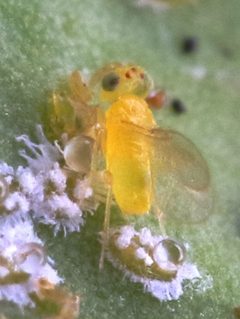
Members of Aleurothrixus can be distinguished from other whitefly by characteristics of the , including the presence of submarginal setae and an uninterrupted submarginal fold at the vasiform orifice. The genus is characterized by woolly, waxy secretions produced by nymphs, which gives the to the most notorious , A. floccosus.
Images
Habitat
in this are found in tropical and subtropical environments, primarily associated with the foliage of woody plants. They occupy the of plants, with nymphal typically highest on middle and lower canopy leaves while and concentrate on upper canopy foliage.
Distribution
The has a pantropical distribution. A. floccosus has been recorded across Europe (Mediterranean region), Africa, Asia, North America (Mexico, southern USA), Central America and Caribbean, South America, and Oceania. Other such as A. chivelensis have more restricted ranges (e.g., Mexico).
Seasonality
Where studied, A. floccosus exhibits year-round activity in suitable climates. In Greece, were captured from May through mid-December, with winter consisting primarily of third and fourth instar nymphs. In Chile's Atacama Desert, all life stages were present throughout the year.
Diet
Phloem-feeding herbivores. A. floccosus feeds on multiple plants including Citrus , coffee (Coffea spp.), mango (Mangifera indica), guava (Psidium guajava), banana (Musa paradisiaca), and aubergine (Solanum melongena). Host associations for other species in the are less documented.
Host Associations
- Citrus - primary Major for A. floccosus
- Coffea - Documented for A. floccosus
- Mangifera indica - Documented for A. floccosus
- Psidium guajava - Documented for A. floccosus
- Musa paradisiaca - Documented for A. floccosus
- Solanum melongena - Documented for A. floccosus
Life Cycle
Hemimetabolous development with , four nymphal instars, and stages. In A. floccosus, all developmental stages can be present simultaneously throughout the year in favorable climates. Puparial cases remain attached to leaves.
Behavior
Nymphs are and feed on phloem sap, producing conspicuous woolly wax secretions. are mobile and disperse to new plants. show stratified distribution within plant .
Ecological Role
Herbivores that can reach pest densities on cultivated plants. Serve as for diverse including in Aphelinidae (Cales noacki, Eretmocerus spp., Encarsia spp.) and Platygastridae (Amitus spiniferus). Hyperparasitoids such as Signiphora spp. also attack these parasitoids.
Human Relevance
Several are significant agricultural pests, particularly A. floccosus (), which causes direct damage to citrus, coffee, and other crops through sap feeding and honeydew secretion leading to growth. Extensive programs have been implemented using introduced , notably Cales noacki.
Similar Taxa
- BemisiaBoth are whitefly with pest ; Aleurothrixus distinguished by woolly wax secretions and puparial characters including submarginal setae and uninterrupted submarginal fold at vasiform orifice
- TrialeurodesBoth Aleyrodidae with agricultural pest ; Aleurothrixus produces more conspicuous woolly wax and has distinct puparial
Sources and further reading
- BugGuide
- Wikipedia
- GBIF taxonomy match
- iNaturalist taxon
- NCBI Taxonomy
- Catalogue of Life
- Aleurothrixus floccosus . [Distribution map].
- Aleurothrixus floccosus . [Distribution map].
- Aleurothrixus floccosus complex. [Distribution map].
- Life History, Seasonal Abundance, Host Range and Geographical Distribution of the Wooly Whitefly, Aleurothrixus floccosus (Maskell) (Homoptera:Aleyrodidae)
- Encounter with Encarsia cubensis, a new natural enemy of invasive woolly whitefly Aleurothrixus floccosus in India
- First Record of Aleurothrixus floccosus (Mask.) (Homoptera: Aleyrodidae) in Greece and Some Observations οn its Phenology
- Especies de Eretmocerus Haldemn (Hymenoptera: Aphelinidae) - parasitoides de Aleurothrixus floccosus (Maskell) (Homoptera: Aleyrodidae) de México, con la descripción de una nueva especie
- New data on the parasitization of Aleurothrixus floccosus (Maskell) (Hemiptera: Aleyrodidae) in Greece
- Fluctuación poblacional y parasitismo de Aleurothrixus floccosus (Hemiptera: Aleyrodidae) en cítricos del Desierto de Atacama, Chile
- Especies de Encarsia Förster (Hymenoptera: Aphelinidae) parasitoides de la mosquita blanca Aleurothrixus chivelensis (Sampson & Drews) (Hemiptera: Aleyrodidae) en Tamaulipas, México
- Distribution of Woolly Whitefly <i>Aleurothrixus floccosus</i> Maskell on Guava from Tamil Nadu
- BIOLOGICAL CONTROL OF CITRUS WOOLLY WHITE FLY ALEUROTHRIXUS FLOCCOSUS MASK (HOMOPTERA: ALEYRODIDAE) BY CALES NOACKI HOW (HYMENOPTERA: APHELINIDAE) IN SOME TANZANIAN SMALL-SCALE CITRUS ORCHARDS
- The Parasitoid Complex of Aleurothrixus floccosus (Hemiptera: Aleyrodidae) in the Citrus Groves of Central-Southern Italy.