
Delphastus pusillus
(LeConte, 1852)
Whitefly Destroyer
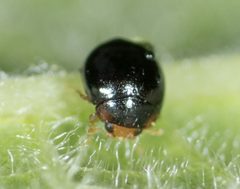
Delphastus pusillus is a minute coccinellid specialized as a of whiteflies. measure approximately 1.6 mm (1/16 in) and are shiny black with brown , though newly emerged individuals appear pale brown to nearly white. The is a voracious predator of all whitefly life stages, with demonstrated preference for and first-instar nymphs. It has been widely studied as a agent for agricultural whitefly pests including Bemisia tabaci and Trialeurodes vaporariorum. Both larvae and adults are active predators capable of consuming over 100 whitefly eggs daily under optimal conditions.
Pronunciation
How to pronounce Delphastus pusillus: //dɛlˈfæstəs pjuˈsɪləs//
These audio files are automatically generated. While they are not always 100% accurate, they are a good starting point.
Identification
Distinguished from other coccinellids by its extremely small size (1.6 mm), shiny black coloration with brown , and association with whitefly colonies. Newly emerged may be confused with other pale coccinellid but darken to characteristic black within days. Differs from Delphastus pallidus, a closely related species also used in , by geographic distribution and subtle morphological differences. Identification to species level typically requires examination of genitalia or expert confirmation.
Images
Appearance
are minute (approximately 1.6 mm), shiny black beetles with brown . Newly emerged adults are pale brown to almost white, gradually darkening to black. The are 0.2 mm long, clear, and twice as long as wide. Larvae are elongate and pale yellow. The exhibits typical coccinellid body plan with short and compact form.
Habitat
Agricultural and greenhouse environments where whitefly occur; associated with crops infested by Bemisia tabaci, Trialeurodes vaporariorum, and other whitefly . In natural settings, found on vegetation supporting whitefly colonies.
Distribution
North America (native range, including United States and Canada); widely distributed in tropical and subtropical regions in association with whitefly pests; established in Oceania. Specific records include Brazil (Pernambuco), Colombia, and Florida (United States).
Diet
Specialized of whiteflies (Aleyrodidae). Preys on all life stages including , nymphs, and , with demonstrated preference for eggs and first-instar nymphs. Documented prey include Bemisia tabaci (sweetpotato whitefly), Trialeurodes vaporariorum (greenhouse whitefly), and other whitefly species. Adult females consume approximately 160 whitefly eggs daily; larvae consume up to 1000 eggs during complete development.
Life Cycle
Complete with four stages: , larva (four instars), pupa, and . Egg stage averages 6.8 days at 25°C. Larval development includes four instars: first instar 3.6 days, second instar 2.1 days, third instar 2.7 days, fourth instar 6.8 days. Pupal stage averages 7.3 days. Total development from egg to adult approximately 15–17 days at 26°C, or 29 days at 25°C. Females live approximately 2 months, laying 3–4 eggs daily. Males live approximately 1.5 months. Eggs are laid in clusters within or near whitefly egg masses. occurs on lower leaves, in leaf litter, or other protected locations, often in groups.
Behavior
Strong fliers that migrate to areas with high whitefly densities. Exhibits Type II to whitefly nymph prey . and larvae display aggregative around prey patches. Females demonstrate oviposition preference for sites near whitefly colonies. Foraging behavior includes on leaf surfaces and inserting between trichomes to reach prey on tomentose leaves. Both life stages avoid feeding on whitefly nymphs parasitized by such as Encarsia formosa and Eretmocerus eremicus when wasps are in late developmental stages. Adults and larvae feed by piercing prey with mouthparts and alternately sucking and regurgitating internal contents for external digestion.
Ecological Role
providing of whitefly in agricultural and natural . Functions as a -dependent regulatory agent that responds numerically and functionally to whitefly . Serves as a natural enemy that can suppress pest populations below in greenhouse and field crop systems.
Human Relevance
Widely used and studied as a agent for whitefly pests in greenhouse crops, cotton, and ornamental plants. Commercially available for releases. Important natural enemy in programs targeting Bemisia tabaci and Trialeurodes vaporariorum. Susceptible to neonicotinoid including thiamethoxam, which can cause 70–100% mortality; pymetrozine shows low . Conservation of natural recommended in whitefly management programs.
Similar Taxa
- Delphastus pallidusClosely related congeneric also used as whitefly agent; distinguished by distribution and subtle morphological differences
- Other Coccinellidae (general)Distinguished by minute size (1.6 mm), shiny black coloration, and exclusive association with whitefly prey as opposed to aphids or other Hemiptera
Sources and further reading
- BugGuide
- Wikipedia
- GBIF taxonomy match
- iNaturalist taxon
- NCBI Taxonomy
- Grasshopper Collections and Survey
- Plains Lubber Grasshopper
- Delphastus pallidus Archives - Entomology Today
- Don't Bet Your Hedges: IPM Guide Outlines Ficus Whitefly Management
- collecting whitefly natural enemies - Entomology Today
- Toxicity of pymetrozine and thiamethoxam to Aphelinus gossypii and Delphastus pusillus
- Biology and Feeding Habits of Delphastus Pusillus (Coleoptera: Coccinellidae) Predator of Whiteflies
- Reproduction and Feeding Behavior of Delphastus pusillus (Coleoptera: Coccinellidae), a Predator of Bemisia tabaci (Homoptera: Aleyrodidae)
- Performance of the predator Delphastus pusillus on Bemisia resistant and susceptible tomato lines
- Effect of Density of the Whitefly Predator Delphastus Pusillus (Le Conte) (Coleoptera: Coccinellidae) On Its Searching Efficiency
- Efecto de la densidad de población de Trialeurodes vaporariorum (Hemiptera: Aleyrodidae) sobre la eficiencia del depredador Delphastus pusillus (Coleoptera: Coccinellidae)
- Predatory behavior of Delphastus pusillus in relation to the phenotypic plasticity of Bemisia tabaci nymphs