
Coleomegilla maculata strenua
(Casey, 1899)
12-spotted lady beetle, pink-spotted lady beetle
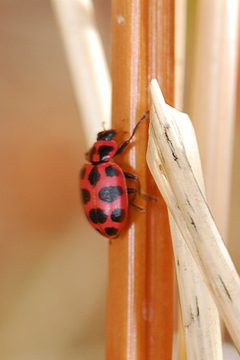
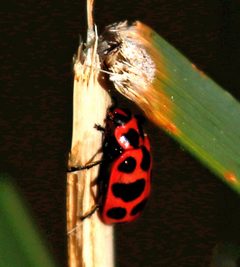
Coleomegilla maculata strenua is a of the 12-spotted lady beetle, a native North American coccinellid. display a distinctive pink to reddish coloration with six black spots on each . This subspecies is part of a known for unusual dietary habits among lady beetles, including substantial consumption of plant pollen alongside typical predatory feeding.
Pronunciation
How to pronounce Coleomegilla maculata strenua: /koʊliːoʊmɛˈɡɪlə ˌmækjʊˈleɪtə ˈstrɛnjuə/
These audio files are automatically generated. While they are not always 100% accurate, they are a good starting point.
Identification
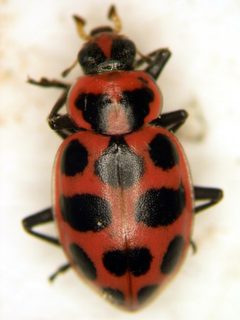
Distinguished from other North American lady beetles by the combination of pink to reddish ground color and twelve black spots (six per ). The unusual pink coloration separates it from most other spotted lady beetles, which tend toward red or orange. The similar Coccinella septempunctata (seven-spotted lady beetle) has seven spots on a red or orange background. Hippodamia convergens (convergent lady beetle) has orange elytra with black spots that typically converge toward the midline.
Images
Appearance
are pink to reddish in ground color with six black spots on each hardened forewing (), totaling twelve spots. Body is oval and moderately convex, typical of lady beetles. Larvae are elongate, somewhat flattened, and dark with orange or yellow markings.
Habitat
Found in agricultural fields, gardens, and open with flowering plants. Associated with crops including wheat, sorghum, sweet corn, alfalfa, soybeans, peas, beans, cotton, potatoes, cole crops, tomatoes, asparagus, and apple orchards. Requires access to both prey and pollen sources.
Distribution
North America, Middle America, and South America. GBIF records indicate presence in Brazil (Amazonas, Pará, Pernambuco, Rio de Janeiro), Colombia (Complejo Humedales Hato Corozal, Ciénaga Zapatosa), and broader regions of Middle and South America. The nominate C. m. maculata occurs primarily in eastern North America.
Seasonality
active from spring through fall. Peak activity coincides with flowering periods of pollen sources such as dandelion in late spring, and with buildups in summer. habits not documented for this specifically.
Diet
consuming aphids (pea aphid, green peach aphid, melon aphid, cabbage aphid, potato aphid, ), mite , insect eggs, and small larvae. Also feeds on eggs of European corn borer, imported cabbageworm, fall webworm, corn earworm, asparagus beetle, Mexican bean beetle, and Colorado potato beetle. Uniquely among North American coccinellids, up to 50% of diet may consist of plant pollen, including dandelion, squash, corn, and lily pollen.
Life Cycle
Complete with , larval, pupal, and stages. Specific developmental details for this are not documented. The nominate subspecies produces multiple per year in temperate regions.
Behavior
forage on vegetation for prey and pollen. Has been observed visiting flowers specifically for nectar and pollen. Larvae are mobile on plant surfaces.
Ecological Role
agent in agricultural systems, suppressing and other crop pests. Pollen feeding may facilitate early-season survival and before prey populations peak, potentially enhancing pest control services. Serves as prey for larger insects, spiders, and birds.
Human Relevance
Beneficial insect in agriculture and horticulture, contributing to natural pest management. Used in programs. Featured on educational materials including Bohart Museum of Entomology t-shirts. Not known to cause nuisance or damage to human structures or health.
Similar Taxa
- Coleomegilla maculata maculataNominate occurring in eastern North America; distinguished by geographic range and subtle morphological differences, though field identification is difficult
- Coccinella septempunctataSeven black spots on red or orange ; lacks pink coloration and has different spot pattern
- Hippodamia convergensOrange with black spots that converge anteriorly; lacks pink ground color
More Details
Pollen feeding significance
This is the only North American lady beetle known to complete its on plant pollen alone, though field typically mix with pollen consumption. This dietary flexibility may explain its success in diverse agricultural and its early-season presence before .
Subspecies taxonomy
C. m. strenua was described by Casey in 1899 and is currently accepted, though subspecific boundaries and diagnostic characters require further study. The exhibits morphological and geographic variation across its range.
Sources and further reading
- BugGuide
- GBIF taxonomy match
- iNaturalist taxon
- NCBI Taxonomy
- Seeing Spots at the Bohart | Bug Squad
- Be careful around baldfaced hornets, Dolichovespula maculata — Bug of the Week
- An inside look at baldfaced hornets, Dolichovespula maculata — Bug of the Week
- High fiber diets for baldfaced hornets? Nah, construction materials for enlarging nests: Baldfaced hornets, Dolichovespula maculata — Bug of the Week
- What do insects do in winter, Part 2? Tolerating the big chill: Banded woolly bears, Pyrrharctia isabella, field crickets, Gryllus spp., baldfaced hornets, Dolichovespula maculata, and others — Bug of the Week
- Bug Eric: Window-winged Moths