
Hippodamia americana
Crotch, 1873
American lady beetle
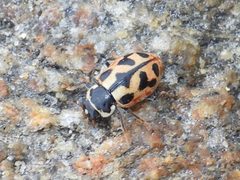
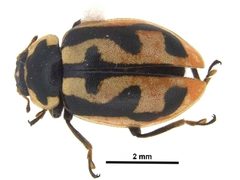
Hippodamia americana is a small lady beetle in the Coccinellidae. measure 4.40–5.10 mm in length. The species has been recorded from western and central Canada and the north-central United States, including Alberta, British Columbia, Manitoba, Northwest Territories, Ontario, Saskatchewan, and Wisconsin. Published observations of this species are limited, with only six records documented on iNaturalist.
Pronunciation
How to pronounce Hippodamia americana: /ˌhɪpoʊˈdeɪmiə əˌmɛrɪˈkaɪnə/
These audio files are automatically generated. While they are not always 100% accurate, they are a good starting point.
Identification
No specific diagnostic features for distinguishing H. americana from were found in the provided sources. Identification to level likely requires examination of genitalia or other subtle morphological characters typical of the Hippodamia.
Images
Distribution
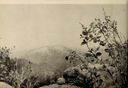
Recorded from North America: Canada (Alberta, British Columbia, Manitoba, Northwest Territories, Ontario, Saskatchewan) and United States (Wisconsin).
Similar Taxa
- Hippodamia convergensConvergent lady beetle is a well-known with extensive published literature on marking techniques, , and use; H. americana may be confused with this but differs in distribution and likely in subtle morphological features.
More Details
Data limitations
Published biological information specific to Hippodamia americana is extremely sparse. Most available literature on Hippodamia focuses on H. convergens. The iNaturalist platform records only six observations of this species, suggesting it is rarely encountered or underreported.
Sources and further reading
- BugGuide
- Wikipedia
- GBIF taxonomy match
- iNaturalist taxon
- Seeing Spots at the Bohart | Bug Squad
- Birds, Bats or a Bloom? But No Splat! | Bug Squad
- Researchers Share New Method for Detecting Insect Egg Predators
- Bacteria Can Aid Aphids Against Predation and Parasitism
- As a Watershed is Urbanized, Damselflies Show Declines
- From Burglars to Bugs: Anti-Theft Dye Useful in Insect-Tracking Studies