
Vanessa virginiensis
(Drury, 1773)
American Lady, American Painted Lady
Vanessa virginiensis, commonly known as the American Lady or American Painted Lady, is a widespread found throughout North America. It belongs to the Nymphalidae and is closely related to the Painted Lady (Vanessa cardui) and the Red Admiral (Vanessa atalanta). The is known for its distinctive wing patterns and its habit of feeding on flower nectar. Unlike some of its Vanessa relatives, the American Lady is not strongly migratory in the mass-movement sense, though it does expand its range seasonally.
Pronunciation
How to pronounce Vanessa virginiensis: /væˈnɛsə vɜːrˌdʒɪnɪˈɛnsɪs/
These audio files are automatically generated. While they are not always 100% accurate, they are a good starting point.
Identification
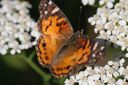
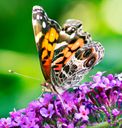
The American Lady can be distinguished from the similar Painted Lady (Vanessa cardui) by two large eyespots on the underside of the hindwing, compared to four smaller eyespots in the Painted Lady. The forewing has a white bar near the tip that is more prominent than in the Painted Lady. The upper surface of the wings is orange-brown with black markings and white spots. The wing margins have a checkered pattern of black and white. The Red Admiral (Vanessa atalanta) has a more striking pattern with a broad red band across the forewings and lacks the eyespots on the hindwing underside.
Images
Habitat
Found in a variety of open including meadows, fields, gardens, roadsides, and disturbed areas. Also occurs in woodland edges and clearings. The is adaptable and can thrive in both natural and human-modified environments.
Distribution
Throughout North America, including the United States, Canada, and Mexico. Also recorded from the Azores (Corvo, Faial, Pico, São Jorge, São Miguel).
Seasonality
are active from spring through fall, with multiple per year in most of its range. In warmer southern areas, adults may be present year-round. The overwinters as an adult or pupa depending on the region.
Diet
feed on nectar from a variety of flowers. Larvae feed on plants in the Asteraceae , particularly cudweeds (Gnaphalium spp.), everlasting (Antennaria spp.), and pussytoes (Antennaria spp.).
Host Associations
- Gnaphalium - larval food plantcudweeds
- Antennaria - larval food planteverlasting, pussytoes
- Asteraceae - larval food plant general
Life Cycle
Complete with four stages: , larva, pupa, and . Females lay eggs singly on plant leaves. Larvae are solitary and construct silk shelters on the host plant. occurs on or near the host plant. Multiple occur annually in most regions.
Behavior
are strong fliers and frequently visit flowers for nectar. They are often seen basking with wings open on sunny days. Males establish territories and perch on vegetation to await females. The is not known for long-distance mass like the Painted Lady, though local and regional movements occur.
Ecological Role
serve as while feeding on nectar. Larvae act as herbivores, consuming plant material in the Asteraceae . The serves as prey for various including birds, spiders, and .
Human Relevance
A common and widespread that is frequently observed in gardens and urban areas. Popular with butterfly watchers and photographers. The larvae occasionally feed on ornamental plants but are not considered significant pests. The is sometimes confused with the monarch or Painted Lady by the general public.
Similar Taxa
- Vanessa carduiPainted Lady is extremely similar in overall appearance; distinguished by four small eyespots on hindwing underside versus two large eyespots in American Lady, and less prominent white forewing bar
- Vanessa atalantaRed Admiral shares orange and black coloration but has distinctive red forewing bands and lacks eyespots on hindwing underside
- Junonia coeniaCommon Buckeye has prominent eyespots but different overall wing shape and pattern arrangement
More Details
Taxonomic note
The Vanessa includes several closely related that can be challenging to distinguish: the American Lady (V. virginiensis), Painted Lady (V. cardui), Red Admiral (V. atalanta), and West Coast Lady (V. annabella).
Etymology
The specific epithet 'virginiensis' refers to the state of Virginia, where the was collected.
Sources and further reading
- BugGuide
- GBIF taxonomy match
- iNaturalist taxon
- NCBI Taxonomy
- Catalogue of Life
- Of Butterfly Patterns and Genetic Codes | Bug Squad
- The Bee and the Butterfly | Bug Squad
- The Migratory Painted Lady and a UC Davis Chancellor's Postdoctoral Fellow | Bug Squad
- Bug Eric: City Nature Challenge 2023 Recap
- Archive — Bug of the Week
- America's Next Top Entomology Outreach Model