
Vanessa atalanta
(Linnaeus, 1758)
Red Admiral, Red Admirable
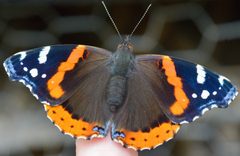
A medium-sized migratory with distinctive black wings marked by orange-red bands and white spots. It is among the most widely distributed butterflies globally, found across temperate regions of North America, Europe, Asia, North Africa, and the Caribbean. The exhibits complex migratory , with moving northward in spring and southward in autumn to track seasonal plant availability. Males are strongly territorial, establishing and defending perching sites in sunny woodland openings to secure mating opportunities.
Pronunciation
How to pronounce Vanessa atalanta: //væˈnɛsə ˌætəˈlæntə//
These audio files are automatically generated. While they are not always 100% accurate, they are a good starting point.
Identification
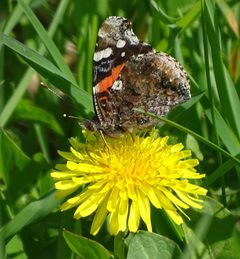
Distinguished from similar Vanessa by the combination of a continuous orange-red band across the forewing (not broken into separate spots) and the extensive red-orange coloration on the hindwing margin. The Painted Lady (Vanessa cardui) has more fragmented orange markings and lacks the bold continuous forewing band. The American Lady (Vanessa virginiensis) has two large eyespots on the hindwing underside, which V. atalanta lacks. The distinctive figure-like markings on the hindwing underside (resembling 18/98 or 81/89) are unique to this species. At rest, the dark upperwing surface with bright bands is immediately recognizable.
Images
Appearance
Wingspan ranges from 4.4 to 6.4 cm (1.75 to 2.50 inches). forewing is black with an oblique vermilion band and white subapical spots; hindwing has red-orange coloration covering most of the margin with small black spots and an elongate blue spot at the anal angle. Underside is variegated with brown, red, white, and black; hindwing underside has a brown marbled pattern with distinctive markings resembling figures (18/98 on left wing, 81/89 on right wing). Summer morphs are larger and more heavily pigmented than winter morphs. Larvae are approximately 2.5 cm long, black with white spots and spines that persist into the pupal stage.
Habitat
Primarily moist woodlands and woodland edges, including forest clearings with sunny perches. Also found in gardens, parks, and disturbed areas where plants occur. In the Mediterranean region, occupies lowland areas for winter breeding and higher elevations for summer . Territorial males select prominent perches in sunlit patches within otherwise shaded environments.
Distribution
Temperate regions of North Africa, North and Central America, Europe, Asia, the Caribbean, Hawaii, and New Zealand. In North America, breeds across most of the continent but overwinters primarily in south Texas and southern regions; northern areas are recolonized annually by spring migrants. In Europe, resident in southern and western areas with seasonal to northern regions. Recently recorded in Tajikistan, representing range expansion in Central Asia.
Seasonality
Activity varies by latitude. In northern Europe, one of the last butterflies active before winter, often seen feeding on ivy flowers on sunny days through late autumn; some individuals hibernate and re-emerge with darker coloration. In North America, two occur from March through October in most areas, with reappearing in early spring. period has advanced approximately six weeks earlier in central England over a 22-year warming period (1976–1998). Migratory movements peak in spring (northward) and autumn (southward).
Diet
feed on nectar from flowering plants including Buddleja , and consume overripe fruit. Larvae feed primarily on stinging nettle (Urtica dioica), with false nettle (Boehmeria cylindrica), Pennsylvania pellitory (Parietaria species), and other Urticaceae also utilized. Additional records include some Compositae and Cannabaceae species.
Host Associations
- Urtica dioica - primary larval Stinging nettle; most abundant during autumn period
- Boehmeria cylindrica - larval False nettle
- Parietaria - larval Pennsylvania pellitory and related
- Buddleja - nectar source bush
Life Cycle
Complete with , larva, pupa, and stages. In the southern winter range (e.g., Catalonia, Spain), migrants arrive in October–November and initiate intensive breeding; larval development continues through winter with first adults emerging in early spring. Most spring-emerging adults emigrate northward without breeding locally. Development rate and pupal coloration are temperature-dependent: at 32°C, pupal period is 6 days with bright scarlet coloration; at 11–18°C, 18–50 days with black and reduced scarlet; at 7°C, 47–82 days with predominantly black pupae. This temperature-dependent plasticity produces brighter, more pigmented summer forms and duller winter forms.
Behavior
Males establish and defend territories in sunny woodland openings from morning through afternoon, perching on prominent spots and patrolling 7–30 times per hour. Territories are oval, approximately 2.4–7.3 m long and 4.0–12.8 m wide. Intruding males are pursued in vertical, helical paths designed to disorient the intruder while minimizing horizontal displacement from the perch. Territorial defense ceases in late afternoon, shifting to nectar feeding. Females mate only with territory-holding males, selecting for superior flight ability. are unusually approachable, often allowing close observation and occasionally landing on humans. Migratory flights occur at high altitudes utilizing favorable winds; autumn migrants in Europe select cool northern winds for southward movement.
Ecological Role
serve as of flowering plants. Larvae function as herbivores on nettles and related plants, with tied to seasonal plant availability. The serves as a model organism for studying insect and climate change responses. High abundance in some years (e.g., 500,000+ individuals estimated in a 100-km coastal strip in Finland in 1998) suggests significant contribution to during peaks.
Human Relevance
Popular among watchers due to its conspicuous appearance and tolerant . Featured in works by Vladimir Nabokov including Speak, Memory (1951), Pale Fire (1962), and King, , Knave (1968). Used as a model in scientific research on , navigation, territoriality, and climate change impacts. occasionally visit gardens and parks, contributing to urban biodiversity. Not considered an agricultural pest.
Similar Taxa
- Vanessa carduiPainted Lady has more fragmented, spotted orange pattern rather than continuous bands; hindwing underside has small eyespots not present in V. atalanta
- Vanessa virginiensisAmerican Lady has two large eyespots on hindwing underside and more irregular orange patterning; lacks the distinctive figure-like markings of V. atalanta
More Details
Vision
Has color vision in the 440–590 nm range (indigo, blue, green, yellow) but cannot differentiate orange and red (590–640 nm) due to absence of lateral filtering pigments on the that are present in some related nymphalids such as the monarch butterfly.
Climate change response
In central England, spring advanced by six weeks between 1976 and 1998; period duration increased by 39.8 days, the largest change among 35 studied. Warmer climates may increase abundance and northward range expansion, though drought risks could reduce survival and plant availability.
Genetic structure
AFLP analysis reveals two distinct clusters across Europe with dramatic frequency variation between sites and years in northern regions, indicating complex migratory patterns beyond simple north-south movement. Few individuals show mixed ancestry, suggesting some reproductive isolation mechanisms exist despite high mobility.
Sources and further reading
- BugGuide
- Wikipedia
- GBIF taxonomy match
- iNaturalist taxon
- NCBI Taxonomy
- Catalogue of Life
- Bingo! First Cabbage White Butterfly of the Year! | Bug Squad
- No Contest, But Art Shapiro Spots First Cabbage White Butterfly of Year | Bug Squad
- He Nabbed It on New Year's Day | Bug Squad
- A Summit to Save the Butterflies | Bug Squad
- Shapiro Records First-of-the-Year Cabbage White Butterfly: 'Pop Goes the Pieris' | Bug Squad
- Bug Eric: Breaking: Mexican Silverspot Butterfly Sighted in Colorado
- Observations o n the migratory behaviour of Vanessa atalanta
- Territorial behavior of the red admiral, Vanessa atalanta (L.) (Lepidoptera: Nymphalidae)
- Red admiral Vanessa atalanta rubria (Fruhstorfer) (Insecta: Lepidoptera: Nymphalidae: Nymphalinae)
- Territorial behavior of the Red Admiral Butterfly, Vanessa atalanta (L.) (Lepidoptera: Nymphalidae)
- First records ofVanessa atalanta(Linnaeus, 1758) in Tajikistan (Lepidoptera: Nymphalidae)
- Life History and Laboratory Rearing of the Red Admiral, Vanessa atalanta (Lepidoptera: Nymphalidae)
- AFLP reveals cryptic population structure in migratory European red admirals ( Vanessa atalanta )
- Interactions between dioecious plants and insect herbivore chewing vibrations and life history and laboratory rearing of the red admiral, Vanessa atalanta
- Red Admirals <i>Vanessa atalanta</i> (Lepidoptera: Nymphalidae) select northern winds on southward migration
- Orientation tests and long-term movement phenology establish the red admiral Vanessa atalanta as an applicable model for navigation research in migratory butterflies
- The nature of migration in the red admiral butterfly Vanessa atalanta : evidence from the population ecology in its southern range
- Understanding the migration ecology of European red admirals Vanessa atalanta using stable hydrogen isotopes