
Vanessa cardui
(Linnaeus, 1758)
Painted Lady, Cosmopolitan
Vanessa cardui, commonly known as the painted lady, is one of the most widespread globally, occurring on every continent except Antarctica and South America. This medium-sized nymphalid butterfly is renowned for its remarkable long-distance migratory , with undertaking multi-generational journeys spanning up to 14,500 km between tropical Africa and the Arctic Circle. The species exhibits extreme polyphagy, with larvae recorded feeding on over 300 plant species, primarily in the Asteraceae . patterns are highly variable and linked to rainfall patterns in wintering areas, with mass migrations occasionally involving billions of individuals.
Pronunciation
How to pronounce Vanessa cardui: //væˈnɛsə ˈkɑːrdjuː.aɪ//
These audio files are automatically generated. While they are not always 100% accurate, they are a good starting point.
Identification
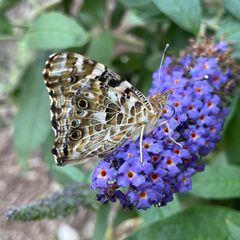
Distinguished from by combination of: four small round spots in curved row on forewing upperside (versus two larger spots in V. virginiensis); hindwing with five black spots in band (versus four in V. annabella); more extensive black markings on forewing apex than V. kershawi. Underside hindwing ocelli pattern diagnostic—fourth ocellus from largest with blue-centered yellow ring. rapid and direct, often described as 'bats out of Hell' during . Frequently confused with monarch (Danaus plexippus) by non- due to similar orange ground color, but lacks monarch's distinctive black and white spots on wing borders.
Images
Appearance
Wingspan approximately 5-9 cm. Upperside ground color reddish-ochreous with black markings. Forewing displays an irregular black broken band crossing from middle of to disc, with area and exterior border black; short white subapical streak and curved row of four round spots before apex. Hindwing with blackish patch across end of cell, recurved discal band, submarginal row of lunules, and marginal scutiform spots; five round black spots between discal band and submarginal lunules. Underside forewing brighter reddish-ochreous with paler apical area; hindwing transversely marbled with olivescent ochreous-brown, speckled black, crossed by sinuous whitish fasciae, with outer-discal row of five ocelli—the fourth largest with black center speckled blue and ringed yellow. Body olivescent ochreous-brown; black above with reddish tip and underside.
Habitat
Occupies diverse open including meadows, fields, gardens, roadsides, and disturbed areas. Strongly associated with sunny, brightly lit environments. In California coastal sage scrub, found in areas with abundant nectar resources. Migratory exploit temporary habitats including desert regions after winter rains. seek small ground depressions on overcast days. Territorial males perch in late afternoon in sheltered areas near hedgerows or forest-meadow edges.
Distribution
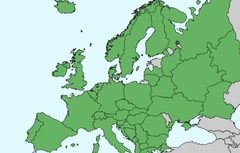
distribution—found on every continent except Antarctica and South America. Resident in warmer temperate and tropical zones; migratory extend into and Arctic regions. In Australia, restricted to southwest region around Bunbury, Fremantle, and Rottnest Island. North American populations winter near US-Mexico border, breeding in deserts after winter rains. European populations migrate from Mediterranean northward to Scandinavia and occasionally Iceland. 2024 evidence documented trans-Atlantic from Africa/Europe to South America (French Guiana), representing first confirmed oceanic crossing by any insect.
Seasonality
Activity patterns vary by region. In temperate zones, active spring through autumn; peak in North America March-June northward, August-October southward. Mediterranean region receives migrants May-June, with occasional autumn return migration. Reproductive activity continues year-round in suitable conditions; multiple per year with generation time approximately 4-6 weeks under favorable conditions. Mass irruptions irregular, linked to El Niño events and desert rainfall patterns.
Diet
Larvae feed on Asteraceae including Cirsium, Carduus, Centaurea, Arctium, Onopordum, Helianthus, and Artemisia; recorded on over 300 plant species. feed on flower nectar and honeydew; observed nectaring on , Tithonia rotundifolia, mustard blossoms, lavender, and diverse wildflowers.
Host Associations
- Cirsium - larval plantthistle
- Carduus - larval plantthistle
- Centaurea - larval plantknapweed
- Arctium - larval plantburdock
- Onopordum - larval plantcotton thistle
- Helianthus - larval plantsunflower
- Artemisia - larval plantsagebrush/wormwood
- Malvaceae - larval plantmallow ; desert annuals
- Boraginaceae - larval plantborage ; desert annuals
Life Cycle
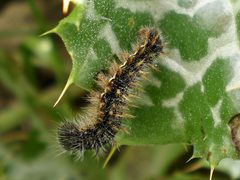
Complete with four stages: , larva, pupa, . Eggs laid singly on plants. Larvae construct small silk nests on leaf tops for protection from . occurs on bare, leafless stems. Multiple per year; no observed. Generation time approximately 4-6 weeks under favorable conditions. High with females producing over 1,000 eggs in laboratory conditions.
Behavior
Highly migratory with complex, multi-generational movements. Northward migrants fly rapidly in straight lines, passing obstacles rather than circumnavigating; do not feed or mate until fat reserves depleted. Southward more protracted with feeding and breeding en route. Males establish territories in late afternoon, perch to intercept females; pursue intruding males vertically before returning to perch. Courtship involves groups of 2-8 individuals flying in circles for 1-5 seconds. Continuous mating system throughout year in suitable conditions; females may suspend temporarily when ready to oviposit. Oviposition choices influenced by nectar availability rather than larval quality. Uses solar compass for orientation; requires direct sky view for directional flight.
Ecological Role
of diverse flowering plants; significant component of as prey for birds (24+ documented including European -eater, Cattle Egret, tyrant flycatchers). Larval herbivory can locally defoliate plants. Migratory movements transport nutrients and genetic material across continents. irruptions provide pulse resource for .
Human Relevance
Widely used in educational settings—bred in schools for demonstrations. Popular for releases at hospices, memorial events, and weddings. Subject of extensive citizen science monitoring (Worldwide Painted Lady project). Mass migrations occasionally cause traffic interference and media attention. Model organism for research on migration physiology, developmental plasticity, and climate change responses.
Similar Taxa
- Vanessa virginiensisAmerican Painted Lady; distinguished by two large eyespots on hindwing underside versus five in V. cardui, and reduced black markings on forewing apex
- Vanessa annabellaWest Coast Lady; hindwing with four black spots in band versus five in V. cardui; more restricted western North American distribution
- Vanessa kershawiAustralian Painted Lady; sometimes treated as ; larger size, more extensive orange on forewing, reduced black markings
- Vanessa atalantaRed Admiral; predominantly black wings with red-orange bands and white spots; similar but readily distinguished by color pattern
- Danaus plexippusMonarch; frequently misidentified due to orange coloration, but has distinctive black-veined wings with white marginal spots and different pattern
Misconceptions
Frequently misidentified as monarch butterfly by general public during mass , leading to false reports of monarch recoveries. Former North American name '' abandoned due to confusion with other widespread . Historical debate about whether offspring of northward migrants undertake return migration—now resolved by radar and isotope studies confirming multi-generational round-trip migration.
More Details
Trans-Atlantic Migration
2024 study in Nature Communications provided first evidence of oceanic crossing by any insect. Specimens captured in French Guiana carried West African shrub pollen; genomic and isotope analysis confirmed European/African origin. Trade wind conditions exceptionally favorable for 4,200 km journey.
Thermal Effects on Flight
Laboratory studies show butterflies reared at higher temperatures (28°C vs 24°C) develop larger body size. speed fastest when rearing and testing temperatures differ, regardless of direction. Matching thermal environments produce slower but longer-duration flight.
Agrochemical Sensitivity
Larvae extremely sensitive to moxidectin (antiparasiticide from cattle feed yards) with LD50 of 2.1 ng/g. Developmental delays observed with pyraclostrobin, clothianidin, and permethrin at environmentally relevant concentrations.
Visual System
contain ultraviolet, blue, and green opsins; lacks red receptors found in some other butterflies. Visual system resembles ; cannot distinguish yellow from orange or orange from red light.
Sources and further reading
- BugGuide
- Wikipedia
- GBIF taxonomy match
- iNaturalist taxon
- NCBI Taxonomy
- Catalogue of Life
- Of Butterfly Patterns and Genetic Codes | Bug Squad
- The Migratory Painted Lady and a UC Davis Chancellor's Postdoctoral Fellow | Bug Squad
- The Bee and the Butterfly | Bug Squad
- A Flash of Orange: Welcome, California Tortoiseshell! | Bug Squad
- Painted Ladies on the Move | Bug Squad
- Lovin' the Lavender | Bug Squad
- Endocrine biology of the Painted Lady butterfly Vanessa cardui
- Effects of temperature experienced across life stages on morphology and flight behavior of painted lady butterflies (Vanessa cardui)
- Feeding on migratory butterflies: opportunistic observations of birds preying on the Painted Lady Vanessa cardui
- Timing of mating, reproductive status and resource availability in relation to migration in the painted lady butterfly, Vanessa cardui
- Environmental stress during larval development induces head methylome profile shifts in the migratory painted lady butterfly ( Vanessa cardui )
- Toxicity of Agrochemicals Among Larval Painted Lady Butterflies (Vanessa cardui)
- Effects of temperature experienced across life stages on morphology and flight behavior of painted lady butterflies (Vanessa cardui)
- The Relationship Between Habitat Selection and Preference for Adult and Larval Food Resources in the Polyphagous Butterfly Vanessa cardui (Lepidoptera: Nymphalidae)
- Arthropod Pax Gene Evolution: A Role for Vanessa Cardui Twin of Eyeless in Eye Development
- Linkage mapping and genome annotation give novel insights into gene family expansions and regional recombination rate variation in the painted lady ( Vanessa cardui ) butterfly
- The role of vernal pools in the 1992 mass dispersal of Vanessa cardui (Nymphalidae) with new larval hostplant records