
Vanessa annabella
(Field, 1971)
West Coast Lady
The West Coast Lady is one of three North American "painted lady" butterflies, to western North America. Long-term monitoring by UC Davis researcher Art Shapiro since 1972 documents this as in conspicuous decline across its California range, with dwindling even in urban and weedy where it was once abundant. The species is known to overwinter as in mild climates, emerging on warm winter days to nectar.
Pronunciation
How to pronounce Vanessa annabella: /vəˈnɛsə ænəˈbɛlə/
These audio files are automatically generated. While they are not always 100% accurate, they are a good starting point.
Identification
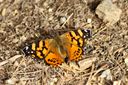
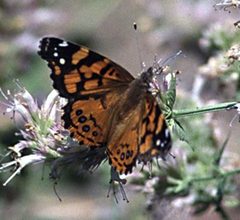
Distinguished from the Painted Lady (Vanessa cardui) by smaller size and more orange hindwing spots; forewing bar typically solid black versus pale-centered in V. cardui. Separated from the American Painted Lady (Vanessa virginiensis), which occurs in eastern North America, by hindwing pattern and range. The Red Admiral (Vanessa atalanta) has a bold white forewing band and lacks the spotted hindwing pattern.
Images
Habitat
Open, disturbed including vacant lots, fields, gardens, and urban edges; associated with weedy mallows (Malvaceae) as larval plants. Occurs from sea level to moderate elevations in western North America.
Distribution
Western United States and southwestern Canada, from southern British Columbia through Washington, Oregon, and California; eastward through the Great Basin to the Rocky Mountains. Records from Alberta, Saskatchewan, and Manitoba are irregular.
Seasonality
active nearly year-round in mild coastal and lowland California climates, with peak activity in spring and summer. Overwinters as adults, emerging on warm winter days to feed. Multiple per year where climate permits.
Diet
Larvae feed on weedy mallows (Malvaceae), particularly of Malva. nectar on diverse flowers including crucifers and composites.
Host Associations
- Malva - larval plantweedy mallows
Life Cycle
Complete with , larva, pupa, and stages. Multiple per year in favorable climates. Adults enter reproductive in response to and temperature cues; warmer temperatures require longer nights to induce dormancy, creating potential mismatch under climate change.
Behavior
are strong, direct fliers often seen nectaring at low flowers. adults may be observed on warm winter days even in January. Previously common enough to be collected for laboratory experiments; now difficult to find at former abundance.
Ecological Role
; larval herbivore on weedy vegetation. trends serve as indicators of broader insect decline and climate change impacts.
Human Relevance
Subject of long-term ecological research documenting declines; formerly used in laboratory studies of cold-shock responses and experiments. Decline noted by researchers who previously could reliably collect larvae from urban weeds.
Similar Taxa
- Vanessa carduiLarger size; more extensive black markings on forewing; hindwing spots more blue than orange; forewing bar typically pale-centered
- Vanessa virginiensisEastern North American distribution; two large eyespots on hindwing underside versus more numerous smaller spots in V. annabella
- Vanessa atalantaBold white forewing band; dark hindwings without spotted submarginal pattern; more associated with nettle
Misconceptions
Frequently misspelled as "anabella" (omitting the second 'n'). Previously treated as a of the South American Vanessa carye, but now recognized as a distinct to western North America.
More Details
Population Decline
Art Shapiro's 52-year monitoring dataset documents conspicuous decline: "during most of the year I used to be able to collect West Coast Lady larvae from weedy mallows to use in lab cold-shock experiments. Today, I cannot find any at all!" Listed among "perceived to be struggling" in recent regional assessments.
Climate Vulnerability
Like other multivoltine Vanessa , facultative induction depends on coupled -temperature cues. Climate warming creates mismatch between these signals, potentially disrupting seasonal timing and contributing to observed declines.
Sources and further reading
- BugGuide
- GBIF taxonomy match
- iNaturalist taxon
- NCBI Taxonomy
- Catalogue of Life
- Two Insect Contests: One Winner, One to Go | Bug Squad
- No Contest, But Art Shapiro Spots First Cabbage White Butterfly of Year | Bug Squad
- Mary Louise Flint's Article in The Acorn: 'Butterflies in Decline' | Bug Squad
- An Unexpected Find But Right on Time: First Cabbage White Butterfy of the Year | Bug Squad
- Where Are All the Butterflies? | Bug Squad
- Of Butterfly Patterns and Genetic Codes | Bug Squad