
Vanessa
Fabricius, 1807
Ladies and Related Admirals, Painted Ladies, Red Admirals
Species Guides
4- Vanessa annabella(West Coast Lady)
- Vanessa atalanta(Red Admiral)
- Vanessa cardui(Painted Lady)
- Vanessa virginiensis(American Lady)
Vanessa is a of brush-footed butterflies (Nymphalidae) with near-global distribution. The genus includes conspicuous such as the painted ladies (subgenus Cynthia) and red admirals. Members are known for mass migratory , particularly in North American of Vanessa cardui. The genus has been extensively studied for wing pattern development and seasonal .
Pronunciation
How to pronounce Vanessa: //vəˈnɛsə//
These audio files are automatically generated. While they are not always 100% accurate, they are a good starting point.
Identification
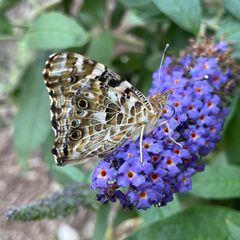
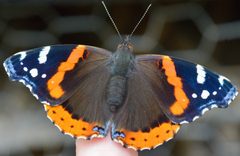
Vanessa are characterized by reduced forelegs with brush-like hairs (the 'brush-footed' trait of Nymphalidae), medium to large size, and typically orange-brown wing coloration with black markings and white spots. The painted ladies (subgenus Cynthia) display distinctive eyespot patterns on the wing undersides. Red admirals show bold red-orange bands across dark forewings. Species-level identification requires examination of wing pattern details, geographic location, and sometimes genitalia.
Images
Habitat
vary by . Painted ladies (Vanessa cardui) breed in desert regions after winter rains and migrate through diverse habitats including coastal sage scrub, agricultural areas, and urban gardens. Red admirals occupy woodland edges, gardens, and riparian areas. Many species utilize disturbed habitats and can be abundant in anthropogenic landscapes.
Distribution
Near-global distribution. The occurs across North America, Europe, Asia, Africa, Australia, and New Zealand. Individual show varying ranges: Vanessa cardui is ; the red admiral (V. atalanta) is widespread in the Northern Hemisphere; the American painted lady (V. virginiensis) is restricted to North America.
Seasonality
Activity patterns vary by and region. In North America, painted lady begin March-April from desert wintering grounds near the U.S.-Mexico border, moving northward through California and the Pacific Northwest through May-June. Southward migration occurs August-October. Red admirals show multiple in temperate regions with present spring through fall.
Diet
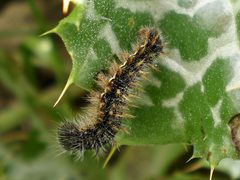
feed on nectar from diverse flowering plants. Larvae of Vanessa cardui have been documented feeding on plants in Malvaceae, Boraginaceae, and Asteraceae. Specific plant associations vary by ; Vanessa atalanta larvae feed on nettles (Urticaceae).
Host Associations
- Malvaceae - larval in desert regions
- Boraginaceae - larval in desert regions
- Asteraceae - larval in desert regions
- Urticaceae - larval Primary for Vanessa atalanta
- Ceanothus - larval Wild Lilac for related species
Life Cycle
Complete (holometabolous): , larva, pupa, . Painted ladies in migratory may complete multiple per year, with northward-migrating adults reproductively and carrying fat reserves from the larval stage. Development time varies with temperature and plant quality. Pupae are typically grayish-violet and may be formed on bare stems.
Behavior
Mass migratory is well-documented in Vanessa cardui, with moving in directional at speeds up to 20 miles per hour. Northward migrants fly in straight lines from southeast to northwest, crossing obstacles rather than circumventing them. engage in rapid, darting flight. Males establish perching territories. Some show seasonal in wing patterns.
Ecological Role
serve as . Larvae can reach densities and defoliate plants. The mass of painted ladies represent significant nutrient and energy transfers across . Research on Vanessa has contributed to understanding of developmental genetics, particularly regarding wing pattern formation and compartment boundaries.
Human Relevance
Popular subjects for watching and photography. Painted lady mass periodically attract media attention and can interfere with traffic. Used as model organisms in developmental and genetics research. Larvae are commercially available for educational purposes. Sometimes mistaken for by the public.
Similar Taxa
- AntanartiaAfrican admirals formerly classified in Vanessa; distinguished by geographic distribution and subtle wing pattern differences
- NymphalisRelated nymphaline including tortoiseshells; distinguished by wing shape and hibernation as
- Danaus; distinguished by larger size, different wing venation, and lack of brush-footed forelegs
- AgraulisGulf fritillaries; distinguished by silvery undersides and different wing shape
Misconceptions
Painted ladies are frequently mistaken for by the public due to similar orange coloration, leading to false reports of monarch recovery. The California Tortoiseshell (Nymphalis californica) is also commonly misidentified as a monarch during mass .
More Details
Genetic Research
Research on Vanessa butterflies has identified genetic codes for wing pattern development, including a previously undetected - compartment boundary that may exist in all holometabolous insects. factors establish wing compartments that can evolve color patterns independently.
Migration Research
UC Davis researcher Art Shapiro has monitored Central California since 1972, documenting painted lady dynamics. Research indicates that migration timing and success are strongly influenced by winter rainfall patterns in desert breeding areas.
Sources and further reading
- BugGuide
- Wikipedia
- iNaturalist taxon
- NCBI Taxonomy
- Catalogue of Life
- Of Butterfly Patterns and Genetic Codes | Bug Squad
- The Bee and the Butterfly | Bug Squad
- The Migratory Painted Lady and a UC Davis Chancellor's Postdoctoral Fellow | Bug Squad
- A Flash of Orange: Welcome, California Tortoiseshell! | Bug Squad
- Painted Ladies on the Move | Bug Squad
- Lovin' the Lavender | Bug Squad