
Nymphalis californica
(Boisduval, 1852)
California Tortoiseshell, Cal Tortie
The California Tortoiseshell is a medium-sized brushfoot known for its mass events that can occur at irregular intervals. overwinter and may be seen sunning on mild winter days. The is notable for its seasonal altitudinal migration pattern and its ability to defoliate stands of Ceanothus plants during .
Pronunciation
How to pronounce Nymphalis californica: //nɪmˈfæ.lɪs ˌkæ.lɪˈfɔːr.nɪ.kə//
These audio files are automatically generated. While they are not always 100% accurate, they are a good starting point.
Identification
Distinguished from monarchs by the orange and black spotted pattern rather than orange with black and white spots on wing borders. Differs from painted ladies by the larger, more irregular black spots and more rounded wing shape. The gray-brown underwings separate it from other orange butterflies when at rest. Greg Shapiro notes they are often misidentified as monarchs by observers.
Images
Appearance
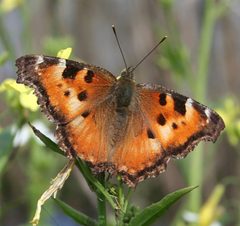
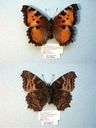
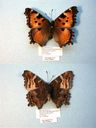
Wings are bright pumpkin orange with large black spots on the upperside. The underwings are dull gray-brown, resembling a dead leaf—an effective camouflage when the is at rest. The body is relatively robust. When wings are folded, the butterfly appears inconspicuous against bark or leaf litter.
Habitat
Foothill canyons in late winter, where oviposit on young tender growth of Ceanothus . High-altitude estivation sites generally above tree-line, including areas in Yosemite, Sequoia and Kings Canyon National Parks, the Trinity Alps, South Cascades, and Mount Rose. Hibernation occurs in foothills.
Distribution
Western North America from British Columbia and Alberta south through California. In California, found from the coast to the Sierra Nevada and Cascade ranges. Summer breeding localities vary widely year to year, sometimes in the high southern Sierra, sometimes in the Cascades, sometimes only in far northeastern California or farther north.
Seasonality
overwinter and may be active on mild midwinter days. Oviposition occurs in late winter in foothill canyons. Adults emerge late May to early June and emigrate north, east, and upslope. Second adults emerge late July, migrate to estivation sites, and remain until late September when they scatter downslope to hibernate. Estivating-hibernating adults may live 9-10 months.
Life Cycle
laid on tender growth of Ceanothus , particularly wild lilacs. Larvae are spiny, black with yellow markings, and feed gregariously without constructing a web. In years, larvae can defoliate entire stands of plants. occurs on bare, leafless stems, often en masse, with grayish-violet pupae that twitch in unison when disturbed. emerge in late May to early June and in late July for the second .
Behavior
are strong fliers and mass migrants. During estivation, adults are relatively inactive, simply 'hanging out' in large . adults may be territorial and active in late winter before trees leaf out or wildflowers bloom. Exhibits seasonal altitudinal : upslope in spring, downslope in late September-October.
Ecological Role
Larval herbivore on Ceanothus ; can function as a significant defoliator during . serve as when nectaring.
Human Relevance
Mass occasionally tie up traffic and attract public attention. High-altitude hikers frequently encounter estivating , sometimes describing the experience in 'mystical terms.' Often mistaken for monarchs by the public.
Similar Taxa
- Danaus plexippusAlso orange with black markings, but monarchs have black and white spots on wing borders rather than large irregular black spots; monarchs also lack the gray-brown leaf-mimic underwings
- Vanessa carduiPainted lady has more angular wings with smaller, more numerous black spots and different underwing pattern; does not exhibit the same mass estivation
- Nymphalis antiopaMourning cloak shares the and similar wing shape but has dark purple-black upperside with yellow borders and blue spots, not orange
Misconceptions
Commonly misidentified as monarchs by observers, particularly when seen in large at high altitudes during estivation.
Sources and further reading
- BugGuide
- GBIF taxonomy match
- iNaturalist taxon
- NCBI Taxonomy
- Catalogue of Life
- A Flash of Orange: Welcome, California Tortoiseshell! | Bug Squad
- 'Fourteen' Is a Lucky Number: That's Where the Monarchs Are | Bug Squad
- Good Day, Mourning Cloak | Bug Squad
- The Big 43: The California Native Plants, Plus One, Studied in UC Davis Research | Bug Squad
- Bohart Museum: Learn about California's State Insect on UC Davis Picnic Day | Bug Squad
- No Open House March 21 at Bohart Museum of Entomology | Bug Squad