
Junonia coenia
Hübner, 1822
Common Buckeye, Buckeye
Junonia coenia, commonly known as the common buckeye, is a distinctive in the Nymphalidae. It is widely distributed across North America, Central America, and parts of northern South America. The is known for its prominent eyespots on the wings and its migratory , moving south in autumn to escape cold temperatures. feed preferentially on yellow flowers, while larvae specialize on plants containing iridoid glycosides.
Pronunciation
How to pronounce Junonia coenia: /d͡ʒuˈnoʊniə ˈtʃoʊniə/
These audio files are automatically generated. While they are not always 100% accurate, they are a good starting point.
Identification
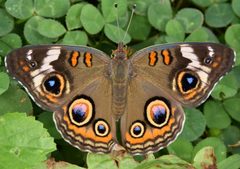
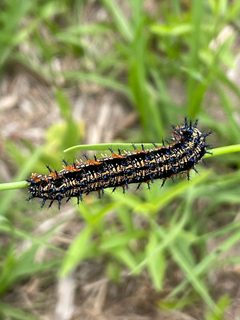
The common buckeye is one of the most readily identifiable North American butterflies due to its large, prominent eyespots on both forewings and hindwings. The combination of two eyespots on each forewing (one large with bluish center, one smaller ) and two on each hindwing is distinctive. The orange forewing bars and white postmedian band further aid identification. Similar include the gray buckeye (Junonia grisea), formerly considered a , which occurs west of the Rocky Mountains and differs in coloration. Caterpillars may be confused with those of the painted lady, Glanville fritillary, and red admiral, but can be distinguished by their specific spine arrangement and color pattern.
Images
Habitat
Open, sunny environments including fields, dunes, and scrub. Found in areas with low vegetation and some bare ground, typically below 1,300 meters (4,300 ft) elevation. Occupies patchy in fragmented landscapes and readily uses corridors for movement between patches.
Distribution
Resident or vagrant across much of North America and Central America, with records from parts of northern South America. In North America: most of the eastern United States, lower to middle Midwest, Southwest (including most of California), southern Canada, and Mexico. Migrates northward in spring and southward in autumn, reaching as far north as Manitoba, Canada (irregularly) and Vermont, USA. Overwinters in southern United States.
Seasonality
are active from spring through fall. Migrates north into temperate regions in spring and early summer; completes up to two in northern parts of range. Migrates south from September or October to escape cold temperatures, returning north the following spring. Cannot survive winter in regions with extreme cold.
Diet
feed on nectar from flowers, with strong preference for yellow flowers in the 'pre-change' stage (before color change due to insect visitation). Larvae feed on plants containing iridoid glycosides, including narrowleaf plantain (Plantago lanceolata), common plantain (Plantago major), blue toadflax, false foxglove, Mexican petunia (Ruellia ), firecracker plant (Russelia equisetiformis), and cudweed.
Host Associations
- Plantago lanceolata - larval plantpreferred; in California; high iridoid glycoside content stimulates oviposition and larval growth
- Plantago major - larval plantcommon greater plantain
- Russelia equisetiformis - larval plantfirecracker plant; first documented in California in 2019; produces iridoid glycosides
- Hippuris vulgaris - larval plantmare's tail; emergent aquatic plant; documented in northern California
- Ruellia species - larval plantMexican petunia
Life Cycle
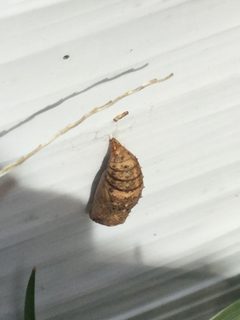
Complete with four stages: , larva, pupa, . Females lay eggs on plants containing iridoid glycosides, detected through contact chemoreception (drumming with foretarsi). Larvae feed individually in isolation, not cooperatively. Caterpillars pupate by spinning a silk pad on a downward-facing horizontal surface, attaching with rear end, hanging in J-shape for approximately one day before shedding skin to reveal chrysalis. Multiple per year in southern range; up to two generations in northern migratory areas.
Behavior
exhibit migratory , moving with tailwinds directed north or northwest after cold fronts in autumn. On a local , readily moves between patches connected by corridors. Adults preferentially feed on yellow 'pre-change' flowers, a learned behavior that maximizes nectar reward. Caterpillars feed solitarily and are generally non-aggressive, tolerating presence of other caterpillars without conflict. Females use drumming behavior to taste-test plants for iridoid glycosides before oviposition. Chrysalis wiggles when disturbed.
Ecological Role
Larvae sequester iridoid glycosides from plants, providing chemical defense against . This creates a tritrophic interaction: plants produce defensive compounds, larvae incorporate them for protection, and predators learn to avoid iridoid-rich prey. function as , with flower color preferences potentially influencing plant reproductive success. Serves as host for the Junonia coenia densovirus, a parvovirus that has been studied for potential use as a agent.
Human Relevance
Featured on a 2006 United States Postal Service 24-cent postage stamp. Popular subject for watchers and photographers due to distinctive appearance and approachable . Sometimes considered a minor garden visitor; larvae occasionally feed on ornamental plants including firecracker plant. Subject of extensive scientific research on chemical , plant relationships, and . Used as a model organism for studying effects of climate change on butterfly in long-term monitoring studies in California.
Similar Taxa
- Junonia griseaFormerly treated as of J. coenia; occurs west of Rocky Mountains; differs in coloration (grayer, less contrasting markings)
- Vanessa carduiPainted lady caterpillars resemble J. coenia caterpillars in appearance; both have spiny larvae but differ in plant associations and geographic patterns
- Euptoieta claudiaVariegated fritillary shares orange and brown wing pattern but lacks prominent eyespots; both are migratory in North America
Sources and further reading
- BugGuide
- Wikipedia
- GBIF taxonomy match
- iNaturalist taxon
- NCBI Taxonomy
- Catalogue of Life
- A 'Firecracker of a Surprise' in Davis: Who Knew? | Bug Squad
- A Close Call | Bug Squad
- Mary Louise Flint's Article in The Acorn: 'Butterflies in Decline' | Bug Squad
- Jeff Smith Zooms in on 'Mimicry in Butterflies and Moths' | Bug Squad
- What do insects do in winter? Migrants in the DMV: Common Buckeye, Junonia coenia, Variegated Fritillary, Euptoieta Claudia, Painted Lady, Vanessa cardui, Large Milkweed bug, Oncopeltus fasciatus — Bug of the Week
- 🪲 Entomologizing w/ the WGNSS Entomology Group at Hughes Mountain Natural Area — 11 Oct 2025 | Beetles In The Bush
- Common Buckeye, Junonia coenia Hübner (Insecta: Lepidoptera: Nymphalidae)
- Host plant effects on buckeye (Junonia coenia) survival and immunity during infection with theJunonia coeniadensovirus
- Corridor Length and Patch Colonization by a Butterfly, Junonia coenia
- A Recent Host Range Expansion in Junonia coenia Hubner (Nymphalidae): Oviposition Preference, Survival, Growth, and Chemical Defense
- Use of Hippuris, and emergent aquatic plant, as a larval host by the buckeye, Junonia coenia, in northern California
- Iridoid glycosides and host-plant specificity in larvae of the buckeye butterfly,Junonia coenia (Nymphalidae)
- Effect of hostplant genotype and predators on iridoid glycoside content of pupae of a specialist insect herbivore, Junonia coenia (Nymphalidae)
- A RECENT HOST RANGE EXPANSION INJUNONIA COENIAHÜBNER (NYMPHALIDAE): OVIPOSITION PREFERENCE, SURVIVAL, GROWTH, AND CHEMICAL DEFENSE
- Seasonal Plasticity in Junonia coenia (Nymphalidae): Linking Wing Color, Temperature Dynamics, and Behavior
- Transcytosis of Junonia coenia densovirus VP4 across the gut epithelium of Spodoptera frugiperda (Lepidoptera: Noctuidae)
- Junonia coenia Densovirus-Based Vectors for Stable Transgene Expression in Sf9 Cells: Influence of the Densovirus Sequences on Genomic Integration