
Euptoieta claudia
(Cramer, 1775)
Variegated Fritillary
Euptoieta claudia, commonly known as the variegated fritillary, is a migratory native to North and South America. Unlike the sedentary Speyeria fritillaries, this is nomadic and produces two to three annually. are highly wary and difficult to approach, a trait reflected in the name derived from Greek meaning 'easily scared.' The species is one of the last butterflies active in temperate regions each growing season before migrating south to overwinter.
Pronunciation
How to pronounce Euptoieta claudia: /juːptoʊˈaɪtə ˈklɔːdiə/
These audio files are automatically generated. While they are not always 100% accurate, they are a good starting point.
Identification
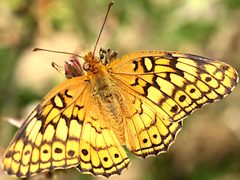
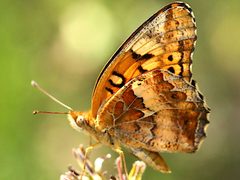
The variegated fritillary can be distinguished from the Mexican fritillary (Euptoieta hegesia), the only similar in its range, by several features: E. claudia is less bright orange, has markings on the upper hindwing basal area (absent in E. hegesia), and shows submarginal spots and black lines on the wing underside (plainer in E. hegesia). Unlike Speyeria fritillaries, it lacks silver spots on the underside and has a more checkered, less spotted appearance.
Images
Habitat
Open, disturbed including clover and alfalfa fields, pastures, waste areas, roadsides, and mountain meadows. Frequently found in sunny, open areas with abundant flowering plants.
Distribution
North and South America. Present throughout much of North America with irregular records in southern Canada (Alberta, Manitoba, Saskatchewan). Year-round resident in southern United States; migratory extend northward during warmer months.
Seasonality
period varies by latitude: April to October in southern regions, summer to early fall in northern areas. One of the last butterflies active in temperate regions before autumn . Two to three per year in mid-latitudes; single generation in northernmost range.
Diet
feed on nectar from diverse flowers including milkweeds (Asclepias), dogbane (Apocynum), asters, coneflowers (Echinacea), clovers (Trifolium), thistles (Cirsium), and many others. Larvae consume leaves, flowers, and stems of plants.
Host Associations
- Passiflora caerulea - Blue passionflower
- Passiflora foetida - Foetid passionflower
- Passiflora incarnata - Purple passionflower
- Viola sororia - Common blue violet
- Viola bicolor - American field pansy
- Viola tricolor - Heartsease
- Podophyllum peltatum - Mayapple
- Portulaca oleracea - Common purslane
- Sedum lanceolatum - Lance-leaf stonecrop
- Linum australe - Southern flax
- Linum rigidum - Stiffstem flax
- Menispermum canadense - Canadian moonseed
- Boerhaavia intermedia - Five-wing spiderling
Life Cycle
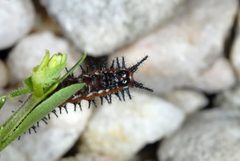
Complete with , larva, pupa, and stages. Females lay pale green or cream-colored eggs singly on plant leaves and stems. Larvae are red with black and spiracular stripes infused with white spotting, with six rows of black spines and clubbed spines on the . Chrysalis is shiny white with small black spots, variable brown markings, and orange and gold . Two to three per year in most of range; adults overwinter in southern regions.
Behavior
is low and swift. are extremely wary and difficult to approach even when resting or nectaring. Males actively patrol for females. Nomadic rather than sedentary; migrate northward in spring and southward in autumn.
Ecological Role
serve as while nectaring. Larvae function as herbivores on diverse plants. The ' use of passionflowers as host plants creates taxonomic links to heliconian butterflies, suggesting potential ecological connections to passionflower defense chemistry.
Human Relevance
Occasional garden visitor appreciated for its orange and black coloration. Larvae sometimes feed on ornamental pansies and violets, which may be viewed as minor garden damage. Not a significant agricultural pest.
Similar Taxa
- Euptoieta hegesiaMexican fritillary is brighter orange, lacks markings on upper hindwing basal area, and has plainer wing undersides without submarginal spots or black lines
- Speyeria cybeleGreat spangled fritillary and other Speyeria have silver spots on wing underside, are sedentary with single , and use only violets as plants
More Details
Etymology
The name Euptoieta derives from Greek 'euptoietos' meaning 'easily scared,' referring to the ' extremely wary .
Taxonomic relationships
Despite differences in , Euptoieta is closely related to Speyeria fritillaries. Use of passionflowers as creates additional links to heliconian butterflies (Heliconius).
Sources and further reading
- BugGuide
- Wikipedia
- GBIF taxonomy match
- iNaturalist taxon
- NCBI Taxonomy
- Catalogue of Life
- Stylish Lepidoptera: Ermine Moth, Atteva aurea; Yellow-Collared Scape Moth, Cisseps fulvicollis; Pearl Crescent, Phyciodes tharos; Variegated Fritillary, Euptoieta claudia — Bug of the Week
- 🪲 Entomologizing w/ the WGNSS Entomology Group at Hughes Mountain Natural Area — 11 Oct 2025 | Beetles In The Bush
- Archive — Bug of the Week
- From the Bug of the Week mailbag: Monarchs aren’t the only orange and black migrant here in the DMV – Variegated Fritillary, Euptoieta claudia — Bug of the Week
- What do insects do in winter? Migrants in the DMV: Common Buckeye, Junonia coenia, Variegated Fritillary, Euptoieta Claudia, Painted Lady, Vanessa cardui, Large Milkweed bug, Oncopeltus fasciatus — Bug of the Week