
Speyeria cybele
(Fabricius, 1775)
Great Spangled Fritillary
Species Guides
9- Speyeria cybele carpenteri(Great Spangled Fritillary)
- Speyeria cybele charlottii(Charlottesville great spangled fritillary)
- Speyeria cybele cybele(Great Spangled Fritillary)
- Speyeria cybele krautwurmi(Great Spangled Fritillary)
- Speyeria cybele leto(Great Spangled Fritillary (subspecies))
- Speyeria cybele letona(Great Spangled Fritillary (western subspecies))
- Speyeria cybele novascotiae(Great Spangled Fritillary)
- Speyeria cybele pseudocarpenteri(Great Spangled Fritillary)
- Speyeria cybele pugetensis(great spangled fritillary)
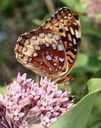
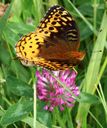
cybele, the great spangled fritillary, is a large native to North America. have a wingspan of 2.25 to 4 inches, with orange-brown upper wings marked by black chevrons and distinctive silvery spots on the undersides. The exhibits pronounced geographic variation: eastern are more orange, while western populations are browner. Females are slightly darker than males and have longer lifespans, often surviving into October. The has an obligate relationship with violets (Viola spp.) as larval plants. Research has demonstrated that S. cybele relies primarily on vision for detection and navigation, with flash-blinded individuals showing 30 times lower success in locating habitat patches.

Pronunciation
How to pronounce Speyeria cybele: //spaɪˈɪəriə sɪˈbiːli//
These audio files are automatically generated. While they are not always 100% accurate, they are a good starting point.
Identification
Large fritillary with orange-brown to brown ground color and black markings on upper wing surface. Underside of wings displays distinctive silvery or silvery-white spots, the source of both common and . Eastern tend toward orange coloration; western populations are browner. Females slightly darker than males and larger-bodied. Most similar to Speyeria atlantis (Atlantis fritillary), with which it was directly compared in navigation studies; S. cybele shows higher navigation success rates at equivalent distances and slightly different wing pattern elements.
Images
Habitat
Open including meadows, pastures, prairies, and woodland edges. Strongly associated with violet plant patches. Research conducted on Lake of the Woods islands demonstrates use of mixed woodland and shoreline meadow habitats on islands, with open water matrix avoided during movements.
Distribution
North America: all northern United States, ranging south to northern Georgia in the east and central California in the west. Rare in central United States. Canadian records from Alberta, Manitoba, and Saskatchewan. Absent from most of the Great Plains and desert Southwest.
Seasonality
emerge in early summer, with males appearing slightly before females. Peak June through July. Females are long-lived for butterflies, often surviving into October with visibly frayed wings. laid August to September. Larvae overwinter in among leaf litter.
Diet
feed on nectar from diverse flowering plants. Larvae feed exclusively on Viola (violets), with strong preference for fresh spring growth after from winter .
Host Associations
- Viola - larval plantObligate association; laid on or near violet clumps; larvae hibernate near violets and feed on fresh spring leaves
Life Cycle
Complete with or partially pattern depending on latitude. laid August–September on or near violet plants. First-instar larvae crawl to violets and immediately enter hibernation among fallen leaves without feeding. Spring from followed by feeding on fresh violet foliage. in chrysalis. emergence early summer, with males preceding females by several days.
Behavior
Strong, fast, direct . Experimental studies demonstrate primary reliance on vision for detection and navigation; individuals with flash-induced blindness (bleached rhodopsins) show severely impaired ability to locate habitat patches even at close range (20 m). Navigation success decreases with distance but shows no fixed perceptual threshold; instead follows probabilistic continuum. Butterflies avoid crossing open water, treating it as unsuitable matrix habitat. Males patrol for females and die after mating; females live extended periods, continuing to visit flowers.
Ecological Role
Human Relevance
Featured on 70-cent United States postage stamp issued 2014, designed for irregular-shaped greeting cards. Subject of navigation and visual perception research with applications to understanding and conservation in fragmented . Popular with butterfly watchers and photographers due to large size, bright coloration, and relatively approachable .
Similar Taxa
- Speyeria atlantisOverlapping range and similar appearance; distinguished by wing pattern details and slightly different coloration; S. cybele shows higher navigation success in experimental comparisons
- Speyeria aphroditeSimilar size and use; distinguished by wing pattern elements and geographic distribution
- Speyeria callippeWestern relative with similar ; S. c. hagemani named for California lepidopterist Chuck Hageman
More Details
Research significance
S. cybele was a key study in groundbreaking research on navigation and perceptual range. MacDonald et al. (2019) demonstrated that flash-blinded individuals were 30.1 times less likely to successfully navigate to patches, establishing vision as the primary sensory modality for habitat detection in this species. This finding has implications for understanding how habitat fragmentation and visual obstruction (e.g., by plants or development) may impair butterfly .
Conservation note
While not currently listed as threatened, S. cybele and depend on violet plant availability and open meadow . Habitat loss and fragmentation may impair metapopulation dynamics; the ' demonstrated reliance on visual navigation suggests that maintaining unobstructed sight lines between habitat patches may facilitate .
Sources and further reading
- BugGuide
- GBIF taxonomy match
- Catalogue of Life
- UC Davis Seminar: 'Insect Conservation in an Uncertain Future' | Bug Squad
- Encyrtid Holdings | Entomology Research Museum
- Bohart Museum Butterfly Donor Chuck Hageman Leaves a Lasting Legacy | Bug Squad
- The Eyes Have It: How Butterflies Navigate to Suitable Habitat
- USPS Issues Butterfly Postage Stamp
- Archive — Bug of the Week
- Perceptual Range, Targeting Ability, and Visual Habitat Detection by Greater Fritillary Butterflies Speyeria cybele (Lepidoptera: Nymphalidae) and Speyeria atlantis