
Euptoieta hegesia
(Cramer, 1779)
Mexican Fritillary
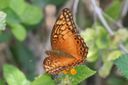
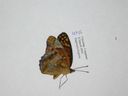
Euptoieta hegesia, commonly known as the Mexican Fritillary, is a in the Nymphalidae found throughout North and South America. It is characterized by bright orange upper wings with black spotting and yellow-orange undersides lacking submarginal spots. The species has a wingspan of 2.5 to 3 inches and is active year-round in Mexico, with seasonal periods in the southern United States. Larvae feed on passionflowers and other plants, displaying distinctive red coloration with silver spots and black spines.

Pronunciation
How to pronounce Euptoieta hegesia: /juːptoʊˈaɪɛtə hɛˈɡeɪziə/
These audio files are automatically generated. While they are not always 100% accurate, they are a good starting point.
Identification
The Mexican Fritillary is most easily confused with the variegated fritillary (Euptoieta claudia), the only similar within its range. Euptoieta claudia differs by having black lines on the upperside of the hindwing and a pale postmedian band on the underside of the hindwing—features absent in E. hegesia. The unmarked basal hindwing and lack of submarginal spots on the underside are diagnostic for E. hegesia.
Images
Habitat
Occurs in a wide range of open including fields, pastures, roadsides, and gardens. In Brazil, has been documented in fragmented urban habitats. Found in both natural and disturbed open areas with suitable plants and nectar sources.
Distribution
North and South America. Documented in the southwestern United States (Arizona, Texas), Mexico (year-round resident), Central America, South America including Brazil, and the Caribbean. GBIF records indicate presence in Colombia and other South American localities.
Seasonality
In Arizona: mid-June to November. In Texas: July to December. In Mexico: active year-round. Seasonal migrant in northern portions of range; southern appear to be resident with continuous breeding.
Diet
feed on nectar from various flowering plants. Larvae are herbivores feeding on plants in the Passiflora, Turnera, and Ipomoea.
Host Associations
- Passiflora foetida - plantFoetid passionflower; primary plant
- Turnera ulmifolia - plantYellow alder; used in Mexico and the Antilles
- Turnera diffusa - plantDamiana
- Ipomoea maritima - plantUsed in Brazil
Life Cycle
Complete with , larva, pupa, and stages. Larva is shiny red with silver spots edged with black, row of white spots ringed with black, spiracular silver line with black edges, and six rows of black spines. Red bears two long black spines with clubbed ends. Chrysalis dark brown or rarely tan, with gold and short gold lateral and subdorsal cones; wing cases bear a black T-shaped marking. One to three per year depending on latitude and climate.
Behavior
are active fliers in open sunny areas. Has been observed basking in sunlight. Larval feeding occurs on plant foliage. in urban areas suggest adaptability to fragmented .
Ecological Role
serve as when visiting flowers for nectar. Larvae function as herbivores, consuming leaves and other plant parts of . May contribute to of weedy Passiflora species.
Human Relevance
Occasionally encountered in gardens and urban green spaces. Not considered a significant agricultural pest. Of interest to watchers and naturalists in the southwestern United States.
Similar Taxa
- Euptoieta claudiaVariegated Fritillary is the only similar in range; distinguished by black lines on upperside hindwing and pale postmedian band on underside hindwing
More Details
Taxonomic Placement
Classified in Heliconiinae, tribe Argynnini, though sometimes associated with the fritillary group in broader classifications.
Population Biology
A study in southeastern Brazil examined in urban fragmented , indicating adaptability to human-modified environments.
Sources and further reading
- BugGuide
- Wikipedia
- GBIF taxonomy match
- iNaturalist taxon
- NCBI Taxonomy
- Catalogue of Life
- Stylish Lepidoptera: Ermine Moth, Atteva aurea; Yellow-Collared Scape Moth, Cisseps fulvicollis; Pearl Crescent, Phyciodes tharos; Variegated Fritillary, Euptoieta claudia — Bug of the Week
- From the Bug of the Week mailbag: Monarchs aren’t the only orange and black migrant here in the DMV – Variegated Fritillary, Euptoieta claudia — Bug of the Week
- What do insects do in winter? Migrants in the DMV: Common Buckeye, Junonia coenia, Variegated Fritillary, Euptoieta Claudia, Painted Lady, Vanessa cardui, Large Milkweed bug, Oncopeltus fasciatus — Bug of the Week
- 🪲 Entomologizing w/ the WGNSS Entomology Group at Hughes Mountain Natural Area — 11 Oct 2025 | Beetles In The Bush
- Archive — Bug of the Week
- Population biology of Euptoieta hegesia (Nymphalidae: Heliconiinae: Argynnini) in an urban area in Southeastern Brazil