
Desmocerus californicus
Horn, 1881
California Elderberry Borer, Valley Elderberry Longhorn Beetle
Species Guides
1- Desmocerus californicus dimorphus(Valley Elderberry Longhorn Beetle)
Desmocerus californicus is a longhorned beetle to the United States, with two recognized . The nominate subspecies D. c. californicus occurs in California, while D. c. dimorphus (the valley elderberry longhorn ) is restricted to the Central Valley of California and is federally listed as threatened. are active for only a few weeks per year and feed on Sambucus pollen.
Pronunciation
How to pronounce Desmocerus californicus: /dɛsˈmoʊsərəs ˌkælɪˈfɔrnɪkəs/
These audio files are automatically generated. While they are not always 100% accurate, they are a good starting point.
Identification
Distinguished from the eastern Desmocerus palliatus by geographic range. Within its range, separated from other blue-and-orange longhorned beetles by association with Sambucus plants and specific antennal proportions in males. identification of females requires molecular or pheromonal analysis; males can be distinguished by antennal length and structure.
Images
Appearance
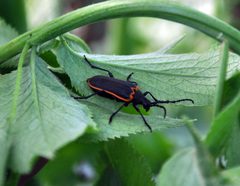
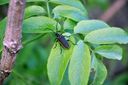
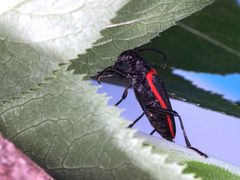
display striking aposematic coloration: metallic blue or deep blue-black with contrasting orange or yellow-orange markings on the pronotum and base of elytra. Body is elongated with moderately long typical of the Lepturinae. Females of D. c. dimorphus are morphologically indistinguishable from females of D. c. californicus.
Habitat
Riparian corridors and wetlands where elderberry (Sambucus) shrubs grow. Associated with both natural and restored riparian in California's Central Valley and surrounding regions. Requires living elderberry stems and roots for larval development.
Distribution
to the United States. The nominate D. c. californicus occurs in California outside the Central Valley. The subspecies D. c. dimorphus is restricted to the Central Valley of California from Shasta County to Kern County.
Seasonality
are active for approximately 2–4 weeks annually, typically emerging in late spring to early summer (May–June). Exact timing varies with locality and weather conditions.
Diet
beetles feed on pollen of Sambucus (elderberry). Larvae bore into and feed on the living pith of elderberry stems and roots.
Host Associations
- Sambucus - obligateLarvae develop exclusively in living stems and roots; feed on pollen.
Life Cycle
Complete . Larvae tunnel through living elderberry stems and roots, likely requiring multiple years to develop. emerge from exit holes in stems or sometimes from below the soil line from root galleries. Specific duration of stages not documented.
Behavior
are and visit elderberry flowers for pollen. Males are attracted to a , (R)-desmolactone, produced by females. Adults move slowly and are relatively unwary, consistent with chemical defense. Larval boring causes distinctive oval exit holes in elderberry stems.
Ecological Role
Larval tunneling in elderberry stems creates internal galleries that may influence plant architecture and provide microhabitats for other organisms. pollen feeding contributes to elderberry pollination, though quantitative contribution is unknown. Aposematic coloration suggests participation in Müllerian mimicry complexes with other chemically defended insects such as netwinged beetles (Lycidae).
Human Relevance
The D. c. dimorphus is federally listed as threatened under the U.S. Act, making it a significant concern for conservation planning, land management, and development projects in California's Central Valley. restoration for this subspecies is a major conservation activity. -based monitoring has been developed to improve detection and reduce survey costs. The has no known agricultural or economic importance.
Similar Taxa
- Desmocerus palliatusEastern North American with similar coloration and ; distribution separates the two .
- Calopteron spp. (Lycidae)Netwinged beetles share similar orange-and-blue aposematic coloration and may participate in Müllerian mimicry complex; distinguished by soft, flexible and different .
- Lycomorpha pholusBlack-and-yellow lichen moth may be a Batesian mimic of Desmocerus; distinguished by -like appearance, scaled wings, and different activity patterns.
More Details
Conservation status
D. c. dimorphus was listed as threatened in 1980. A 2012 proposal to delist was withdrawn in 2014 following improved survey methods demonstrating the remained vulnerable. Current survey guidelines rely heavily on trapping.
Pheromone research
The synthetic (R)-desmolactone has proven highly effective for detecting males, attracting more individuals in two years of study than had been collected in the previous three decades. This has revolutionized monitoring and assessment for the threatened .