
Desmocerus palliatus
(Forster, 1771)
Eastern Elderberry Borer, Elderberry Borer
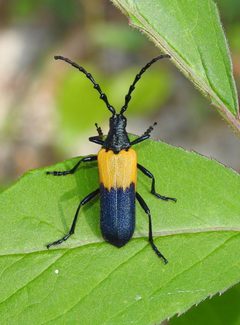
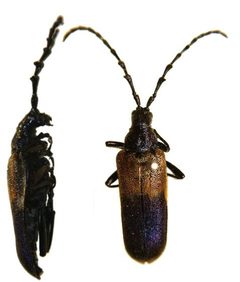
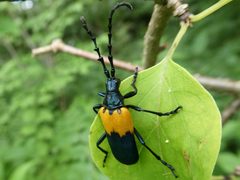
Desmocerus palliatus is a striking longhorned beetle in the Cerambycidae, known for its vivid aposematic coloration. exhibit a shimmering dark blue body with yellow to yellow-red bases on the . The is an obligate on elderberry (Sambucus), with larvae tunneling into living stems and roots. It has been proposed as a participant in Müllerian mimicry with netwinged beetles (Lycidae) and certain , and may serve as a Batesian model for harmless mimics.
Pronunciation
How to pronounce Desmocerus palliatus: //dɛsˈmoʊsɛrəs ˌpæl.iˈeɪ.təs//
These audio files are automatically generated. While they are not always 100% accurate, they are a good starting point.
Identification
The combination of large size, metallic dark blue coloration, and yellow-red elytral bases distinguishes this from other eastern North American cerambycids. The color pattern resembles that of netwinged beetles ( Lycidae, particularly Calopteron species), which may cause initial confusion; however, D. palliatus possesses the elongated characteristic of Cerambycidae. The similar-appearing Lycomorpha pholus occurs in the same range but is smaller and has different wing venation.
Images
Appearance
measure 17–26 mm in length. The body is predominantly a shimmering, metallic dark blue. The basal portions of the are distinctly colored yellow to yellow-red, creating a sharp color contrast. The overall appearance is robust and somewhat clumsy in movement compared to other flower-visiting cerambycids.
Habitat
Associated with swampy areas and riparian zones where elderberry grows. are found on or near plants in moist, open to semi-open including stream banks, wetland edges, and roadside thickets with Sambucus.
Distribution
Eastern North America, ranging from Oklahoma through the central United States to the southern Appalachian Mountains. More abundant in the northern portion of its range. Canadian records include New Brunswick, Newfoundland, Nova Scotia, and Ontario.
Seasonality
active from April through August, with peak activity likely corresponding to elderberry flowering period.
Diet
feed on pollen and Sambucus tissues. Larvae feed exclusively on living Sambucus, tunneling into stems and roots.
Host Associations
- Sambucus - obligateLarvae tunnel into living stems and roots; feed on pollen and plant tissues
Life Cycle
are laid near stems or at the base of the plant. Larvae burrow into stems and excavate tunnels into the roots of living plants. Development occurs within the living host tissue. emerge in spring and summer.
Behavior
move slowly and clumsily, resting in the upper portions of elderberry plants. They are easily alarmed and may drop from vegetation when disturbed. Their lumbering gait and lack of alert evasiveness contrasts with other flower-visiting cerambycids and is consistent with chemically defended .
Ecological Role
Larvae act as stem and root borers in living elderberry, potentially influencing plant vigor. contribute to pollination while feeding on pollen. The participates in mimicry complexes, potentially reinforcing warning signals for co-mimics.
Human Relevance
Not a significant agricultural pest. Occasionally encountered by naturalists and photographers due to its striking appearance. Subject of citizen science monitoring efforts (e.g., SciStarter project by Dr. Dan Duran).
Similar Taxa
- Lycomorpha pholusBlack-and-yellow lichen moth with similar color pattern; harmless Batesian mimic of D. palliatus and other aposematic . Distinguished by , smaller size, and different wing structure.
- Calopteron spp.Netwinged beetles (Lycidae) with similar blue-orange aposematic coloration; co-models in proposed Müllerian mimicry complex. Distinguished by soft, flexible , different antennal structure, and -level characters.
- Desmocerus auripennisWestern with orange rather than yellow elytral bases; distribution reduces overlap but similar association with Sambucus.
More Details
Chemical Defense
are presumed to sequester cyanogenic glucosides from their elderberry plants for defense, accounting for their aposematic coloration and slow, unguarded movements.
Mimicry Relationships
Proposed to participate in Müllerian mimicry with netwinged beetles (Lycidae) and Pyromorpha dimidiata (orange-patched smoky moth), while serving as Batesian model for harmless Lycomorpha pholus.