
Desmocerus
Audinet-Serville, 1835
Elderberry Borers
Species Guides
3- Desmocerus aureipennis(Golden-winged Elderberry Borer)
- Desmocerus californicus(California Elderberry Borer)
- Desmocerus palliatus(Eastern Elderberry Borer)
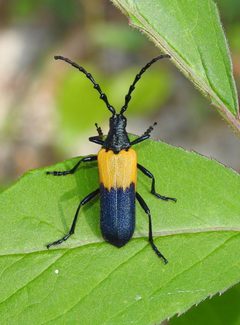
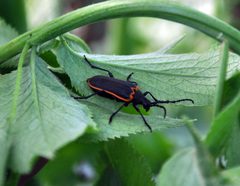
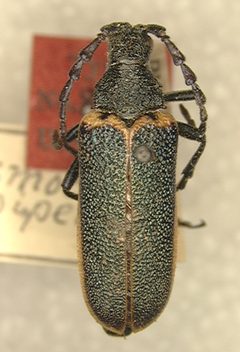
Desmocerus is a of longhorn beetles (Cerambycidae) commonly known as elderberry borers. The genus contains three North American : Desmocerus palliatus (eastern North America), D. aureipennis (western), and D. californicus (California and Pacific Northwest). are strikingly colored with metallic blue and orange or yellow markings, reflecting their aposematic (warning) coloration. All species are obligate on elderberry (Sambucus), with larvae developing in living stems and roots. The valley elderberry longhorn beetle (D. californicus dimorphus) is federally listed as threatened.
Pronunciation
How to pronounce Desmocerus: /dɛsˈmoʊsɛrəs/
These audio files are automatically generated. While they are not always 100% accurate, they are a good starting point.
Identification
are distinguished from other cerambycids by their robust body form combined with vivid metallic blue and bright orange or yellow markings on the pronotum and legs. The color pattern varies among : D. palliatus has orange pronotal markings, D. aureipennis has yellow-orange markings, and D. californicus shows with males having elongated and different coloration than females. The combination of large size (15-25 mm), metallic blue color, and orange/yellow accents is unique among North American longhorn beetles. Females of D. californicus dimorphus are morphologically indistinguishable from females of the non-threatened D. c. californicus.
Images
Habitat
Found exclusively in association with elderberry (Sambucus) shrubs. are often observed on elderberry flowers and foliage. Larval consists of living stems, roots, and root crowns of elderberry plants. Occurs in diverse settings including riparian corridors, wetlands, prairies, and open woodlands where elderberry grows.
Distribution
North America. D. palliatus occurs in eastern and central North America from Canada through the eastern United States. D. aureipennis ranges through the western United States. D. californicus is restricted to California and the Pacific Northwest, with the threatened D. c. dimorphus to California's Central Valley.
Seasonality
are active primarily in June and July, with timed to elderberry flowering. Adult activity period is brief, typically lasting only a few weeks per year.
Diet
feed on pollen of various flowers including elderberry. Larvae feed on the pith of living elderberry stems and roots.
Host Associations
- Sambucus - obligate larvae develop in living stems and roots; feed on pollen
Life Cycle
Two-year . Larvae develop in living elderberry stems and roots, in the pith. occurs within the plant. emerge in early summer, feed on pollen, mate, and females oviposit in elderberry stems.
Behavior
are and often found on elderberry flowers. Movement is characteristically slow and lumbering, consistent with chemically protected that do not rely on rapid escape. Adults are easily alarmed and will fly when disturbed. The species participates in apparent Müllerian mimicry complexes with netwinged beetles (Calopteron) and orange-patched smoky moths (Pyromorpha dimidiata), and may serve as a Batesian model for the harmless black-and-yellow lichen moth (Lycomorpha pholus).
Ecological Role
herbivore tightly linked to elderberry. As a stem-borer, larvae may influence elderberry growth form and . contribute to pollination of elderberry and other flowers while feeding on pollen.
Human Relevance
D. californicus dimorphus (valley elderberry longhorn beetle) is federally listed as threatened under the U.S. Act, making it significant for conservation planning and land management in California's Central Valley. -based survey methods using (R)-desmolactone have been developed to improve detection and monitoring. The is otherwise not economically significant.
Similar Taxa
- Calopteron (netwinged beetles)share similar orange and black/blue aposematic coloration; participate in Müllerian mimicry complex
- Pyromorpha dimidiata (orange-patched smoky moth)similar warning coloration; co-occurs in mimicry complex
- Lycomorpha pholus (black-and-yellow lichen moth)similarly colored but harmless; presumed Batesian mimic of Desmocerus
- Other flower-visiting cerambycids (e.g., Strangalia, Typocerus)share flower-visiting but lack the robust build and metallic blue-orange color pattern of Desmocerus