
Tetraopes
Dalman in Schönherr, 1817
Milkweed Longhorn Beetles
Species Guides
14- Tetraopes annulatus(Ringed Long-horned Beetle)
- Tetraopes basalis(western milkweed longhorn beetle)
- Tetraopes discoideus
- Tetraopes femoratus(Red-femured Milkweed Borer)
- Tetraopes linsleyi
- Tetraopes mandibularis
- Tetraopes melanurus(Blackened Milkweed Beetle)
- Tetraopes pilosus(Pilose Milkweed Beetle)
- Tetraopes quinquemaculatus(five-spotted milkweed beetle)
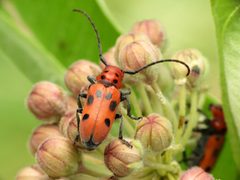
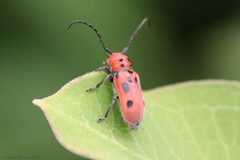
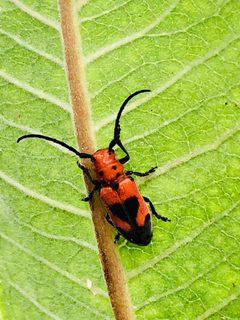
Tetraopes is a of specialized longhorn beetles (Cerambycidae: Lamiinae) distributed from Guatemala to Canada. The genus is defined by extreme specificity to milkweeds (Asclepias and related genera in Apocynaceae), with larvae feeding on roots and feeding on leaves and flowers. All exhibit aposematic red-and-black coloration advertising their of cardiac glycosides from host plants. The are completely divided by antennal insertions, giving rise to both the ("four eyes") and "four-eyed " for some species. The genus represents a classic example of coevolutionary radiation with its host plants.
Pronunciation
How to pronounce Tetraopes: /tɛˈtrɛəpiːz/
These audio files are automatically generated. While they are not always 100% accurate, they are a good starting point.
Identification
Members of Tetraopes are distinguished from other Cerambycidae by the unique structure: each is completely divided into upper and lower lobes by the antennal insertion, creating the appearance of four eyes. This trait is diagnostic for the . are further characterized by bright red-and-black aposematic coloration, moderately elongated , and dense white covering much of the body. -level identification requires examination of antennal proportions, body size, pubescence , and elytral maculation patterns. The abruptly attenuate (clubbed) last antennomere distinguishes T. texanus from similar-appearing .
Images
Habitat
are defined by presence of milkweed plants. occupy diverse environments including prairies, grasslands, sand dunes, open woodlands, and seasonally dry tropical forests. T. pilosus is restricted to Quaternary sandhills in the central and southern Great Plains, where it associates with sand milkweed (Asclepias arenaria). T. texanus occurs in Black Belt prairies and other grassland remnants. The shows strong fidelity to specific host plant microhabitats rather than broad environmental conditions.
Distribution
The ranges from Guatemala to Canada. Individual show varying distributions: T. tetrophthalmus is widespread in eastern North America; T. texanus occurs primarily in Texas and Oklahoma with disjunct in Mississippi and Alabama; T. pilosus is restricted to sandhills of the central and southern Great Plains. One extinct species, †T. submersus, is known from the fossil record. A new species from Yucatán, Mexico was described in 2024, extending the genus into seasonally dry tropical forest.
Seasonality
are active primarily during summer months, with peak activity in June and July for northern . T. texanus has been observed in late May in Mississippi. Activity patterns are tied to plant , particularly flowering periods. Adults may be found on host plants from late spring through early fall depending on latitude and species.
Diet
Both larvae and feed exclusively on milkweeds (Asclepiadaceae/Apocynaceae). Larvae feed externally on living roots in soil, a habit unique within Lamiinae. Adults feed on leaves, flowers, and developing seed pods. Before feeding, adults deactivate the latex defense by cutting through leaf midribs with their , allowing sap to drain from tissues before consumption begins. This -cutting prevents mouthparts from becoming gummed with coagulated latex.
Host Associations
- Asclepias - primary larvae feed on roots, on leaves and flowers; most show strong specificity to single Asclepias species
- Asclepias arenaria - of T. pilosus in sandhills
- Asclepias viridis - presumed of T. texanus in Mississippi
- Asclepias viridiflora - of T. texanus in Missouri
- Dictyanthus yucatanensis - of undescribed Tetraopes in Yucatán, Mexico
- Matelea quirosii - of T. paracomes
Life Cycle
Females deposit in soil near plant roots. Larvae are free-living, terricolous insects that feed externally on living roots, moving between roots through soil galleries. Larval development occurs entirely below ground. takes place immediately below the soil surface in prepared by larvae. emerge and climb host plants to feed and mate. The is closely tied to host plants, with larvae potentially requiring multiple growing seasons to mature depending on conditions.
Behavior
are and spend much time on plants feeding and mating. When disturbed, many exhibit stridulation producing audible squeaks. capacity varies by sex: females possess greater flight capacity and make longer between-patch movements, while males make more frequent short flights within patches for mate-searching. Some species show limited escape when approached, likely due to chemical protection from sequestered cardiac glycosides. T. texanus exhibits unusually flighty, nervous behavior compared to , possibly indicating local pressure. Adults are attracted to conspecifics, with females attracting more individuals than males.
Ecological Role
As specialized herbivores, Tetraopes function as important consumers of milkweed , potentially influencing plant . Their of cardiac glycosides makes them key members of Müllerian mimicry complexes involving other milkweed-feeding insects including , milkweed bugs, and milkweed tussock moths. The bright aposematic coloration of abundant species like T. tetrophthalmus may enhance protection for less common co-mimics. Larval root-feeding represents a distinctive nutrient in soil .
Human Relevance
Tetraopes serves as a model system for studying , specialization, and aposematic coloration. T. tetrophthalmus is a common subject in undergraduate laboratories and ecological research. The has contributed to understanding of insect-plant chemical , particularly mechanisms of cardenolide and latex defense deactivation. Some are collected by enthusiasts, though rarely in sufficient numbers to threaten . No economic importance as pests or beneficial insects has been documented.
Similar Taxa
- Crossidiussimilar reddish-orange and black coloration in some , but lacks divided and is associated with rabbitbrush (Chrysothamnus/Ericameria) rather than milkweed
- Batylesome have similar coloration and flower-visiting , but are shorter and are not divided; not restricted to milkweeds
- Moneilemasimilar robust body form and aposematic coloration in some , but associated with cacti (Opuntia) rather than milkweeds; are flightless with reduced wings
More Details
Coevolutionary radiation
Phylogenomic studies indicate Tetraopes represents a temperate coevolutionary radiation with milkweed plants. diversification appears correlated with host plant chemistry, with more derived milkweed species containing complex cardenolides hosting larger, more brightly colored species with reduced escape . This correlation between host and beetle aposematism represents a classic example of escape-and-radiate .
Population genetics
T. texanus shows strong structure with two distinct genetic clusters corresponding to Texas/Oklahoma and Mississippi/Alabama populations, with divergence estimated in the mid-Pleistocene. The ' limited range and specificity make it a useful model for grassland insect conservation genetics and studying effects of habitat fragmentation on herbivores.
Sexual dimorphism
Females are typically larger than males. In T. tetrophthalmus, females cut more milkweed during feeding and attract more conspecifics than males, though no consistent differences in trenching rates or feeding patterns were found between sexes. in has been documented: females make longer migratory flights between patches while males make more frequent short mate-searching flights within patches.
Sources and further reading
- BugGuide
- Wikipedia
- GBIF taxonomy match
- iNaturalist taxon
- NCBI Taxonomy
- Catalogue of Life
- Tracking Tetraopes texanus with Terry | Beetles In The Bush
- Bugs in orange and black III, Halloween edition: Milkweed longhorned beetles, Tetraopes sp. — Bug of the Week
- Hooray for the red, white, and blue! Milkweed longhorned beetle, Tetraopes tetraophthalmus; dogbane tiger moth, Cycnia tenera; and familiar bluet, Enallagma civile — Bug of the Week
- Cerambycidae | Beetles In The Bush | Page 8
- Hairy milkweed beetle | Beetles In The Bush
- Population Genomics of Tetraopes texanus (Coleoptera: Cerambycidae)
- The flight behavior and dispersal ecology of the red milkweed beetle, Tetraopes tetraopthalmus
- The behavioural components of sexual selection in the milkweed beetle tetraopes tetraophthalmus
- The Effect of Host Plant Patch Size Variation on the Population Structure of a Specialist Herbivore Insect, Tetraopes tetraophthalmus
- The Flight and Migration Ecology of the Red Milkweed Beetle (Tetraopes Tetraophthalmus)
- Faculty Opinions recommendation of Evolution of specialization: a phylogenetic study of host range in the red milkweed beetle (Tetraopes tetraophthalmus).
- A test of sexual dimorphism in deactivating plant defense and attraction of conspecifics in the four-eyed red milkweed beetle (Tetraopes tetrophthalmus)
- A Note on Oviposition and Larval Habits of the Milkweed Beetle,Tetraopes tetrophthalmusForst. (Coleoptera: Cerambycidae)
- NOTES ON THE BIONOMICS OF THE MILKWEED BEETLE TETRAOPES TETROPHTHALMUS (FORST.) (CERAMBYCIDAE)
- A new species of Tetraopes Dalman (Coleoptera, Cerambycidae) from the seasonally dry tropical forest of Yucatán, Mexico
- Tetraopes Milkweed Beetle Genomes Elucidate the Adaptive Basis of a Temperate Coevolutionary Radiation.
- Phylogenomics of Tetraopes longhorn beetles unravels their evolutionary history and biogeographic origins.