
Crossidius
LeConte, 1851
Species Guides
13- Crossidius ater(Grizzled Long-horned Beetle)
- Crossidius coralinus(Red and Black Long-horned Beetle)
- Crossidius discoideus(Orange-bracketed Longhorned Beetle)
- Crossidius grahami(Ohoopee Dunes Crossidius Beetle)
- Crossidius hirtipes
- Crossidius humeralis
- Crossidius hurdi
- Crossidius militaris
- Crossidius mojavensis
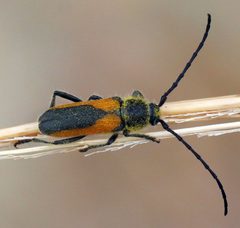
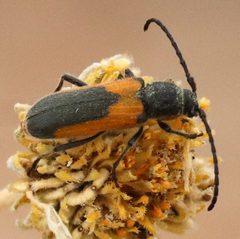
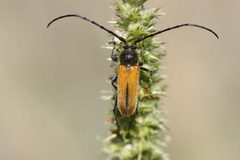
Crossidius is a of longhorned beetles (Cerambycidae) to western North America, containing 11 described and numerous . The genus exhibits exceptional polytopic variation, with geographically isolated showing marked differences in coloration, size, and elytral pattern. Unlike most cerambycids, which develop in dead wood, Crossidius species are root borers in living shrubs of the Asteraceae . are and strongly associated with plant flowers, where they feed, mate, and shelter.
Pronunciation
How to pronounce Crossidius: /kroʊˈsɪdiəs/
These audio files are automatically generated. While they are not always 100% accurate, they are a good starting point.
Identification
Identification to level requires examination of coloration, elytral maculation patterns, antennal proportions, and geographic origin. identification often depends on subtle differences: C. h. immaculatus males have completely versus reduced sutural stripe in females; C. h. setosus distinguished from C. h. immaculatus by short dark bristle-like hairs on antennal scape; C. c. caeruleipennis distinguished from C. c. monoensis by larger size and absence of black pronotal bands and expanded elytral markings. Reference to Linsley & Chemsak (1961) is essential for subspecies determination.
Images
Habitat
Arid and semi-arid regions of western North America, including Great Basin sage grasslands, Owens Valley sage grassland, and mountain valleys. Strongly associated with specific plant distributions; found where Chrysothamnus/Ericameria (rabbitbrushes), Gutierrezia (snakeweeds), or related Asteraceae shrubs occur in sufficient . Elevational range varies by , from low desert valleys to montane basins above 7000 feet.
Distribution
to western North America, with center of diversity in the Great Basin (especially Nevada and Utah, with 17 described / in Utah alone). Range extends from eastern Oregon and Washington south through California, east to Colorado and the Great Plains, and into northern Mexico. Individual species and subspecies often have highly restricted, discontinuous distributions tied to plant patches and topographic isolation.
Seasonality
active in late summer and fall, coinciding with flowering of plants. Activity patterns : adults present on flower during daylight hours, retreating down stems or burying among flowers at night. C. hirtipes observed to exit flower heads after approximately 5 p.m. and not reappear until mid-morning; C. coralinus subspecies remain on flower heads through night.
Diet
feed on flowers of Asteraceae shrubs. Larvae bore through roots of living shrubs, primarily in Chrysothamnus, Ericameria, Gutierrezia, and Haplopappus.
Host Associations
- Chrysothamnus viscidiflorus - larval (roots); feeding site (flowers)Yellow rabbitbrush; primary for most C. hirtipes
- Ericameria nauseosa - feeding site (flowers)Gray rabbitbrush; feed on flowers though larvae may not develop in roots
- Ericameria greenei - larval (roots); feeding site (flowers) for C. h. rubrescens in west-central Nevada
- Gutierrezia sarothrae - larval (roots); feeding site (flowers)Broom snakeweed; for C. pulchellus throughout Great Plains and southern Rocky Mountains
Life Cycle
Larvae develop as root borers in living shrubs. emerge in late summer, coinciding with plant flowering. Adult lifespan brief, spent almost entirely on host plant flowers. retreat varies: C. hirtipes descend stems to base of plant; C. coralinus subspecies remain in flower . Specific and details not documented in available sources.
Behavior
activity on plant flowers for feeding and mating. Strong fidelity to host plants: encountered almost exclusively on flowers of larval host or closely related . C. hirtipes show early evening retreat from flower , disappearing after ~5 p.m.; C. coralinus subspecies remain on flower heads through night, burying themselves among flowers. Beetles become more active with rising temperatures and sunlight.
Ecological Role
Pollen feeders on Asteraceae flowers; may contribute to pollination though primarily exploiting floral resources. Larval root-boring creates distinctive trophic among Cerambycidae, which are predominantly saproxylic. plant specificity and geographic isolation have driven exceptional diversification within the .
Human Relevance
Subject of specialized collecting interest due to aesthetic appeal and taxonomic complexity. Reference work by Linsley & Chemsak (1961) remains foundational for identification. Some localities on public lands require permits for collection (e.g., Carrizo Plain).
Similar Taxa
- Other CerambycidaeMost cerambycids develop in dead wood and lack association with living herbaceous or shrubby ; Crossidius distinguished by root-boring habit in living Asteraceae and flower-visiting
More Details
Taxonomic complexity
The exhibits one of the highest levels of polytopic variation among North American Cerambycidae, with 11 described , 36 additional , and numerous locally distinctive . This variation has been attributed to discontinuous plant distributions across rugged western topography and hybridization among sympatric species.
Molecular research
Specimens from multiple have been collected for ongoing molecular studies to assess genetic variability and clarify relationships among described .
Sources and further reading
- BugGuide
- Wikipedia
- GBIF taxonomy match
- iNaturalist taxon
- NCBI Taxonomy
- Catalogue of Life
- Consolation Crossidius | Beetles In The Bush
- The sublimely beautiful Crossidius coralinus caeruleipennis | Beetles In The Bush
- GBCT Beetle #5: Crossidius coralinus monoensis | Beetles In The Bush
- Crossidius hirtipes rhodopus in Adobe Valley, California | Beetles In The Bush
- GBCT Beetle #4—Crossidius hirtipes rubrescens | Beetles In The Bush
- GBCT Beetle #1: Crossidius hirtipes immaculatus | Beetles In The Bush
- A Distributional and Taxonomic Study of the Genus <i>Crossidius</i> (Coleoptera, Cerambycidae)
- A Distributional and Taxonomic Study of the Genus <i>Crossidius</i> (Coleoptera, Cerambycidae)