
Crossidius discoideus
(Say, 1824)
Orange-bracketed Longhorned Beetle
Species Guides
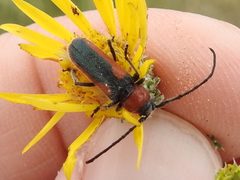
2Crossidius discoideus is a of longhorned beetle in the Cerambycidae, described by Thomas Say in 1824. are notable for their striking orange-and-black coloration, which closely mimics that of toxic soldier beetles (Chauliognathus spp.) and blister beetles (Epicauta spp.) through . The species is strongly associated with flowers of Gutierrezia sarothrae (broom snakeweed), where adults feed on pollen and nectar. Larvae develop in the root crowns of broom snakeweed and related Isocoma species (Jimmyweed).
Pronunciation
How to pronounce Crossidius discoideus: //ˌkɹɒˈsɪdiəs ˌdɪskoʊˈidiəs//
These audio files are automatically generated. While they are not always 100% accurate, they are a good starting point.
Identification
Most readily distinguished from similar-appearing soldier beetles (Chauliognathus spp.) by its extremely long —soldier beetles have short, clubbed antennae. Differs from blister beetles (Epicauta spp.) by more elongate body form, hardened (blister beetles have softer, more flexible wing covers), and longer antennae. Separated from other Crossidius by specific elytral pattern and association with Gutierrezia sarothrae rather than Ericameria nauseosa (rubber rabbitbrush).
Images
Appearance
Medium-sized longhorned beetle with elongated body and very long (distinctive for the ). Coloration consists of black with prominent orange or yellow-orange brackets or bands, creating a striking warning coloration pattern. The orange-and-black pattern closely resembles that of sympatric soldier beetles (Chauliognathus basalis, C. deceptus) and blister beetles (Epicauta stuarti). Antennae are notably longer than those of the mimicked soldier beetles, providing a key distinguishing feature upon close inspection.
Habitat
Arid and semi-arid regions of western North America, particularly in association with its plant Gutierrezia sarothrae (broom snakeweed). Found in grasslands, sagebrush steppe, pinyon-juniper woodlands, and open canyonlands where broom snakeweed occurs. are encountered on flowering plants in open, sunny areas.
Distribution
Western North America, recorded from the southwestern United States including Utah, Arizona, New Mexico, Colorado, and adjacent regions. Observations extend from the Colorado Plateau through the Great Basin and into the southern Rocky Mountain foothills. The appears to reach its eastern limits in the western Great Plains.
Seasonality
are active in late summer and early autumn, with peak activity typically from August through September. This timing coincides with flowering of Gutierrezia sarothrae and overlaps with peak abundance of mimicked soldier beetle .
Diet
feed on pollen and nectar of flowers, particularly Gutierrezia sarothrae (broom snakeweed). Larvae bore in root crowns of broom snakeweed and Jimmyweed (Isocoma spp.).
Host Associations
- Gutierrezia sarothrae - food source; larval feed on pollen/nectar; larvae develop in root crowns
- Isocoma spp. - larval Jimmyweed serve as larval
Life Cycle
Larvae develop as borers in the root crowns of plants (Gutierrezia sarothrae, Isocoma spp.). occurs within the host plant tissue. emerge in late summer, coinciding with flowering of host plants. The appears to have a single per year (), with adults present for a relatively brief period in late summer to early autumn.
Behavior
are and active on flowers during daylight hours. Frequently encountered on flowering of Gutierrezia sarothrae, where they feed on pollen and nectar. Adults may be found in close proximity to the mimicked soldier beetles and blister beetles on the same flowers. activity has not been documented for this .
Ecological Role
serve as of their flowers while feeding on pollen and nectar. Larvae act as root crown borers, potentially influencing plant of their weedy host plants. The participates in a Müllerian/ complex with toxic soldier beetles and blister beetles, potentially gaining protection from through its warning coloration.
Human Relevance
No direct economic importance to humans. The may be of interest to entomologists studying mimicry complexes. Its larval plants (broom snakeweed) are sometimes considered rangeland weeds, though the 's impact on plant is likely minimal. The species poses no threat to crops or structures.
Similar Taxa
- Chauliognathus basalisColorado soldier beetle shares nearly identical orange-and-black color pattern; distinguished by short, clubbed and softer, more flexible body
- Chauliognathus deceptusMountain soldier beetle with similar coloration; distinguished by short and different (foothills/mountains vs. plains)
- Epicauta stuartiBlister beetle with similar warning coloration; distinguished by softer , different body proportions, and shorter
- Crossidius pulchellusCongeneric also associated with Gutierrezia sarothrae; differs in elytral pattern details and typically has more extensive orange markings
- Crossidius coralinusCongeneric associated with Ericameria nauseosa (rubber rabbitbrush) rather than Gutierrezia; differs in plant association and subtle pattern differences
More Details
Mimicry complex
Crossidius discoideus participates in a well-documented mimicry complex involving at least three : Cantharidae (soldier beetles), Meloidae (blister beetles), and Cerambycidae (longhorned beetles). The mimicry is considered Batesian, as C. discoideus lacks the chemical defenses of the toxic soldier and blister beetles it resembles. The convergence of multiple unrelated beetles on this color pattern suggests strong from visually-oriented such as birds.
Taxonomic history
Described by Thomas Say in 1824, one of the earliest American entomologists. The specific epithet 'discoideus' likely refers to the disc-like or bracket-like orange markings on the .